Permits guide
Chester County Conservation District: What to Ask Before Clearing
The Conservation District is the office that reads erosion and sediment plans for Chester County. A short, specific question list saves weeks.
The Chester County Conservation District reviews erosion and sediment plans and administers NPDES stormwater permits under delegation. Its own materials list a written plan above 5,000 square feet, a plan review at 1 acre, and a separate timber harvest application. Bring acreage, a map and your clearing method, and ask whether mulching counts.
Last checked: October 2026
What the District does
The Chester County Conservation District is a county office with delegated or contracted responsibilities that include Chapter 102 erosion and sediment control and NPDES permitting, according to its About page. Its FAQ explains that NPDES is a federal program administered by the state, that the District has delegation authority to administer the program for stormwater from construction sites, and that any proposed disturbance of 1 acre or more through the life of the project must have an NPDES permit.
The District describes two kinds of NPDES coverage. A general NPDES permit is issued by the District after its review finds the erosion and sediment control plan adequate, and it is for projects in non-protected watersheds. An individual NPDES permit is issued by DEP after a recommendation from the District and a 30 day publication in the Pennsylvania Bulletin, and it is for sites in High Quality or Exceptional Value watersheds and sites with possible pollution concerns or a history of non-compliance.
What the District's own pages list as triggers
- Written plan: all disturbances greater than 5,000 square feet must have a written erosion and sediment control plan.
- District review: any disturbance tied to a Chapter 105 general permit (stream crossing, wetland disturbance and similar), pond dredgings, or one acre and greater disturbance must have a plan developed and reviewed by the District office.
- NPDES: any proposed disturbance of 1 acre or more through the life of the project must have an NPDES permit, unless specifically exempt under Chapter 102.5.
- Timber harvest: a separate Application for District Services for a Timber Harvest is available on the District's website.
The District also says it reviews a plan solely to decide whether it satisfies Title 25, Chapter 102, and that for projects not requiring an NPDES permit it will attempt to review within 30 days from the date of receipt. The District's home page states that its application changed effective February 1, 2026 and that all submissions must use the new District application. Check that you have the current form.
Questions to bring to the District
- Does a forestry mulching job on a wooded parcel, without grubbing or grading, count as earth disturbance for plan purposes, and at what acreage?
- Is the work handled as a timber harvest, and does the separate timber harvest application apply?
- Does a written plan need to be submitted to the District, or only kept on site?
- Is the parcel in a High Quality or Exceptional Value watershed, and does that change which permit path applies?
- How is acreage counted, for example for the whole project or a larger common plan, and what about work done in phases?
- Who prepares the plan, given that section 102.4(b)(3) calls for a person trained and experienced in erosion and sediment control?
- What is the current review timeline for this project type, and what should be in the first submission?
- Which township approvals does the District expect to see before it acts?
Write the answers down, with the name of the person who gave them and the date. Owners should keep that record with the job file.
What to bring
Bring the tax parcel number, an aerial or survey map with the work area outlined, an acreage estimate for the area to be cleared, notes on slopes, drainage and any stream, pond or wetland edges, and a plain description of the method. For a forestry mulching job that means saying what is cut and ground at the surface, whether stumps and roots will be removed, whether any soil will be graded or stockpiled, and where machines will enter and travel.
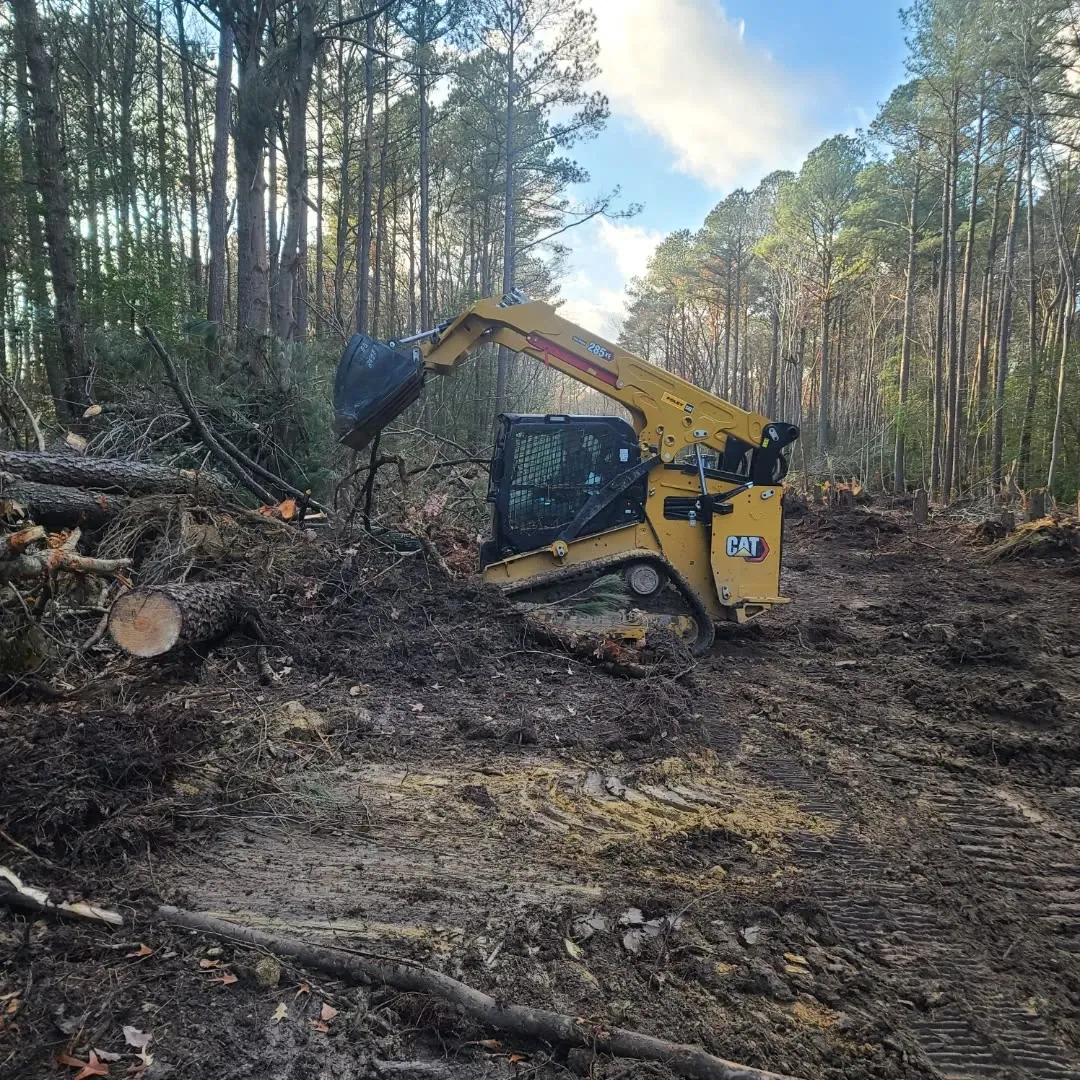
Our flagship is a Cat 285XE compact track loader with a forestry package, a BRX418 brush cutter and a rock grapple, and we are glad to describe our method and access routes to the District or to the township. We do not guess at permit outcomes. The District decides what it needs, and we plan our work around what it confirms.
How township rules fit in
A district answer does not replace a township answer. Kennett Township, for example, states on its timber harvest permit application that an erosion and sediment control plan must be submitted to the County Conservation District for review, recommendation and approval before the township permit is issued. Pocopson Township's code says its timber harvesting plan review may draw on help from the Chester County Conservation District. Township pages for Kennett and Pocopson are on this site, and each lists what we could and could not verify.
Timing
Ask early. The District states a review goal of 30 days for projects that do not need an NPDES permit, and projects that do need one follow the NPDES path the District describes, which for individual permits includes DEP issuance and a 30 day Pennsylvania Bulletin publication. A site walk can happen in parallel, but no machine should be scheduled until the owner has the District's answer in hand.
Questions about this page
Sources: Chester County Conservation District, FAQ, Chester County Conservation District, District Services Application, Chester County Conservation District, About, Chester County Conservation District, home page, Kennett Township, Timber Harvest Permit Application with Ordinance No. 158, Pocopson Township Code, Chapter 250, Section 250-87, Conservation of natural features. This is general information, confirm with the township or agency.
What does the Chester County Conservation District review?
Its materials say it has delegated or contracted responsibilities for Chapter 102 erosion and sediment control and NPDES permitting, and that it reviews plans to decide whether they satisfy Chapter 102. It lists a separate application for timber harvests.
When does the District say a plan must be reviewed by its office?
The District FAQ says any disturbance tied to a Chapter 105 general permit, pond dredgings, or one acre and greater disturbance must have a plan developed and reviewed by the District office. Written plans start above 5,000 square feet.
How long does District review take?
The District's service application says it will attempt to review projects that do not need an NPDES permit within 30 days of receipt. Projects needing an NPDES permit follow a different path, and individual permits include a 30 day Pennsylvania Bulletin publication.
Will the District tell me whether forestry mulching is exempt?
That is the right question to put to the District in writing. We found no District or DEP text stating that mulching is exempt, so we do not claim it. Describe the acreage, method and location and ask for the answer for your parcel.
Call, or send the details.
(484) 486-7272hello@huntlyland.com. Send the town, rough acreage and two or three photographs. We reply with site-walk times, and a written plan follows the walk.
Office hours Monday to Saturday, 8 a.m. to 4 p.m. On call 24/7 for storm and emergency cleanup. If anyone is in danger, call 911 first.