Land clearing
Overgrown parcels, building envelopes and neglected estate ground cleared mulch-first, with topsoil and specimen trees intact.
How it works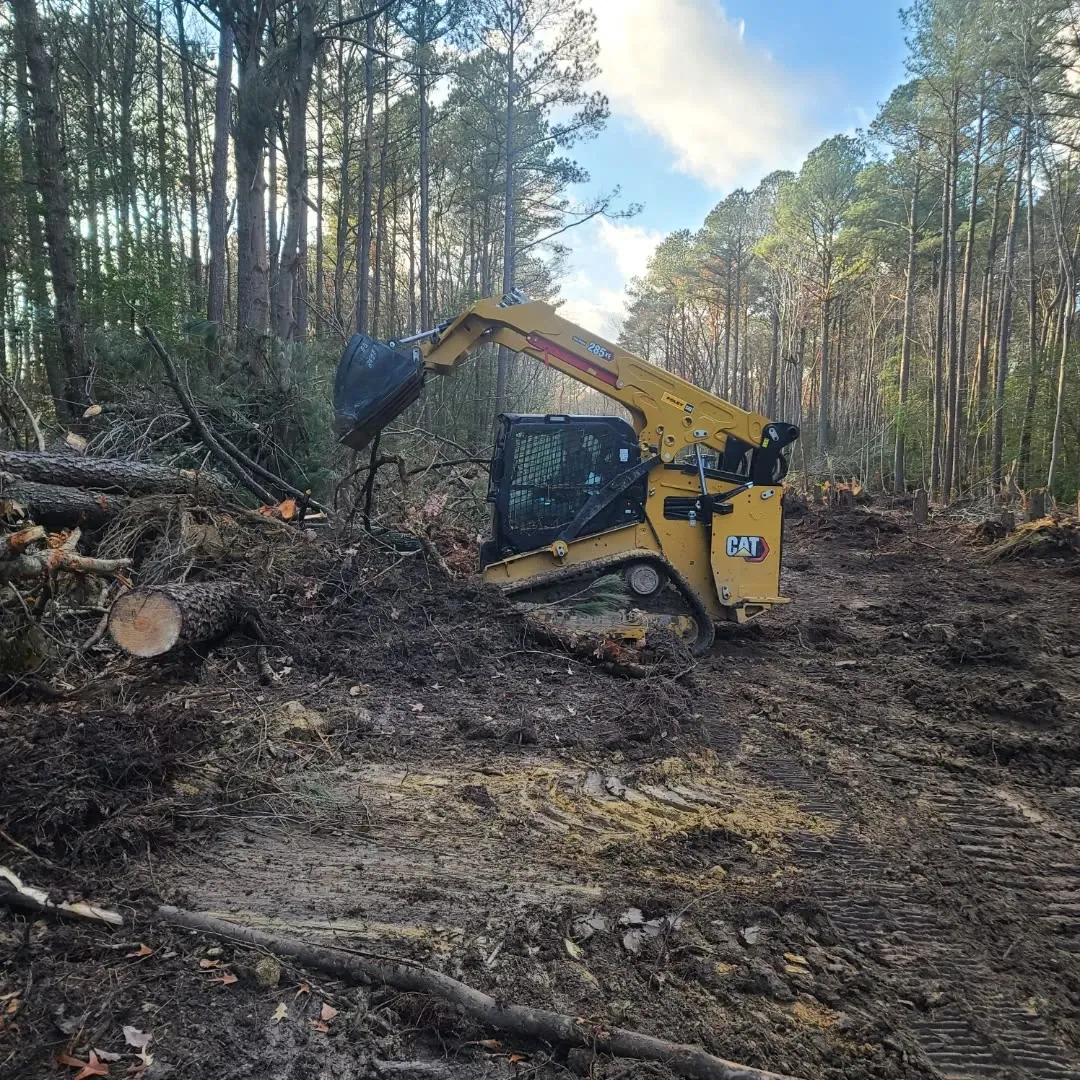
Service
Understory, brush and saplings reduced to a soil-holding mulch layer where they stand, no burning, no hauling, no burn piles left on an estate lawn. Scoped on a private site walk and finished to a written standard.
Forestry mulching grinds standing brush, saplings and small trees into a mulch layer in place with a drum mulcher on a track loader. Nothing is burned or hauled off. It fits understory, woodlots and sightline work. Huntly Land Co. does this work from Chadds Ford across the Brandywine Valley, after a private site walk.
Forestry mulching grinds standing brush, saplings and small trees into a mulch layer in place, using a drum mulcher on a compact track loader. Nothing is burned, nothing is hauled off, and there are no root balls or burn scars to clean up afterwards. The mulch layer holds soil on slopes, suppresses regrowth for a season or two, and breaks down into the ground it came from.
Stem density and diameter first, then the ground: slope, surface rock and whether the site will carry equipment dry. After that it is the finish standard, an open understory left park-clean reads very differently from a rough reduction, and how much selective retention the property calls for. A written proposal follows the walk: scope, finish standard, resource plan, stewardship measures, schedule and investment in one document.
| What we assess on the walk | Why it moves the figure |
|---|---|
| Density and stem size | What is standing, how heavy it is, and how many passes the ground needs before it reads finished. |
| Ground and terrain | Slope, surface rock, wet or low-bearing ground, and what the site will carry without being marked. |
| Access and staging | Gates, lanes, tree lines, distance from the road, and where equipment and material can be staged out of sight. |
| Finish standard | Turnout-safe pasture, park finish, selective retention or a working surface, written into the scope rather than left to interpretation. |
| Resource plan | Specialized equipment and project resources matched to site conditions and scope, and the days on the ground they require. |
| Stewardship | Specimen trees, fence lines, wetland and stream edges, soils and drainage protected as part of the work. |
| Schedule | Season, dormant-season windows, and how the work sequences around the rest of the property. |
Every property is assessed on its own ground rather than against a published table. After a private site walk you receive a written proposal setting out scope, finish standard, resource plan, stewardship measures, schedule and investment in a single document.
A clean acre of light brush is usually a half-day; heavy stems with six-inch material can take a full day or more per acre. Slope, wet ground and how much you want taken to grade all move the clock, which is why we walk the ground before quoting rather than pricing off a satellite image.
Mulching is carried out with high-flow compact track carriers running dedicated drum mulcher heads, low ground pressure, which is what allows slopes, paddocks, soft fields and stream-side ground to be worked without the rutting wheeled equipment leaves. Industrial brush cutters, grapples and, where the site calls for it, excavators, dozers, loaders and hauling are matched to the conditions and the scope. A named Huntly project lead directs the property from the first walk to the final walkthrough.
Some of it will. Mulching removes the top growth and leaves the root systems, so vigorous invasives like multiflora rose and autumn olive push back within a season or two unless you clear, graze or spot-treat the regrowth. We tell you that up front and build the follow-up into the plan rather than pretending one pass is permanent.
Across the Brandywine Valley first, then Chester County and southeastern Pennsylvania, northern Delaware and Sussex County, Delaware, estate woodlots, horse farms, preserved ground and coastal-plain parcels alike. Coverage includes Greenville, Centreville, Montchanin, Yorklyn, Hockessin, Unionville, West Marlborough, Kennett Square, Chadds Ford and Landenberg.
Mobilization is the expensive part of any land project, so most owners stack scope into a single visit. These are the services most often added to this one.
Overgrown parcels, building envelopes and neglected estate ground cleared mulch-first, with topsoil and specimen trees intact.
How it worksEstate drives, farm lanes, bridle paths and utility corridors cut to a graded, drivable surface, merchantable timber decked for the owner.
How it worksMultiflora rose, briar and woody invasion taken back to turnout-safe pasture, with fence lines and paddock edges finished to standard.
How it worksInvasive reed brought under control on a multi-year program for waterfront estates, associations and farms.
How it worksFallen timber cleared, drives, lanes and riding trails reopened, fence lines made safe, with 24/7 storm and emergency response.
How it worksUnderstory conversion on an estate woodlot and invasive removal on a paddock edge share a machine and little else. Each is set out in full:
Regulatory notes are general guidance; Huntly confirms the rules that apply to each site before work.
Density and stem size, ground and terrain, access and staging, finish standard, resource plan, stewardship and schedule. Haul-off of non-organic debris, stump grinding below grade, permits and licensed applications are quoted as separate visible lines. Every job is priced in writing after a private site walk, and the walk carries no charge inside the service region.
Dormant season, from late fall through winter, gives leaf-off sightlines, firm or frozen ground and visible stems, and it is when Huntly has the most capacity. As general guidance in Pennsylvania, cutting of larger trees is commonly timed to the October 1 to March 31 window, when bats are not roosting in trees. Huntly confirms whether and how that window applies to each site before scheduling.
It depends on the township, the slope and any water nearby. In Chester County, earth disturbance over 5,000 square feet needs a written erosion-and-sediment-control plan, and one acre or more needs NPDES coverage. Whether a mulching scope counts as earth disturbance is a question for the approving body, so for the Brandywine Valley we confirm with the township or conservation district before work.
For most brush and small-tree work, yes. Mulching leaves roots in the ground and a chip layer on the surface, so slopes stay put, stream-adjacent ground stays stable, and there are no burn piles or haul-off loads. A buildable surface, root-ball removal, grading or drainage work may call for a broader clearing or excavation plan.
It is left as a thin layer that holds soil and suppresses regrowth for a season or two, then breaks down into the ground it came from. Merchantable timber is decked on the property for the owner rather than hauled away.
The track carriers work on low-ground-pressure tracks, so slopes, paddocks, soft fields and stream-side ground are worked without the rutting wheeled equipment leaves. Whether horses stay on the property during the work is settled on the site walk for that farm, and turnout is worked when horses are moved or the paddock is closed. Ground beside streams and wet areas is flagged on the walk before any work is scheduled.
Send the town, rough acreage and two or three photographs. We reply by email with site-walk times, and a written scope follows the walk.
Office hours Monday to Saturday, 8 a.m. to 4 p.m. On call 24/7 for storm and emergency cleanup. If anyone is in danger, call 911 first.