Decision guide
Forestry Mulching vs Brush Hogging vs Excavator Clearing
Three ways to clear ground, compared on roots, stumps, erosion, regrowth, debris and slope. The right one depends on what the ground becomes next.
Forestry mulching grinds brush and small trees in place and leaves the roots, so regrowth needs follow-up. Brush hogging clears saplings and brush as a rough cut. Excavator or dozer clearing pulls stumps and roots, which suits building pads but disturbs topsoil. Pick by what the ground becomes next.
The three methods in one table
People use the words clearing, mulching and brush hogging as if they mean the same job. They do not. Each one leaves a different thing behind, and that decides how the ground behaves next season. The table below uses the USDA Forest Service review of mastication, Virginia Cooperative Extension, Cornell and Penn State.
| Method | Stems, roots and stumps | Soil and erosion | Regrowth | Debris | Slope and wet ground |
|---|---|---|---|---|---|
| Forestry mulching | Grinds stems into small pieces in place. Virginia Cooperative Extension says mulching heads push down and mulch stems up to 6 to 8 inches and grind a range of stump sizes. Roots stay in the ground. | Soil stays covered. In Forest Service reviewed studies, mulched residue did not increase runoff or compaction when machines drove over it. | Stumps of sprouting species can resprout. Penn State notes resprouting after mastication is often lower than after saw cutting, but follow-up is still planned. | Stays on site as a mulch layer. The Forest Service says the method does not reduce biomass, it places small pieces on the soil. | Forest Service: ground machines should work at or below 40 percent slope. Tracks cause less disturbance than wheels. Work dry soils. |
| Brush hogging (rotary cutter on a tractor) | Cornell says the blades cut saplings and small trees up to several inches in diameter. It is a rough cut. Stumps and roots are left. | Cuts above the ground. The sources we fetched give no erosion figures for it. | Cutting a suckering species does not touch the root system and can mean more stems over a wider area (Penn State). | Cut material is left lying. Cornell warns of thrown objects, rocks and debris thrown over 300 feet. | No slope figure in the sources we fetched. Hidden rocks and stumps damage equipment. |
| Excavator or dozer clearing (grubbing) | Pulls stumps and roots out. Virginia Cooperative Extension describes bulldozing to grub out stumps as a common way to clear land. | The same source says bulldozers and loaders nearly always destroy topsoil. An excavator with a root rake disturbs less but does not eliminate topsoil loss. | A removed stump is not there to resprout. The sources we fetched give no regrowth rates. | Leftover trees and brush have to be handled in some other way (Virginia Cooperative Extension lists the options in a table). | Forest Service: excavators and crawler tractors at or below 40 percent slope. Wet soil raises compaction risk (Clemson). |
Where a source did not give a figure, the cell says so. We would sooner leave a gap than guess.
What each method does to roots and stumps
Mulching and brush hogging both cut at or near the surface. Neither removes the root system. Penn State explains that stump sprouts come from dormant buds at the root collar, the meeting place of stem and roots, and that they become active after injury or stress. Penn State also separates suckering woody plants, which send new shoots from their roots, from non-suckering plants, which do not. For a suckering species, cutting the stems leaves the roots alive and can mean more stems over a wider area.
Penn State also makes a point that favors mulching on dense invasive shrubs. It describes leveling a stand with a forestry mower as a useful first step, and reports that resprouting after mastication is often reduced compared with saw cutting, possibly because of damage to the root collar. The same page says the resprouts are then managed over the following growing seasons. So mulching is the first pass of a plan and not the finish.
Excavator clearing is the method that takes the stumps and roots out. Virginia Cooperative Extension notes that most hardwood trees sprout vigorously from the stump unless something is done to kill the root system, Removal is one answer to that when the ground will be built on or plowed.
Soil disturbance, erosion and wet ground
Virginia Cooperative Extension is blunt about dozers. It says bulldozers and front-end loaders nearly always destroy the topsoil, because ripping roots out of the ground takes valuable topsoil with them. It adds that an excavator with a root rake means fewer disturbances but does not eliminate topsoil loss. It calls mulching a method that preserves soil integrity and can maintain or increase organic matter and reduce erosion.
The Forest Service review backs the mulching side with studies, most of them in the western United States and not in Pennsylvania. In those studies mulched residue did not increase runoff compared with bare soil, and compaction was not significant when machines drove over the residue. The review still advises working dry soils and driving on slash. It notes that wheeled carriers can rut wet soil, that tracked machines spread weight and rut less, and that rubber tracks give the lowest pressure.
Clemson adds a rule of thumb for any ground-based machine: soil compaction depends on soil type, machine, number of passes, time of year and slope, and in the study it reviewed bulk density rose by up to 50 percent over the first three passes. Avoiding wet ground is the simplest fix.
Slope, size and what a method cannot do
The Forest Service gives one clear slope figure. Excavators, crawler tractors and similar machines should work at or below 40 percent slope, and ground equipment made for steep slopes should not exceed 50 percent. Above 40 percent, mechanical treatment is rarely an option unless machines are tethered. Clemson says ground-based logging suits slopes under 30 percent and needs extra precautions above that.
On stem size, Virginia Cooperative Extension puts mulching heads at stems up to 6 to 8 inches, and Cornell puts brush hog blades at saplings and small trees up to several inches. Larger trees are felled first. We regularly take trees of 100 feet and more, up to 130 feet, most with the mulching equipment itself or large chainsaws and felling, and the stems are then reduced in place.
Mulch depth matters for what comes after. In Colorado conifer studies reviewed by the Forest Service, plant cover and species richness fell to zero when the forest floor depth went past 4 inches, and did better at about 2 inches or less. If you plan to seed grass, ask for a depth you can live with.
Which method fits which job
The table below is our read of how the sources line up with common jobs on Brandywine Valley properties. It is not a quote from them.
| Goal for the ground | Method that usually fits | Why |
|---|---|---|
| Pasture, trail, view corridor or lane that stays vegetated | Forestry mulching | The soil stays covered and the roots stay put. Plan on regrowth visits and on grass seed after. |
| Rank grass, weeds and light saplings in an open field | Brush hogging | It is built for rough cutting of open ground. Not meant for heavy woody cover. |
| Building pad, pond, foundation or ground that will be graded | Excavator or dozer clearing | Stumps and roots have to come out. Grading follows. |
| Dense invasive shrubs such as multiflora rose or autumn olive | Forestry mulching as the first step | Penn State describes leveling the stand with a forestry mower, then managing resprouts in later seasons. |
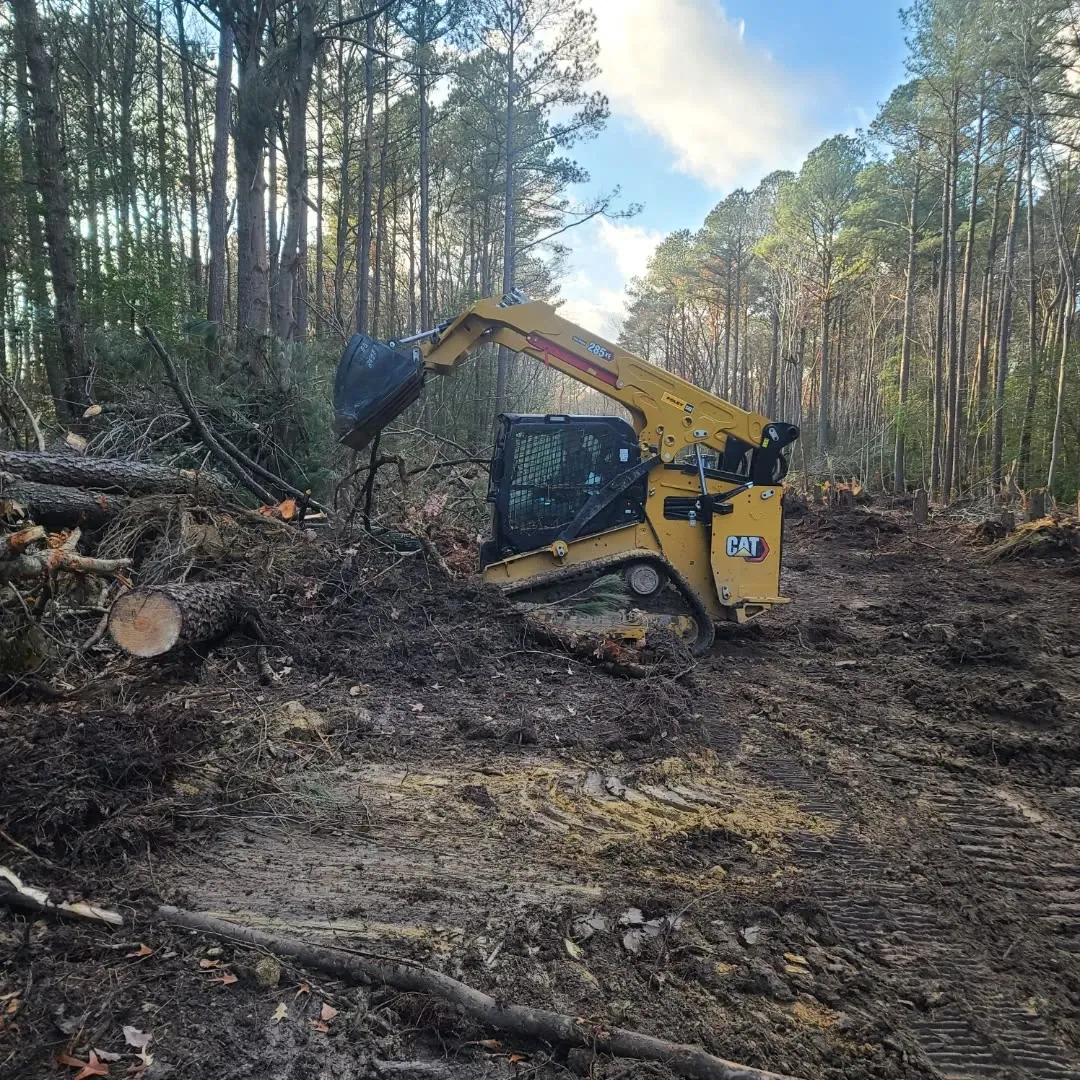
Our equipment is a Cat 285XE track loader with a full forestry package, a BRX418 brush cutter and a rock grapple. That covers mulching, brush cutting and moving debris. This is general information, confirm with the township or agency for your parcel.
Questions about clearing methods
Sources: USDA Forest Service, To Masticate or Not (RMRS-GTR-381), Virginia Cooperative Extension, Options for Clearing Land: Pasture Establishment, Cornell Small Farms, Brush Hogs and Rotary Cutters, Penn State Extension, Winter Invasive Plant Control, Penn State Extension, Prolific Stump Sprouters, Clemson Land-Grant Press, Logging Operations and Soil Compaction. Figures and quotes are from the sources named. The fit table is our own reading. This is general information, confirm with the township or agency for your parcel.
Does forestry mulching remove stumps and roots?
No. The Forest Service describes mastication as grinding material into small pieces and leaving them on the soil. Roots stay in the ground, and stumps of sprouting species can resprout, so follow-up visits are part of the plan.
Is brush hogging the same as forestry mulching?
No. Cornell describes a brush hog as a rough-cut rotary mower for saplings and small trees up to several inches across. Mulching heads handle larger stems and grind them into a mulch layer left on the ground.
Which method disturbs the soil least?
Virginia Cooperative Extension says bulldozers nearly always destroy topsoil, and an excavator with a root rake disturbs less but not zero. It describes mulching as preserving soil integrity. Wet ground raises compaction risk for any machine.
Is there a slope limit for clearing equipment?
The Forest Service says excavators, crawler tractors and similar ground machines should work at or below 40 percent slope. Steeper ground rarely suits mechanical treatment unless machines are tethered. We check slope on the site walk.
Call, or send the details.
(484) 486-7272hello@huntlyland.com. Send the town, rough acreage and two or three photographs. We reply with site-walk times, and a written plan follows the walk.
Office hours Monday to Saturday, 8 a.m. to 4 p.m. On call 24/7 for storm and emergency cleanup. If anyone is in danger, call 911 first.