Decision guide
What Drives Land Clearing Cost in the Brandywine Valley
Nine factors decide how much work a clearing job is. Here they are in plain terms, with the sources behind them, so you know what to tell us before a site walk.
Land clearing scope comes down to nine things: acreage, stem diameter and density, slope, access, stumps, debris, invasives, ground wetness and hauling. Two parcels of equal size can differ widely on those. This page lists each factor and what it changes. For published per-acre ranges, see our cost page; your written price follows the site walk.
Nine factors that set the scope
Ask three contractors for a number on the same parcel and the answers will differ. The land is not the only reason. The scope each one has in mind differs too: cut or pulled, left or hauled, one pass or a plan with follow-up. The table lists the factors that move a clearing job, using the USDA Forest Service review of mastication, Virginia Cooperative Extension, Cornell, Penn State and Clemson. Published per-acre ranges are on our cost page; your own price comes in writing after the walk.
| Factor | What it changes | Source basis |
|---|---|---|
| Acreage | Machine size and number of days. A small machine suits small areas and tight spots. A larger one suits open ground with room to maneuver. | USDA Forest Service decision tree and project size notes |
| Stem diameter and density | Mulching suits sites with many small unmerchantable trees and shrubs. A few large trees are felled first, and the stems are then reduced. | Forest Service; Virginia Cooperative Extension; Cornell |
| Slope | Ground machines are limited to about 40 percent slope. Steeper ground needs different methods or hand work. | Forest Service |
| Access | Gate width, lane condition and room to turn decide which machine can reach the work and how it is moved in. | Forest Service project size and access notes |
| Stumps | Mulching grinds stumps at the surface and leaves roots. Pulling stumps is a separate scope and moves topsoil. | Virginia Cooperative Extension |
| Debris | Mulching leaves material on site. Methods that remove stems create piles that must be handled. | Forest Service; Virginia Cooperative Extension |
| Invasives | Dense multiflora rose, autumn olive and similar shrubs need a first pass plus planned follow-up on resprouts. | Penn State Extension |
| Ground wetness | Wet soil rutting and compaction push work to dry or frozen windows, or to different machines. | Forest Service; Clemson; MSU Extension |
| Hauling | Moving machines to the site, and handling any material that has to leave. | Forest Service transport notes |
Acreage, stem size and density
The Forest Service says mastication becomes viable when a site has no commercial timber value but still carries numerous shrubs or hundreds to thousands of small unmerchantable trees per acre. If only a few trees or shrubs exist, the review points to more practical options such as hand slashing. In other words, density per acre matters as much as total acres.
Stem diameter sets the equipment and the method. Virginia Cooperative Extension puts mulching heads at stems up to 6 to 8 inches. Cornell puts a rotary cutter at saplings and small trees up to several inches. Larger trees come down first. We regularly take trees of 100 feet and more, up to 130 feet, most with the mulching equipment itself or large chainsaws and felling. A parcel with a few giants and a lot of brush is a different job from one that is all brush.
Acreage also changes machine choice. The Forest Service decision tree asks whether a project is larger than about 10 acres and whether homes or other sensitive areas call for a smaller machine.
Slope, access and ground wetness
Slope is the one factor with a published limit. The Forest Service says excavators, crawler tractors and similar machines should work at or below 40 percent slope, and above 40 percent mechanical treatment is rarely an option unless machines are tethered. Clemson says ground-based logging suits slopes under 30 percent and needs added care on steeper ground.
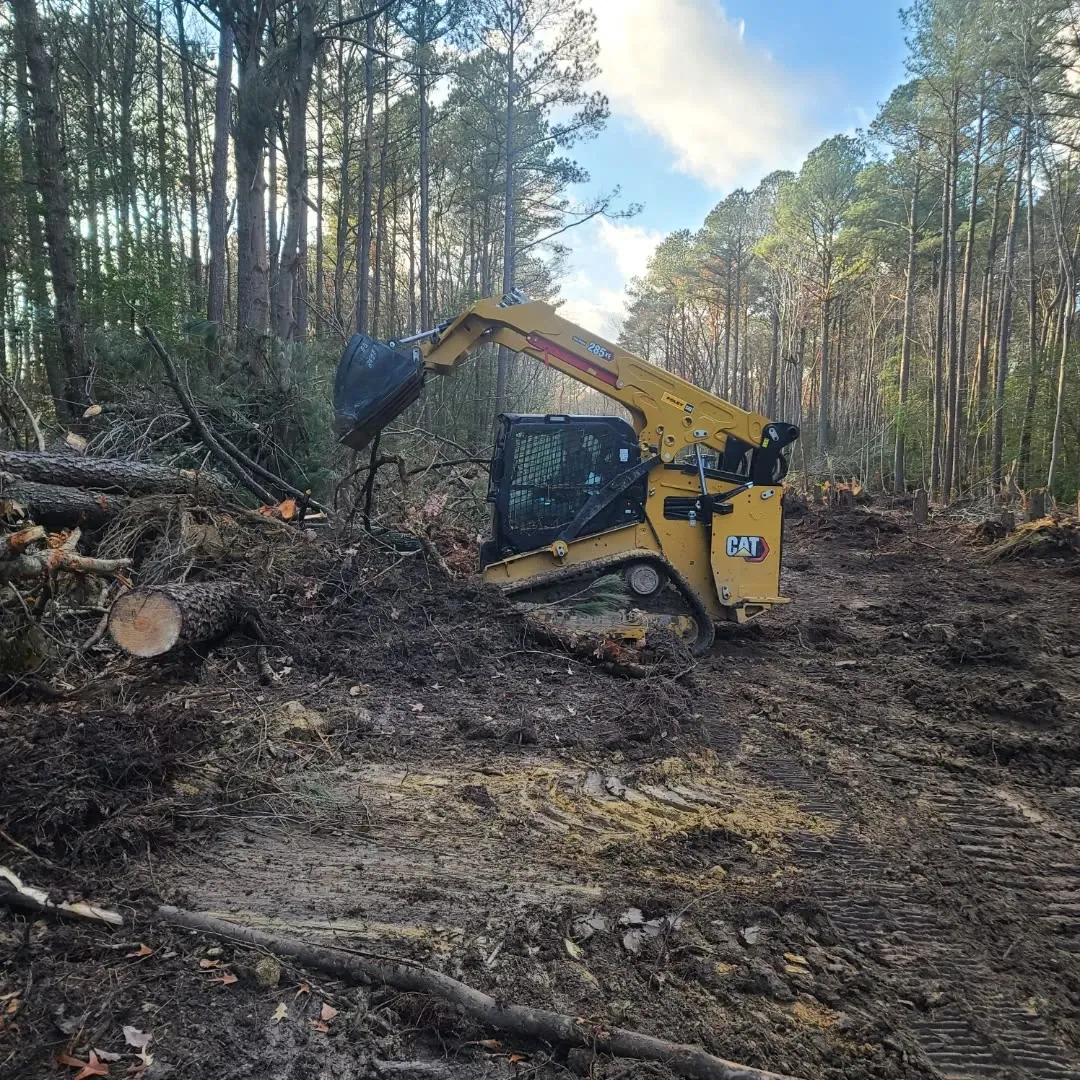
Access is mostly about the way in. The Forest Service notes that skid steers and compact track machines have an advantage in tight places around homes, while a larger dedicated masticator fits sites with room to maneuver. It also notes that easy road access matters for fuel and repairs on long days.
Wet ground changes timing and sometimes machine choice. The Forest Service advises working dry soils, notes that wheeled carriers rut wet soil and that rubber tracks give the lowest ground pressure. Clemson calls avoiding wet areas, or letting water drain naturally, the best way to limit compaction. MSU Extension says frozen or snow-covered ground can reduce or eliminate compaction and rutting. A site that stays wet may wait for a dry or frozen window, and that wait is a real part of the scope.
Stumps, debris, invasives and hauling
Stumps are the biggest scope difference between methods. Virginia Cooperative Extension says mulching can grind a range of stump sizes, while the common bulldozer approach pulls the stumps out and nearly always destroys topsoil. Mulching leaves roots in the ground, and stumps of sprouting species can resprout. Penn State explains that stump sprouts come from dormant buds at the root collar.
Debris decides whether a job ends with a haul. The Forest Service says mastication does not reduce biomass, it places small pieces on the soil to decompose. Methods that remove stems and stumps leave piles that must be handled in some other way. The Forest Service also finds that a mulch layer deeper than 4 inches suppressed plant growth in the studies it reviewed, so depth is worth agreeing in advance if you plan to seed.
Invasives add follow-up. Penn State describes leveling an established stand of exotic shrubs with a forestry mower, then managing resprouts in the following growing seasons. That plan has visits after the first pass, and they belong in the scope.
Hauling has two sides. The Forest Service says initial plans must account for moving machines to the site. Material that has to leave the property adds its own work. This is general information, confirm with the township or agency for your parcel.
What to send before a site walk
The more of this you can send, the closer the first conversation gets to a real plan. Photographs do most of the work.
- Town and rough acreage, with a sketch or a phone pin of the boundary.
- Photographs of the densest areas and of the largest trees, with something for scale.
- Where equipment would enter, and the narrowest gate or lane on the way.
- Whether the ground stays wet, and where.
- What the ground becomes next: pasture, lawn, trail, view, building site.
- Known invasives, fences, easements, streams and utilities.
Email hello@huntlyland.com with those items. We reply with site walk times, and a written plan follows the walk.
Questions about what drives clearing cost
Sources: USDA Forest Service, To Masticate or Not (RMRS-GTR-381), Virginia Cooperative Extension, Options for Clearing Land: Pasture Establishment, Cornell Small Farms, Brush Hogs and Rotary Cutters, Penn State Extension, Winter Invasive Plant Control, Penn State Extension, Prolific Stump Sprouters, Clemson Land-Grant Press, Logging Operations and Soil Compaction, MSU Extension, Winter timber harvest. This page lists factors; published per-acre ranges are on the cost page. This is general information, confirm with the township or agency for your parcel.
Why do two clearing quotes for the same land differ?
Scope differs. One may cut and leave material, another may pull stumps and haul debris. Density, stem size, slope, access and wet ground also change the work. A written plan after a site walk states exactly what is included.
Does acreage alone set the price?
No. The Forest Service says mulching suits sites with many small stems per acre, while a few trees or shrubs can call for other methods. Density, stem diameter, slope and access matter as much as acres.
How does wet ground change a clearing job?
Wet soil ruts and compacts. The Forest Service advises dry soils and says rubber tracks give the lowest pressure. MSU Extension notes frozen ground can reduce compaction. Wet sites may wait for a dry or frozen window.
Do stumps add to the work?
Yes. Mulching grinds stumps at the surface and leaves the roots, while pulling stumps is a separate scope that moves topsoil, according to Virginia Cooperative Extension. Say whether stumps must come out.
Call, or send the details.
(484) 486-7272hello@huntlyland.com. Send the town, rough acreage and two or three photographs. We reply with site-walk times, and a written plan follows the walk.
Office hours Monday to Saturday, 8 a.m. to 4 p.m. On call 24/7 for storm and emergency cleanup. If anyone is in danger, call 911 first.