Defined scope
Trail, greenway and park corridor clearing
Encroachment cut back to a defined corridor width and overhead clearance, with mulch left in place as a soil-holding layer.
Corridor clearing cuts encroachment back to a defined width and overhead clearance on trails, greenways, tow paths and park access roads. It is quoted per linear foot or by machine-day. Mulch stays in place as a soil-holding layer instead of hauled spoil, which keeps the trail surface from washing out.
For parks, trail and greenway managers
Parks departments, land trusts, conservancies, campuses and community associations with common ground. The scope sets width, overhead clearance, the finish and the repeat-pass schedule.
- Unit: per linear foot or machine-day
- Boundary: corridor width and overhead clearance
- Finish: mulch left as a soil-holding layer
- Record: dated ground and aerial photographs
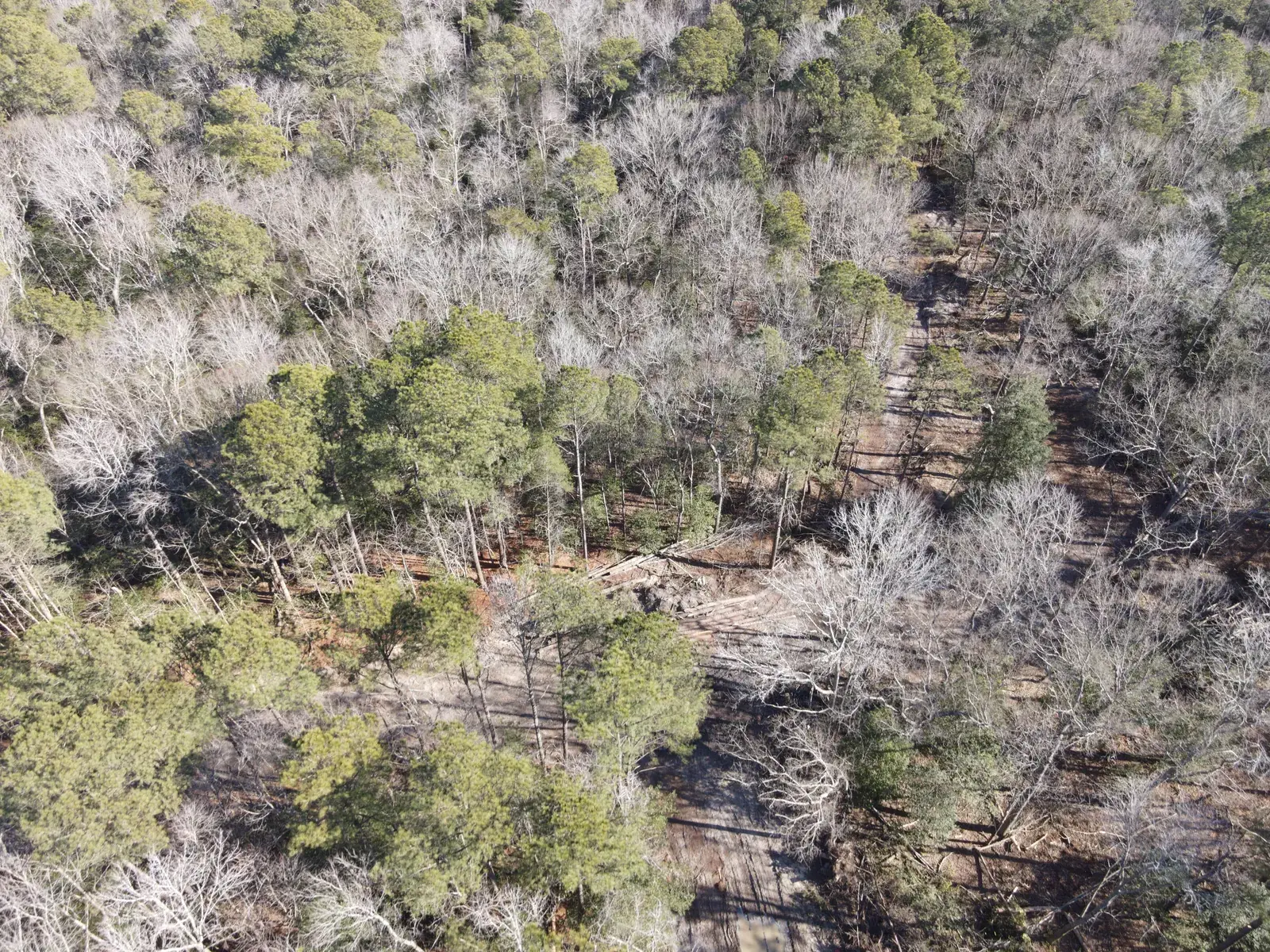
A cleared road through tree cover, top-down.
Timber landings and haul roads
After a harvest closes, landings, haul roads and skid trails can be reduced, graded and stabilized so the access that remains is usable and the ground is not left to erode. That is quoted by machine-day.
Low impact on the trail
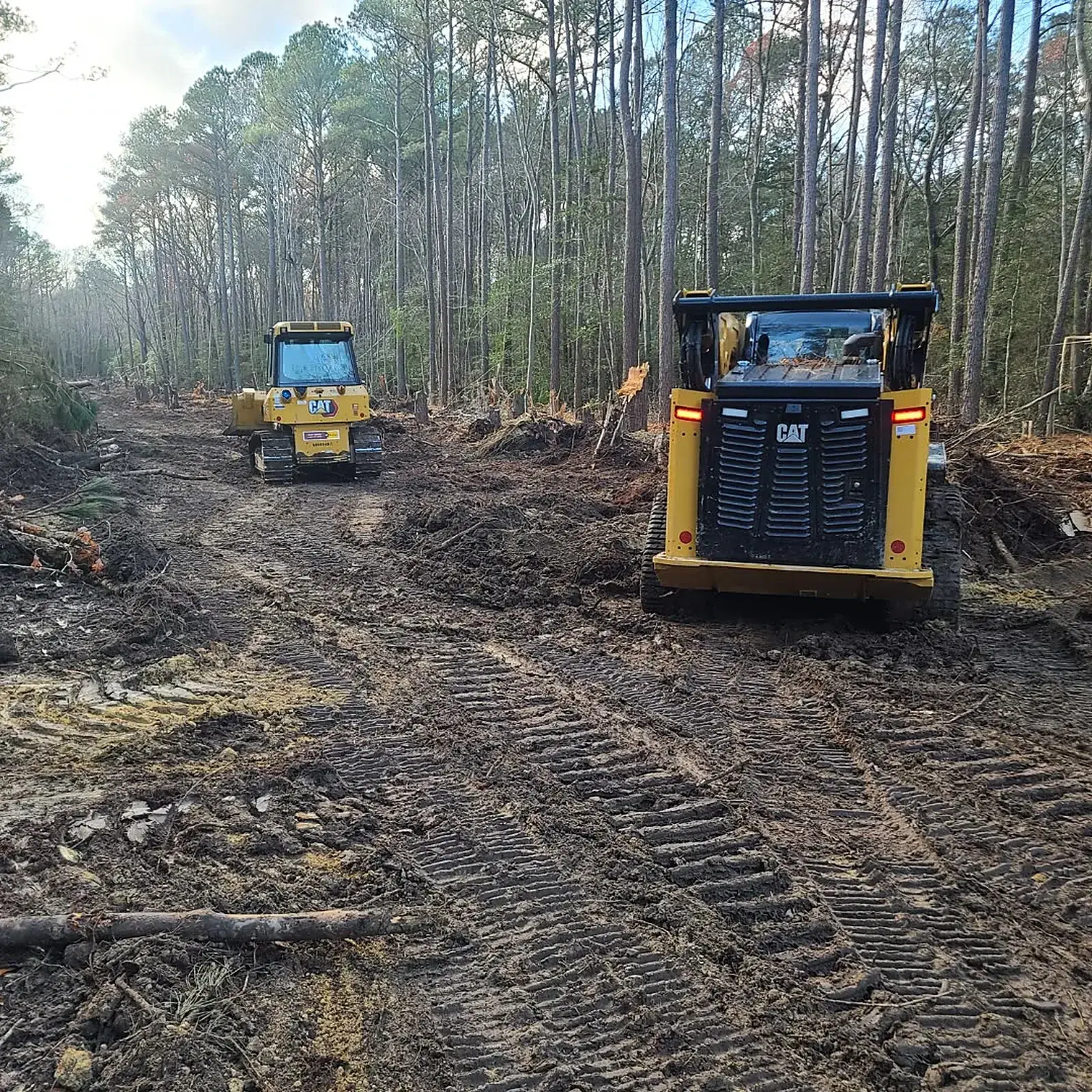
Low-ground-pressure tracks leave less mark than wheeled equipment on a trail surface, and the work can be sequenced to keep sections open to users.
Asked about trail, greenway and park corridor clearing
Can a trail stay open during work?
Sections can be closed and reopened in sequence. The sequence is agreed in the scope.
Do you haul material away?
Mulch is left in place by default. Hauling is a separate visible line when material must leave.
Five steps, in this order.
- Request for quoteSend the scope, location, acreage or linear footage, access constraints, permit conditions, required window and insurance requirements.
- Pre-mobilization site walkBoundaries, prong limits and no-track zones are marked on the ground and agreed in writing.
- Written scope with fixed line itemsEach line has a unit, a boundary and a finish standard, so it compares line for line against another quote.
- Dated ground and aerial documentationPhotographs from the ground and the air record each phase of the work as it happens.
- Close-out packageA paired before and after set and a short written summary, ready for an inspection, insurance or reimbursement file.
Quotes, timing, permits and ground protection
Regulatory notes are general guidance; Huntly confirms the rules that apply to each site before work.
How is a public vegetation scope quoted in Pennsylvania and Delaware?
Line by line: per structure, per linear foot or by machine-day, depending on the scope. Haul-off, stump grinding below grade and licensed applications are separate visible lines. The scope states the window your own documents require, and every quote follows a walk of the site.
When is the best time to schedule vegetation work?
Dormant season: leaf-off sightlines, frozen or firm ground and visible stems. It is also when Huntly has the most capacity. As general guidance in Pennsylvania, cutting of larger trees is commonly timed to the October 1 to March 31 window, when bats are not roosting in trees. Huntly confirms whether and how that window applies to each site before scheduling.
Who handles permits on a public scope?
Permits and engineering stay with the owner or their engineer. Huntly executes the vegetation scope they define, and we confirm requirements with the township, conservation district or DNREC before work.
How do you protect a basin floor or a saturated right-of-way?
With low-ground-pressure tracks rather than wheeled equipment, on frozen or firm ground in the dormant season, with no-track zones agreed in the scope.
Is forestry mulching better than bulldozing on public land?
For most brush and small-tree work, yes. Mulching leaves roots in the ground and a chip layer on the surface, so slopes stay put, stream-adjacent ground stays stable, and there are no burn piles or haul-off loads. A buildable surface, root-ball removal, grading or drainage work may call for a broader clearing or excavation plan.
More from the Municipal & Institutional division
- Dam and basin embankment de-woodying
- Drainage and watercourse right-of-way clearing
- Sightline and entrance-approach remediation
- Storm and emergency debris and access restoration
- Mechanical invasive and noxious vegetation control
- Capability statement
- How a scope gets documented
- Land work in Chester County & SE Pennsylvania
- Land work in Northern Delaware
- Land work in Sussex County, Delaware
- All counties and towns we serve
Send the scope. A written quote follows.
hello@huntlyland.comSend the town, rough acreage and two or three photographs. We reply by email with site-walk times, and a written scope follows the walk.
Office hours Monday to Saturday, 8 a.m. to 4 p.m. On call 24/7 for storm and emergency cleanup. If anyone is in danger, call 911 first.