Plant guide
Eastern Red Cedar Encroachment Clearing and Regrowth
A native tree that moves into pasture, old fields and fence lines. We clear the encroachment, leave what you choose to keep, and come back for seedlings.
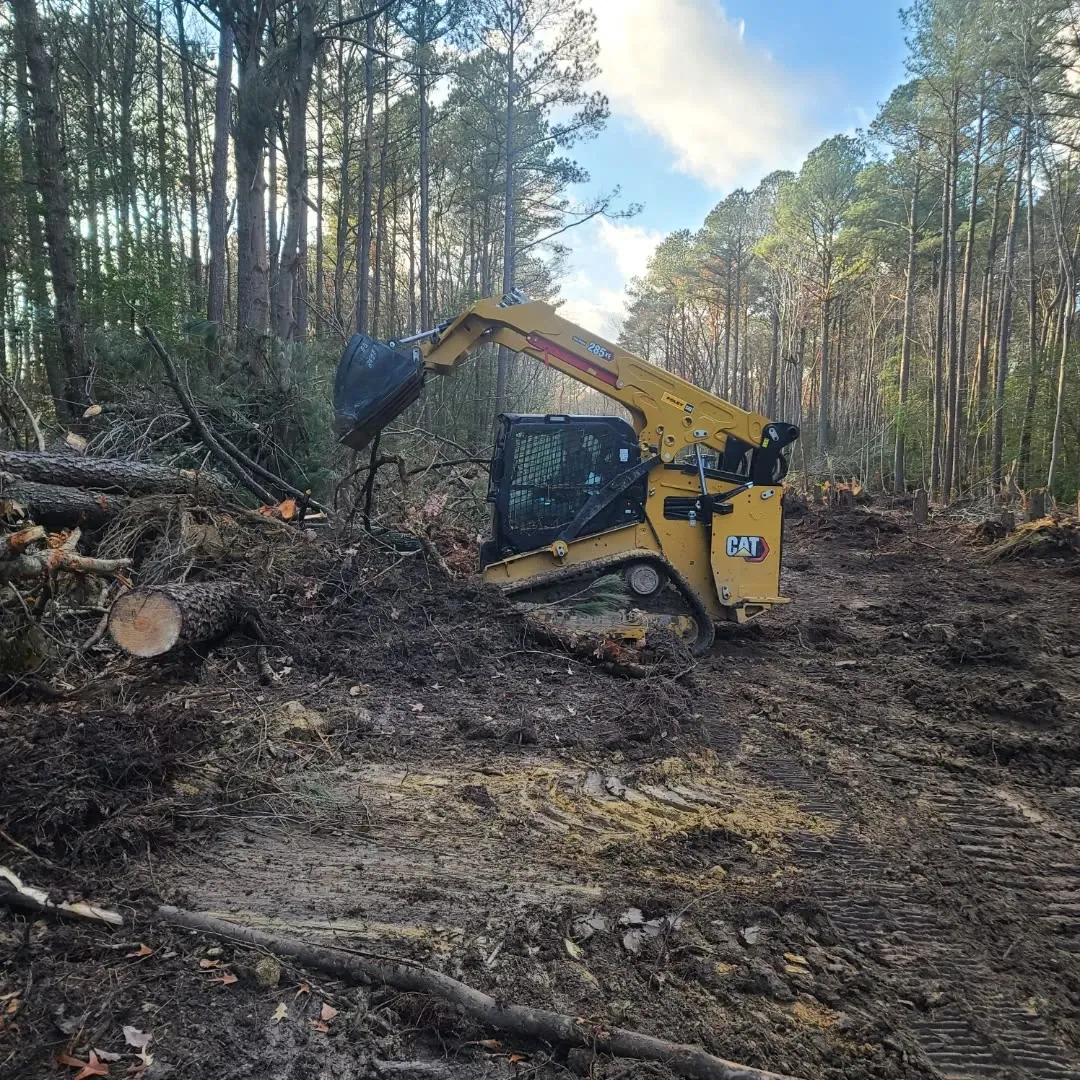
Eastern red cedar is a native tree that moves into pasture and old fields once birds seed it in. The USDA Forest Service says it does not sprout after complete cutting, so a cleared tree stays cleared. We mulch the encroaching cedar with the Cat 285XE and return for seedlings. Trees you want to keep can stay.
How to recognize it
Eastern red cedar is a long-lived evergreen. Mature trees typically reach 40 to 70 feet, with thin, fibrous bark. Mature branches carry overlapping, scale-like leaves in opposite pairs, while seedlings and new twigs have pointed, awl-shaped leaves. Young trees are typically narrow and columnar, and crowns open and become irregular with age, according to the USDA Forest Service.
The seeds ride in small, fleshy, berrylike cones that turn from green to whitish-blue to bluish between late July and mid-November and stay on the tree until early spring. The tree is dioecious, with separate male and female trees, and Nebraska Extension notes that female trees produce the berrylike fruits. In winter an evergreen cedar stands out against bare field edges and hedgerows, which makes the encroachment easy to see.
Why it matters locally
Eastern red cedar is native to the eastern United States, and that is why this page speaks of encroachment and not eradication. The Forest Service calls it both a pioneer and an invader. It colonizes disturbed sites such as abandoned pastures and cultivated fields, it is most competitive on exposed, dry sites, and its seedlings survive best in open conditions. Birds and small mammals disperse the seed, and seedlings cluster near seed-bearing trees and fence lines, where there are perches.
For a pasture the problem is displacement. Brittany Fletcher of the University of Maryland, quoted in Lancaster Farming, says redcedar displaces pasture grasses and is hard to remove once established, and that the trees use water heavily, raise soil pH and produce chemicals that suppress competing plants, including forage. Nebraska Extension makes a related point from the other direction: eradication is not realistic, but control is, and treating trees while they are small is usually the most effective approach.
That combination is the reason to decide early which cedars stay and which go. Nebraska Extension notes that cutting only the female trees can slow further spread while leaving the males for cover.
How we remove it
We mulch the encroaching cedar in place with a drum mulcher on our flagship Cat 285XE, which carries the full forestry package. The BRX418 brush cutter works the fence lines and field edges where seedlings cluster and the mulcher cannot reach, and the rock grapple moves larger stems and debris that should not stay where they fall. Trees you want to keep are marked on the site walk and left standing.
Stump and sprout behavior is the good news here. The Forest Service says eastern redcedar does not sprout after complete cutting or burning. Nebraska Extension says trees cut below the lowest branches will not regrow, and the University of Maryland source gives the same instruction to cut below the lowest green branch. A tree cleared down to the ground does not come back from the stump.
The regrowth to plan for is new seedlings. If an owner wants herbicide on small trees, that is done by a pesticide applicator working to the product label. Nebraska Extension gives spring or fall as the preferred season for soil or individual-tree treatments, and the University of Maryland source says mid-spring is the best time for a soil application. Both sources describe herbicide as most useful on small trees.
Timing by season
| When | Step | What happens |
|---|---|---|
| Winter | Survey | Evergreen cedar stands out against bare fields and hedgerows, and the Forest Service notes the cones stay on the tree until early spring. |
| Any season | Clear | Because cut cedar does not sprout, the schedule follows ground conditions and access, set on the site walk. |
| Spring or fall | Applicator window | Nebraska Extension prefers spring or fall for herbicide on individual trees, and says soil treatments will not work unless applied before rainfall. A pesticide applicator handles this. |
| Every year after | Seedling walk | Seedlings cluster near seed trees and fence lines according to the Forest Service. Nebraska Extension advises starting early to catch small plants. |
The schedule is the typical shape. Your dates, the number of passes and the finish standard are set on the site walk and written into the plan.
Regrowth and follow-up visits
A cleared cedar stays cleared, so the follow-up is about seedlings. They arrive because birds and small mammals carry seed from female trees, and they gather along fence lines and under perches. A field that is cleared and then left alone will be reseeded from the trees that remain on the property and on the neighbor's land.
The University of Maryland source says that when trees are small, all it takes is a pair of loppers, and that cutting works best on seedlings. Nebraska Extension recommends long-term selective management over an intensive short-term effort. The plan sets an annual walk of the fence lines and edges, and the number of mulching or cutting passes depends on acreage and how many seed sources remain.
What the owner can do
- Pull small cedars, or cut them with loppers, early. The University of Maryland source says small trees are best controlled early.
- Decide which cedars you want, such as a specimen or a screen, and tell us before the site walk. Only female trees bear the berrylike fruit.
- Watch fence lines, perches and the edges of cleared ground each year for new seedlings.
- Cut cedar can have a second life. The University of Maryland source notes the wood can be sold for products like cedar chests or fence posts.
- Goats are one option for seedlings. In University of Maryland testing, redcedar made up 7 percent of goats' annual diet and 24 percent in winter, and their rumens break down the seeds.
Questions about eastern red cedar
Sources: USDA Forest Service, Fire Effects Information System: Juniperus virginiana, Lancaster Farming, Eastern redcedar trees encroaching on Maryland pastures (University of Maryland), University of Nebraska-Lincoln Extension, Managing Eastern Redcedar in Grasslands. Regulatory and pesticide notes are general; Huntly confirms the rules that apply to each site before work.
Does eastern red cedar grow back after it is cut?
Not from the stump. The USDA Forest Service says it does not sprout after complete cutting or burning, and Nebraska Extension says trees cut below the lowest branches will not regrow. New seedlings are the regrowth to watch for.
Is eastern red cedar invasive?
It is native here, so we call it encroachment. The Forest Service says it colonizes abandoned pastures and old fields, and a University of Maryland source says it displaces pasture grasses. We clear it where it is taking over, not everywhere.
Can I keep some of the cedars?
Yes. Nebraska Extension notes that cutting only the female trees can slow spread while leaving the males for cover. Which trees stay is decided with you on the site walk.
When is the best time to clear cedar encroachment?
Sooner on size, since Nebraska Extension says treating small trees is usually the most effective approach. It gives spring or fall for herbicide on small trees. Mulching dates follow ground conditions and are set on the site walk.
More about Eastern red cedar
Regulatory notes are general guidance; Huntly confirms the rules that apply to each site before work.
How do I tell eastern red cedar from other evergreens in Chester County, PA?
Eastern red cedar is a juniper. Young trees have sharp needle-like foliage and older branches have flat scale-like leaves, with small blue berry-like cones and reddish shredding bark. Pines carry long needles in bundles, and spruces have four-sided single needles. We mark which trees to keep on the site walk.
Does eastern red cedar resprout if I cut it in Delaware?
No. The USDA Forest Service Fire Effects database says eastern redcedar does not sprout after complete cutting or burning, and reproduces only from seed. Birds spread the seed, so new seedlings come in. That makes cedar one of the easier species to clear for good.
How do birds spread eastern red cedar into my pasture in Pennsylvania?
Birds and small mammals eat the berry-like cones and spread the seed, often along fence lines and under perches. Seeds pass through birds quickly, so many land near the parent tree. That's why cedar rings the edges of old fields and why we plan a seedling check after clearing.
Is eastern red cedar worth keeping instead of clearing in New Castle County, DE?
Sometimes. It's a native evergreen that gives winter cover, and the wood is rot-resistant and used for fence posts. A few trees along a windbreak or lane can earn their place. A cedar thicket choking a pasture or hunt-country sightline is a different job. We mark what stays on the site walk.
What month should eastern red cedar be cleared in Pennsylvania?
As general guidance, tree cutting is commonly timed October 1 to March 31 in Pennsylvania to avoid bat roosting season, and firm or frozen ground protects pasture. Because cedar doesn't resprout, there's no season tied to a chemical follow-up. Huntly confirms the rule that applies to each site before work.
Does eastern red cedar change the price of clearing in PA and DE?
Yes, by tree size and density. Small young cedars are quick mulching, while large mature trees take more machine time, and logs you want to keep for posts may be decked rather than ground up. Price is written after the free site walk, including haul-off.
Does cost-share cover removing eastern red cedar encroachment in Pennsylvania?
Possibly in some cases. NRCS Pennsylvania EQIP cost-shares mechanical brush management of large shrubs (practice 314) at a per-acre rate set each year, but whether cedar fits depends on size and your plan. Delaware is set separately. Ask NRCS before work starts. Huntly confirms the rule that applies to each site before work.
Call, or send the details.
(484) 486-7272hello@huntlyland.com. Send the town, rough acreage and two or three photographs. We reply with site-walk times, and a written plan follows the walk.
Office hours Monday to Saturday, 8 a.m. to 4 p.m. On call 24/7 for storm and emergency cleanup. If anyone is in danger, call 911 first.