Plant guide
Black Locust Removal and Regrowth
Thorny locust thickets spreading from fence lines and field corners, mulched with tracked equipment, then watched for the root sprouts that follow.
Black locust sprouts from roots and stumps, so cutting alone can thicken a stand instead of ending it. The USDA Forest Service says sprouting often follows stem or root damage, and Wisconsin DNR says cutting alone does not kill a clone. We mulch the stand, then return to catch sprouts while they are young.
How to recognize it
Black locust leaves are deciduous, alternate and pinnately compound, with 7 to 19 leaflets, according to the USDA Forest Service. The flowers are showy, white and fragrant, in drooping clusters about six inches long, and the fruit is a flat pod holding roughly four to eight dark, bean-like seeds. Within its native range the tree generally flowers from April to June.
Young trees are thorny. Wisconsin DNR notes that seedlings and small branches carry paired thorns. In open ground the Forest Service says trees often form dense thickets or clones, with the oldest trees in the center of a stand and the youngest at the edges, which is a useful pattern to read on a site walk. Send photographs of a leaf, a branch and the pods, and we will say what we see before we visit.
Why it matters locally
Whether a given stand is native or naturalized is hard to say. The Forest Service describes an eastern native region running from central Pennsylvania and southern Ohio south into Alabama, Georgia and South Carolina, and says the original range is not accurately known. What matters on a property is what the tree does. The Forest Service says root sprouting is a means of spread into reclamation sites and abandoned fields, and it is a common reproductive method after logging.
On horse and livestock land the tree is a second concern. Cornell University's weed identification page says the toxins are highest in bark and seeds but also present in leaves, that new growth is the most toxic, and that horses, cattle and poultry are the livestock most often affected. It advises against planting black locust as a shade tree in or around pastures and says to monitor for young shoots and remove them.
The Forest Service also lists black locust as a nitrogen-fixing species. In a North Carolina study, soil nitrogen mineralization and nitrification were highest in dense black locust stands compared with several other stand types.
How we remove it
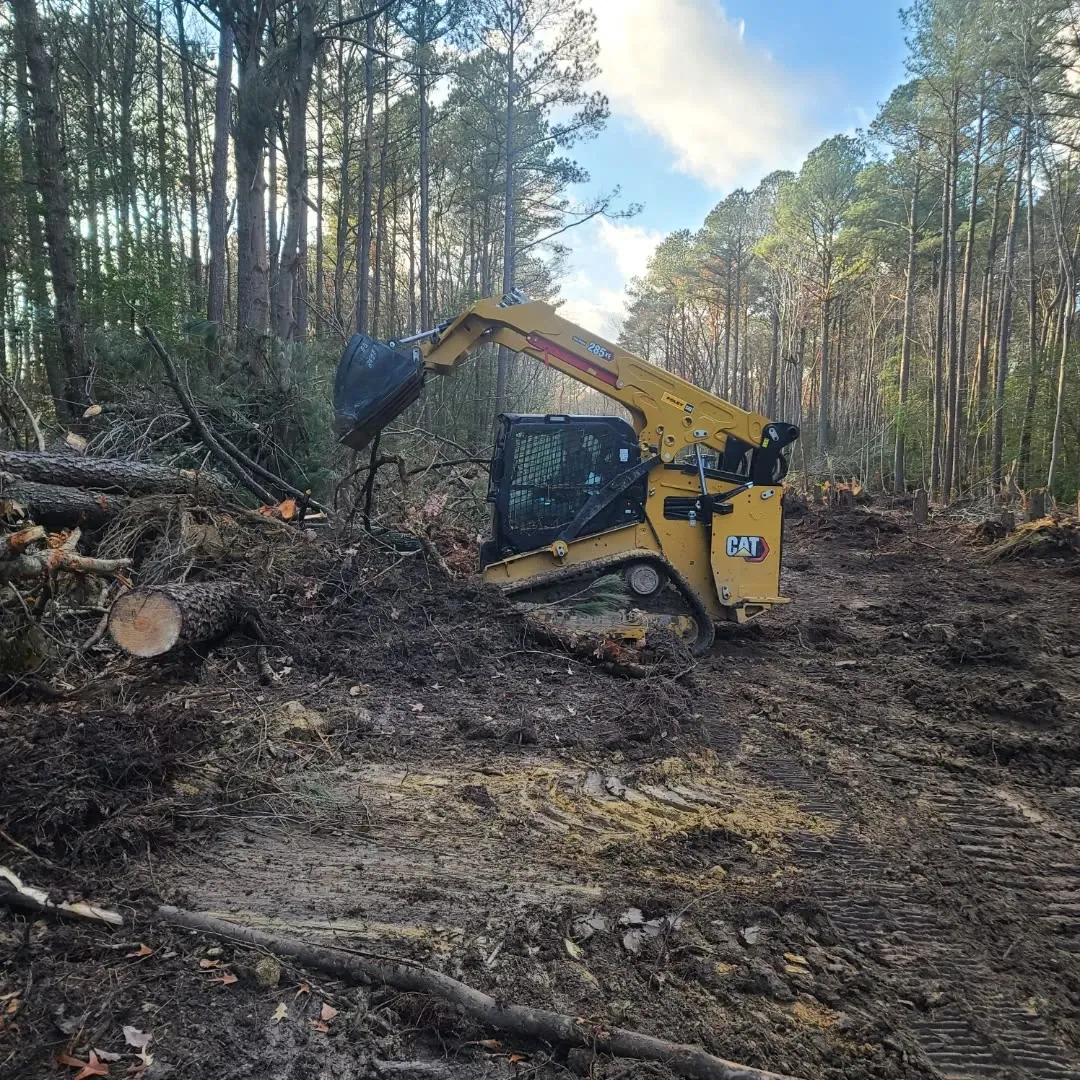
We mulch the standing stand in place with a drum mulcher on our flagship Cat 285XE, which carries the full forestry package. The BRX418 brush cutter works fence lines and field edges the mulcher cannot reach, and the rock grapple moves larger stems and debris that should not stay where they fall.
Stump and sprout behavior is the reason this is a plan and not a single pass. The Forest Service says black locust commonly sprouts from roots and can also sprout from the stump, that sprouting often occurs in response to stem or root damage including cutting, and that root sprouting usually begins when plants are about four to five years old and increases rapidly in full sun and open areas. Wisconsin DNR states that neither cutting nor girdling alone is effective to kill a clone, because both stimulate stump and root sprouting.
Mulching takes the stems off the ground. The clone is still there. Wisconsin DNR adds that all stems in a clone must be treated for a chemical treatment to be effective. Where an owner wants that step, a pesticide applicator does it, working to the product label, and finding the edge of the clone on the site walk is where the plan begins.
Timing by season
| When | Step | What happens |
|---|---|---|
| Late spring | Identify | Flowering generally runs April to June within the native range according to the Forest Service, and the showy white clusters make every tree and clone edge easier to find. |
| Midsummer into fall | Pods ripen | The Forest Service reports pods ripening as early as July in the southern part of the range, with ripening extending into November and seeds persisting through winter. |
| Any season | Cut and mulch | Mulching dates follow ground conditions and are set on the site walk. |
| Each growing season after | Sprout check | Root sprouting increases in full sun and open areas, so walk open edges first. The Forest Service notes that sprouts need sufficient light to survive. |
The schedule is the typical shape. Your dates, the number of passes and the finish standard are set on the site walk and written into the plan.
Regrowth and follow-up visits
Expect a flush of sprouts from the root system after the first pass, often at some distance from the old stems. The Forest Service says root suckers form mainly where branch roots emerge from older roots. Sprouts that are young and few are easy to cut again, and the plan schedules the return visits for that reason.
Ground and brush clearing is not a substitute. Wisconsin DNR says mowing and burning can temporarily control the spread of young shoots, but mowing may encourage seed production and burning may trigger more sprouting. On livestock land, Cornell's note that new growth is the most toxic part is a reason to walk the turnout early in each season. The number of visits depends on stand size, how far the clone reaches and whether a pesticide applicator is treating between passes.
What the owner can do
- Do not cut a few stems and walk away. Cutting stimulates sprouting.
- Keep horses and livestock away from sprouts, bark and seed pods, and ask your veterinarian right away about any suspected poisoning.
- Do not run a disk or blade through the root zone of a stand without a plan. Wisconsin DNR says damage to roots or stems stimulates vigorous sprouting and lateral spread.
- Do not plant black locust as a shade tree in or around pastures, as Cornell advises.
- Photograph the edge of the stand from the same spot each season so spread is easy to compare.
Questions about black locust
Sources: USDA Forest Service, Fire Effects Information System: Robinia pseudoacacia, Wisconsin DNR, Black locust, Cornell University, Poisonous Trees of Pasture. Regulatory and pesticide notes are general; Huntly confirms the rules that apply to each site before work.
Will cutting a black locust kill it?
No. The USDA Forest Service says black locust commonly sprouts from roots and the stump, and Wisconsin DNR says neither cutting nor girdling alone kills a clone. A mulching pass clears the stems, then sprouts are cut and watched over several seasons.
Is black locust dangerous to horses?
Cornell University says the toxins are highest in bark and seeds but are also in leaves, and that horses are among the livestock most often affected. It advises removing young shoots in pasture. Ask your veterinarian about any suspected poisoning.
Why does a locust stand seem to spread after it is cut?
Root sprouting. The Forest Service says sprouting often follows stem or root damage and increases in full sun and open areas, so a cut stand can send up new shoots at a distance from the old stems.
Is black locust native here?
The Forest Service places its eastern native region from central Pennsylvania south and says the original range is not accurately known. Native or not, a stand sprouts and spreads the same way, so the plan is the same.
More about Black locust
Regulatory notes are general guidance; Huntly confirms the rules that apply to each site before work.
How do I tell black locust from honey locust in Chester County, PA?
Black locust has smooth oval leaflets, paired short thorns at the leaf bases, deeply furrowed dark bark, and hanging white flower clusters in late spring. Honey locust has long branched thorns on the trunk and finer leaflets. We mark each tree on the site walk so you know exactly what's being cut.
Does forestry mulching get rid of a black locust grove in Delaware?
No. Mulching removes the trees above ground, but the USDA Forest Service says black locust often regrows from the stump or roots after cutting. Cut stems need a follow-up. For locust, a licensed applicator treats the stumps or regrowth, quoted as a separate visible line. Huntly confirms the rule that applies to each site before work.
Is black locust worth keeping on my New Castle County, DE property?
Sometimes. Locust wood is dense and rot-resistant, which is why it's used for fence posts, and the flowers feed bees. The tradeoff is thorns, brittle limbs and thicket spread. We'll walk it with you and mark what to keep along a lane, what to take out of a pasture, and what's better sawn for posts.
When is the best time to clear black locust in Pennsylvania?
For standing trees, as general guidance, tree cutting in Pennsylvania is commonly timed October 1 to March 31 to stay clear of bat roosting season. Frozen or firm ground also protects pasture sod. Regrowth treatment follows in the next growing season. Huntly confirms the rule that applies to each site before work.
Do black locust thorns affect the price of clearing in Delaware?
Yes, a little. Thorny sucker thickets slow hand work and can puncture tires, so we favor tracked equipment and low-ground-pressure tracks and allow more time. Price mostly follows stem size, how dense the stand is, and haul-off of any logs. You get it in writing after the free site walk.
Where does black locust spread most in Chester County?
It runs along fence lines, old field edges, roadsides and disturbed ground, and it spreads by root suckers (USDA Forest Service) so one tree becomes a stand. Cutting a single tree in a pasture can trigger a ring of shoots. That's why we plan the follow-up before the first cut.
What comes back after black locust is mulched, and when?
Sucker shoots usually appear the first growing season, often in dense flushes around stumps and along old roots. A follow-up visit treats them while they're still small and easy to reach. A licensed applicator does any chemical step, quoted separately, and we re-check the area the following year.
Does cost-share cover black locust removal in Pennsylvania?
Not usually by itself. NRCS's Pennsylvania FY26 EQIP list pays for mechanical brush management of large shrubs, and locust thickets may or may not fit that practice depending on size and your plan. Delaware is set separately. Ask your NRCS office before work starts. Huntly confirms the rule that applies to each site before work.
Call, or send the details.
(484) 486-7272hello@huntlyland.com. Send the town, rough acreage and two or three photographs. We reply with site-walk times, and a written plan follows the walk.
Office hours Monday to Saturday, 8 a.m. to 4 p.m. On call 24/7 for storm and emergency cleanup. If anyone is in danger, call 911 first.