Plant guide
Callery Pear (Bradford Pear) Removal and Regrowth
Thorny, white-flowering pear thickets along hedgerows, fence lines, roadsides and old fields, cut and mulched with tracked equipment, then watched and revisited.
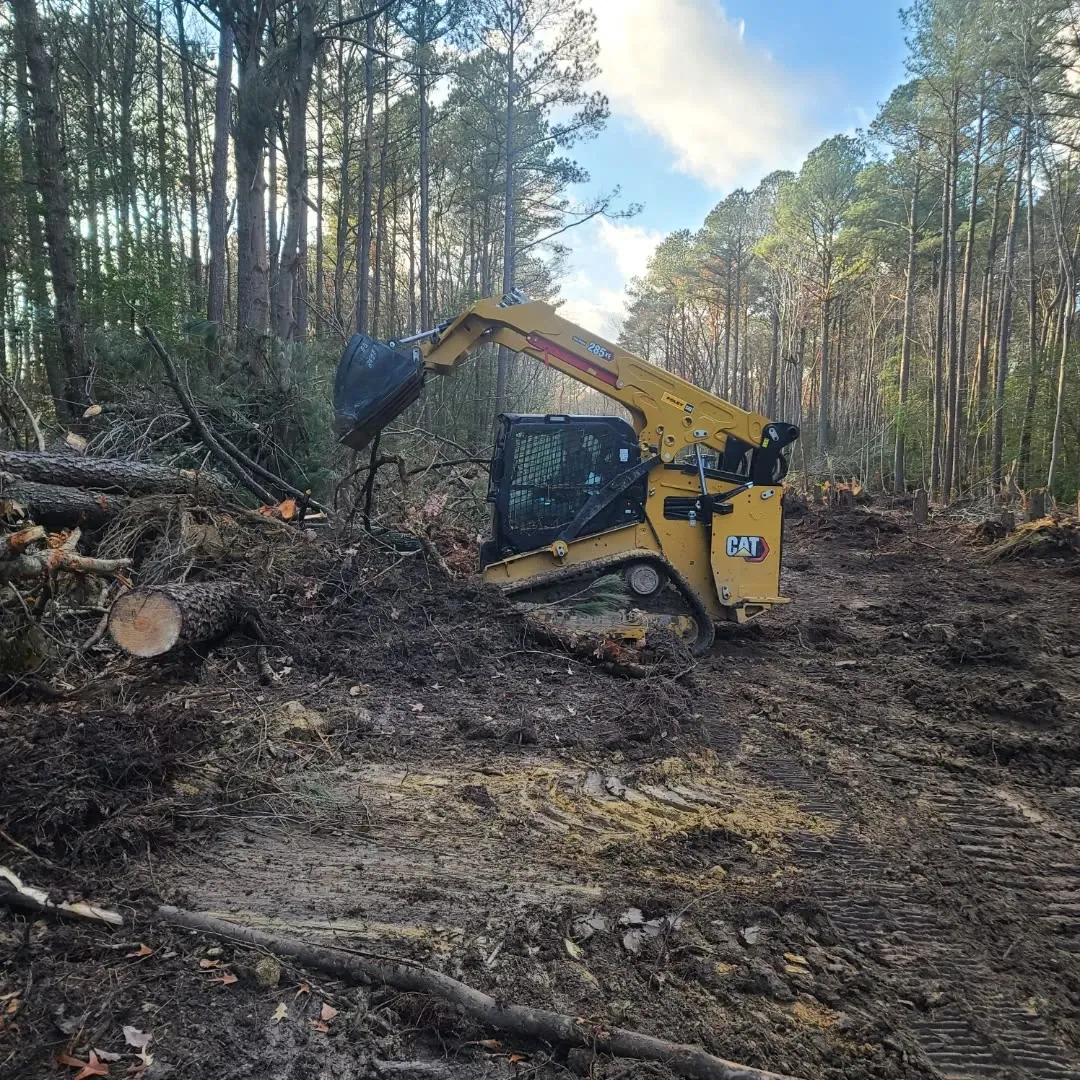
Callery pear, sold for years as Bradford pear, resprouts when cut. Penn State Extension says cut stumps must be treated to prevent resprouting, and shoots also rise from shallow roots. We mulch the thickets with the Cat 285XE, then return to catch regrowth. Any stump treatment is done by a pesticide applicator, working to the product label.
How to recognize it
Callery pear is a small tree, rarely more than 40 feet tall, with thick, waxy, alternate leaves about one and a half to three inches long. The leaf edge is finely toothed with a distinct ripple. In early spring, before the leaves open, it carries white, five-petaled flowers in ball-shaped clusters, and Penn State Extension notes a strong, rancid odor. The fruit is a hard green-to-brown pear about half an inch across, flecked with pale dots and almost woody until frost softens it.
Bradford is the best-known cultivar, but the trees in fields and hedgerows are often not the planted ones. Naturalized plants frequently carry stout spines even though the cultivar was bred without them, and University of Maryland Extension describes a sharp, tapering thorn at the end of a branch spur. Dense thorny thickets form in fields and meadows. Flowering dogwood and viburnums have opposite leaves, which separates them from the alternate leaves of pear. If you are unsure, send photographs of a leaf and a branch and we will say what we see before a site walk.
Why it matters locally
Penn State Extension places Pennsylvania at the northernmost edge of the Callery pear invasion front. The tree turns up on roadsides, in old fields, in hedgerows and along forest edges. Cultivars were bred for sterile fruit, but nearby cultivars cross-pollinate and set viable seed, and birds carry it into ditches, easements and fence lines. The University of Delaware names serviceberry as one native tree of the woodland edge that Callery pear crowds out.
Both states restrict the tree in the trade. The Pennsylvania Department of Agriculture added Callery pear to its Noxious Weed List in late 2021, with a phased ban on sale, transport, planting and propagation beginning in February 2022. Delaware's Invasive Plant List, published in the Delaware Register of Regulations in September 2022, includes Callery pear, and the University of Delaware says it will no longer be propagated or sold in the state. Those sources address sale and propagation, so ask the state agency about any duty that applies to trees already on your land.
The original Bradford cultivar also has a weak branch structure. The University of Delaware reports V-shaped branch angles that split after 15 to 20 years of growth, so an old planted row can be a storm-cleanup call as well as an invasive one.
How we remove it
We mulch standing Callery pear in place with a drum mulcher on our flagship Cat 285XE, which carries the full forestry package. The BRX418 brush cutter works fence lines, hedgerow edges and ditch banks where a track loader cannot turn, and the rock grapple moves larger stems and debris that should not stay where they fall.
Stump and sprout behavior sets the plan. Penn State Extension says cutting or mowing removes low cover, but the plants will readily resprout, and root fragments left in the ground resprout too. Mulching clears the stems and the thorny litter. It does not end the tree. Penn State's guidance is that cut stumps must be treated with herbicide to prevent resprouting, with a foliar treatment in the fall or the following season as the alternative when stump treatment is not practical.
Where an owner wants that step, a pesticide applicator does it, working to the product label, on a schedule agreed with the owner. We plan our passes around that visit. Penn State also notes that small plants can be pulled by hand only if every root comes out.
Timing by season
| When | Step | What happens |
|---|---|---|
| Early spring, in bloom | Map | Callery pear flowers white before it leafs out, and University of Maryland Extension notes it is often one of the first trees to bloom. That makes this the easiest time to mark every tree, including those in hedgerows and on property lines. |
| Any time of year | Cut and mulch | Penn State lists cut-stump treatment as workable year-round. Mulching dates follow ground conditions and are set on the site walk. |
| Mid-May until the onset of fall color | Regrowth treatment window | This is Penn State's foliar treatment window for regrowth, which a pesticide applicator would handle. |
| The following growing season | Check | Penn State lists a fall foliar treatment, or one the following season, when stump treatment is not practical. Walk the site and mark every stump and sprout. |
The schedule is the typical shape. Your dates, the number of passes and the finish standard are set on the site walk and written into the plan.
Regrowth and follow-up visits
Expect shoots from stumps and from the shallow root system in the first growing season after cutting. That is normal for this tree, and it is why return visits are written into the plan. Penn State Extension advises monitoring a site constantly, since removal works best as part of regular maintenance, and starting in the least-invaded areas where native vegetation can compete.
New seedlings will keep arriving while fruiting trees stand nearby, because birds spread the seed. A cleared field beside an unmanaged row of pear gets reseeded. The number of visits depends on stand size, how many seed sources remain on neighboring land, and whether a pesticide applicator is treating between passes. The plan sets it after the site walk.
What the owner can do
- Do not plant Callery pear or Bradford pear. The University of Delaware says plainly not to plant them.
- Do not cut a stump and leave it untreated. Penn State says cut plants will readily resprout.
- Photograph the trees in spring bloom so every one can be found and counted before work starts.
- When replacing a tree, consider the natives the University of Delaware lists: Carolina silverbell, Washington hawthorn, dogwood, fringe tree, serviceberry or redbud.
- Ask the Pennsylvania Department of Agriculture or the Delaware agency that handles your parcel about any rule for trees already on your land.
Questions about callery pear (bradford pear)
Sources: Penn State Extension, Callery Pear, University of Maryland Extension, Callery (Bradford) Pear, University of Delaware, Beauty and Invasion: Bradford Pears, Delaware Register of Regulations, 26 DE Reg. 171 (Invasive Plant List), Pennsylvania Department of Agriculture, Invasive Species Council newsletter, January 2022. Regulatory and pesticide notes are general; Huntly confirms the rules that apply to each site before work.
Will cutting a Callery pear kill it?
No. Penn State Extension says cut or mowed plants will readily resprout, and that cut stumps must be treated to prevent it. A mulching pass clears the stems, then regrowth is treated or cut and watched over several seasons.
Is Callery pear banned in Pennsylvania and Delaware?
It is restricted in both for sale and propagation. Pennsylvania lists it as a noxious weed that cannot be sold, transported, planted or propagated. Delaware's Invasive Plant List includes it. Ask the state about any duty for trees already on your land.
When is the best time to remove Callery pear?
Penn State Extension lists cut-stump treatment as year-round and foliar treatment from mid-May until the onset of fall color. Mulching dates follow ground conditions, and early spring bloom is the easiest time to mark every tree.
Why do Callery pears come back after clearing?
Stumps and shallow roots send up shoots, and birds bring new seed from fruiting trees nearby. Return visits catch both, which is why the plan covers several seasons.
More about Callery pear (Bradford pear)
Regulatory notes are general guidance; Huntly confirms the rules that apply to each site before work.
How do I tell Callery pear from a native tree in Chester County, PA?
Callery pear has glossy dark leaves that turn late to purple or red, and masses of white flowers in early spring that smell unpleasant. Wild seedling stands often carry stout thorns on branches. Native serviceberry blooms white too but has finer, toothed leaves and no thorns. We mark trees on the site walk.
Do I have to remove Callery pear from my own land in Pennsylvania?
No order requires it. Pennsylvania made Callery pear a noxious weed in late 2021 and began a phased ban on sales in February 2022, with stop-sale enforcement aimed at businesses. The state encourages owners to consider native alternatives. Huntly confirms the rule that applies to each site before work.
Does a thorny Callery pear thicket change the price in Delaware?
Yes. Thorned wild-type thickets slow hand work and are hard on tires, so we use tracked equipment and low-ground-pressure tracks and allow more machine time. Price follows stem size, density and haul-off. You get it in writing after the free site walk.
Does forestry mulching get rid of Callery pear thickets in New Castle County, DE?
Mulching removes the stems, but cut stumps often resprout and seeds are spread by birds. A licensed applicator treats stumps or regrowth, quoted as a separate visible line. We schedule a follow-up visit after the first growing season so the cleared ground doesn't refill. Huntly confirms the rule that applies to each site before work.
What replaces Callery pear after it's cleared in Pennsylvania?
The state suggests native alternatives such as Allegheny serviceberry, white fringetree and sourwood. After clearing we can leave the ground ready for planting or seeding. Mulched chips can stay as a ground layer on suitable sites, and we'll tell you where they should be hauled off instead.
Where does Callery pear escape into the field in the Brandywine Valley?
It escapes from planted street, parking-lot and yard trees into old fields, fence lines, powerline corridors and road edges, where birds drop the fruit. Chester County and northern New Castle County edges are typical. Clearing it also opens sightlines and keeps the pasture mowable.
Does cost-share pay for Callery pear removal in PA?
Not usually. NRCS Pennsylvania EQIP cost-shares mechanical brush management of large shrubs (practice 314) at a per-acre rate set each year, and mature pear trees may not fit that practice. Delaware is set separately. Check with NRCS before work starts. Huntly confirms the rule that applies to each site before work.
Call, or send the details.
(484) 486-7272hello@huntlyland.com. Send the town, rough acreage and two or three photographs. We reply with site-walk times, and a written plan follows the walk.
Delaware & coastal line: (302) 497-5263 · Main line: (484) 486-7272
Office hours Monday to Saturday, 8 a.m. to 4 p.m. On call 24/7 for storm and emergency cleanup. If anyone is in danger, call 911 first.