Plant guide
Norway Maple Removal and Regrowth
Seedlings and saplings along fence lines, woodland edges and old lawn margins, mulched with tracked equipment, then recut where stumps send up sprouts.
Norway maple is a street and yard tree that seeds into woodland and shades out the understory. The University of Maryland says small to large trees can be cut to the ground, and sprouts are controlled by repeating the cutting. We mulch seedlings and saplings, treat larger stems case by case, and return to cut regrowth.
How to recognize it
Norway maple is a medium to large deciduous tree, 40 to 90 feet tall at maturity according to the Brandywine Conservancy, with opposite, palmately lobed leaves that can reach about ten inches across and turn yellow in fall. It flowers in early spring before the leaves open and sets paired, winged seeds called samaras. Cultivars with striped or dark purple leaves are common in housing developments.
Sugar maple is the look-alike. University of Maryland Extension points to deeper sinuses between the lobes on Norway maple, and to samaras that resemble a coat hanger, with widely spaced wings, where sugar maple's resemble horseshoes. The Conservancy's field check is the leaf stem: Norway maple has a thick white sap and sugar maple's is clear, though the test may not work in late fall. Send photographs of a leaf, the seeds and the bark and we will say what we see before a site walk.
Why it matters locally
Wind carries the seed from yard and street plantings into adjacent natural areas. The tree is very shade tolerant, so it grows along forest edges and under existing trees, where the Brandywine Conservancy says it can outcompete native understory plants. The Conservancy also cites studies that found significantly less species diversity under Norway maples than under native maples, and University of Maryland Extension adds that the dense canopy suppresses grasses and seedlings beneath it.
Delaware's Invasive Plant List, published in the Delaware Register of Regulations in September 2022, includes Norway maple, and University of Maryland Extension counts Delaware among seventeen states that classify it as invasive. The Brandywine Conservancy profiles it in its invasive species series for the same valley we work in.
For a property owner, a mature planted tree and the seedlings it produces are two separate jobs. Seedlings and saplings in a fence line or woods edge are mulching work. A large shade tree beside a house is a decision about the tree itself, and we talk it through on the walk.
How we remove it
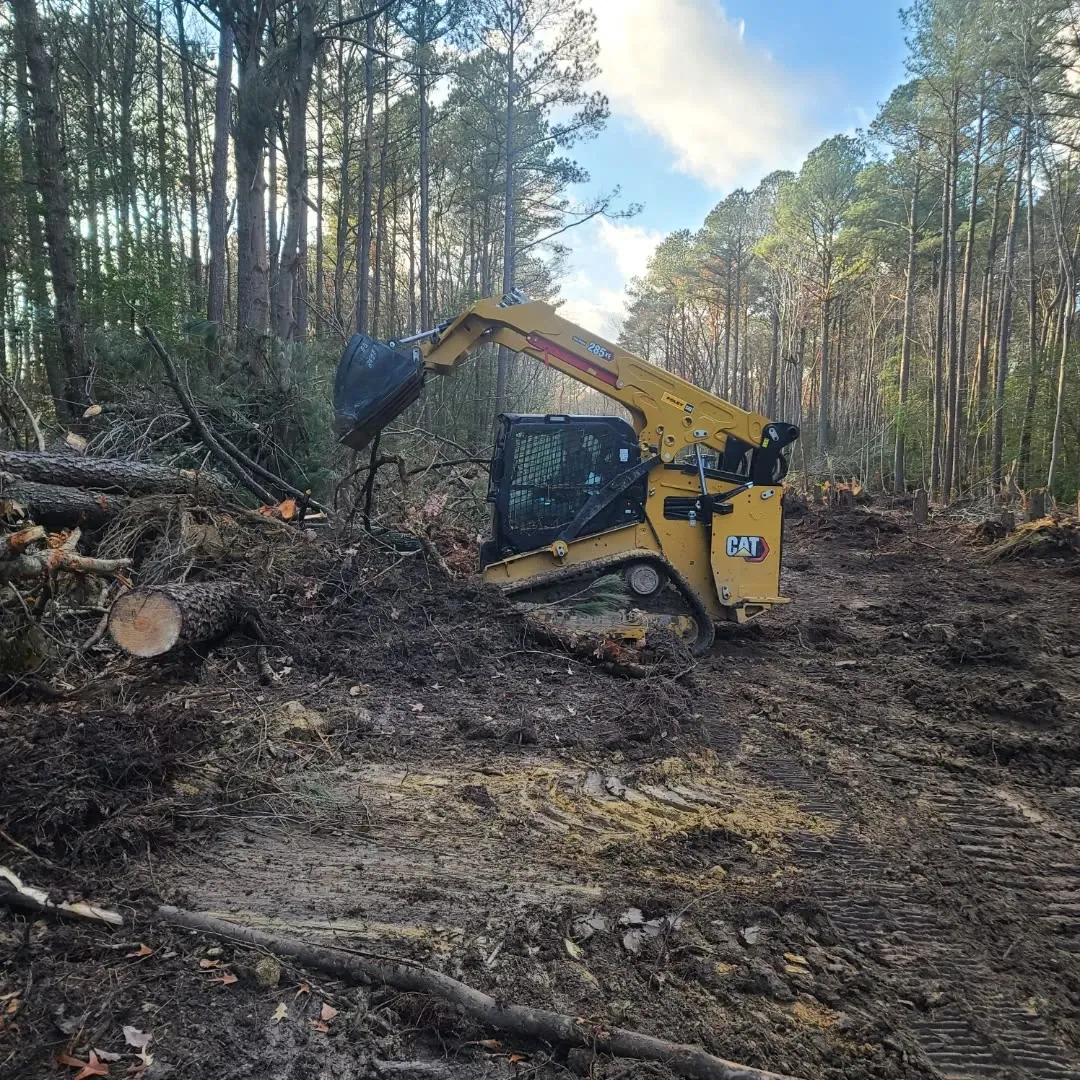
Seedlings and saplings along woods edges, fence lines and old lawn margins are mulched in place with a drum mulcher on our flagship Cat 285XE, which carries the full forestry package. The BRX418 brush cutter works fence lines and edges the mulcher cannot reach, and the rock grapple moves larger stems and cut pieces. Larger trunks are assessed on the site walk, since taking down a mature tree beside a structure or road is a different job from mulching a thicket.
Stump and sprout behavior sets the plan. University of Maryland Extension says seedlings can be pulled by hand and small to large trees can be cut to the ground, and that regrowth from sprouts is controlled by repeating the cutting when necessary. So the plan expects sprouts from stumps and builds in return cuts.
The Conservancy's guidance for young trees is pulling or digging out the root system, and for mature trees a hack-and-squirt herbicide method, with cuts spaced around the trunk. Where an owner wants a herbicide step, a pesticide applicator does it, working to the product label, and we schedule our work around it. The Conservancy adds that herbicide should not be used in very cold temperatures.
Timing by season
| When | Step | What happens |
|---|---|---|
| Early spring | Identify | Norway maple flowers before the leaves open, according to the Brandywine Conservancy, so blooming trees stand out against bare woods. |
| Leaf-on season | Confirm by leaf stem | The white-sap check works with leaves on the tree. The Conservancy warns it may not work in late fall. |
| Any season | Cut and mulch | Mulching dates follow ground conditions and are set on the site walk. |
| The next growing season | Check and recut | The Conservancy says to check the tree during the next growing season to confirm treatment worked, and University of Maryland Extension says to repeat the cutting when sprouts appear. |
The schedule is the typical shape. Your dates, the number of passes and the finish standard are set on the site walk and written into the plan.
Regrowth and follow-up visits
Expect sprouts from stumps in the first growing season after cutting, plus new seedlings from maples that are still seeding nearby. University of Maryland Extension's instruction is plain: repeat the cutting when necessary to control regrowth from sprouts. We schedule return passes to catch shoots while they are small, and the number of visits is written into the plan after the walk.
Because the seed is wind-borne, a cleared woods edge next to a row of mature Norway maples will see seedlings again. The plan names which trees are still seeding and what is to be done about them.
What the owner can do
- Pull seedlings by hand while they are small, as University of Maryland Extension suggests.
- Check the leaf stem for thick white sap before deciding that a tree is a Norway maple.
- Do not cut a mature tree to a stump and walk away. Sprouts are expected, and the cutting has to be repeated.
- A dead Norway maple can stay standing for wildlife if it is far from roads and structures, according to the Conservancy. Ask us about any that stand near a house, drive or riding lane.
- When replacing a tree, the Conservancy suggests native maples with similar appeal, such as sugar maple, red maple or silver maple.
Questions about norway maple
Sources: University of Maryland Extension, Invasives in Your Woodland: Norway Maple, Delaware Register of Regulations, 26 DE Reg. 171 (Invasive Plant List), Brandywine Conservancy, Invasive Species Spotlight: Norway Maple. Regulatory and pesticide notes are general; Huntly confirms the rules that apply to each site before work.
Can a Norway maple be cut down once and be done with it?
Not usually. University of Maryland Extension says trees of any size can be cut to the ground, but sprouts must be controlled by repeating the cutting when necessary. Plan on return visits.
How do I tell Norway maple from sugar maple?
Check the leaf stem. The Brandywine Conservancy says Norway maple has a thick white sap and sugar maple's is clear. University of Maryland Extension adds deeper sinuses between the leaf lobes and coat-hanger-shaped seeds.
Is Norway maple listed as invasive in Delaware?
Yes. Delaware's Invasive Plant List includes Norway maple, and University of Maryland Extension counts Delaware among seventeen states that classify it as invasive.
Can I leave a dead Norway maple standing?
The Brandywine Conservancy says dead trees can be left standing for wildlife habitat if they are far from roads or structures. Near a house, drive or riding lane we look at it on the site walk.
More about Norway maple
Regulatory notes are general guidance; Huntly confirms the rules that apply to each site before work.
When is the best time to clear Norway maple in Pennsylvania and Delaware?
Cut in the dormant season, roughly October through March. As general guidance, tree cutting is commonly timed Oct 1 to Mar 31 to stay clear of bat roosting season, and frozen or dry ground keeps ruts down. Seedlings can be mulched any time the ground carries the equipment. Huntly confirms the rule that applies to each site before work.
Does forestry mulching kill a Norway maple, or only knock it back?
Mulching removes everything above ground, but stumps and roots can send up new shoots. Small saplings usually come back thinner. A follow-up visit the next growing season catches the sprouts while they're small, and a licensed applicator can treat stumps if you want them finished, quoted as a separate visible line.
Will Norway maple seedlings keep coming up after I clear the parent tree?
Yes, for a few years. Seed already on the ground sprouts the next spring, and nearby trees keep dropping more. Plan on one follow-up pass in the first full season to mulch the seedling carpet, then a quick check the year after. That's cheaper than letting them grow into saplings.
Can you clear a full-size Norway maple, or only saplings and thickets?
Both. The Cat 285XE with a drum mulcher handles saplings, thickets and small trunks. Large trunks are felled first, then cut up, left for firewood or hauled off, and the stump is dealt with last. We price big trees as a separate line after the site walk, in writing.
What does a Norway maple clearing cost more for?
Stem size, density and access. A thicket of pencil-thin seedlings runs far faster than a stand of 8-inch trunks. Wet ground, steep banks, fences and buried wire add time. Large trees that need felling, cut-up or haul-off are priced as their own lines. Every job is quoted in writing after a free site walk.
Where do Norway maples show up most in Chester County and Delaware?
As general guidance, along woodland edges, fence lines and old hedgerows, and near older plantings where the seed blew in. The winged seeds travel on the wind into neighboring fields and woods. If you've got a mature one in a yard, expect seedlings in the next property over.
Does cost-share money pay to remove Norway maple?
Not usually. EQIP brush management is written around shrubs and brush, and tree removal isn't the typical fit. Check with your NRCS or conservation district office before work, because project rules change by year. Huntly can quote the clearing either way. Huntly confirms the rule that applies to each site before work.
Should I replace Norway maple with something after clearing?
Yes, if the ground will sit open. Bare soil under a cleared canopy grows weeds first. Plant native trees or seed the area promptly, and ask us to leave a clean surface with forestry mulching mulch spread thin. We'll talk through it at the site walk.
Call, or send the details.
(484) 486-7272hello@huntlyland.com. Send the town, rough acreage and two or three photographs. We reply with site-walk times, and a written plan follows the walk.
Delaware & coastal line: (302) 497-5263 · Main line: (484) 486-7272
Office hours Monday to Saturday, 8 a.m. to 4 p.m. On call 24/7 for storm and emergency cleanup. If anyone is in danger, call 911 first.