Plant guide
Greenbrier Removal and Regrowth
Thorny native vine thickets on fence lines, woodland edges and cleared ground, cut and mulched with tracked equipment, then watched. The roots stay, so the plan is built around return visits.
Greenbrier is a native thorny vine, so the job is thicket control, not eradication. The USDA Forest Service says it sprouts from rhizomes after top growth is killed. We mulch and cut the thicket with tracked equipment, then return to the regrowth. One pass does not end it.
How to recognize it
Roundleaf or common greenbrier (Smilax rotundifolia) is a native woody vine. The USDA Forest Service describes it as a liana that climbs by tendrils to about 10 to 20 feet. The stems are usually four-angled and branch loosely, with flattened prickles up to about 0.3 inch long. The leaves are leathery, and the fruit is a berry.
The rhizomes are long, slender and close to the soil surface, and the canes live two to four years. A thicket is therefore a young top over an older root system. If you cannot tell it from blackberry or a rose, send photographs of the stem and the leaves.
Why it matters locally
Greenbrier grows in both Pennsylvania and Delaware, and the Forest Service lists it as native and not invasive. It is a problem of place and density, not of origin. It is often found on recently logged sites, roadsides and old fields, and once established on disturbed ground it can dominate the early stages of regrowth. The Forest Service says it forms impenetrable thickets of prickly branches.
On an estate that shows up at fence lines, trail edges, field corners and the edge of a cleared woodlot. It also follows our own work. The Forest Service reports that seeds often germinate when disturbance puts more light on the soil, and that medium and heavy thinning of a Louisiana pine plantation increased greenbrier productivity. Opening a canopy can wake it up, so we plan for that before we start.
It also has real wildlife value. The Forest Service notes that many birds and animals eat the fruit and that the persistent berries feed wintering birds, including northern cardinals and white-throated sparrows. Some owners keep a patch for that reason, which is a fair choice.
How we remove it
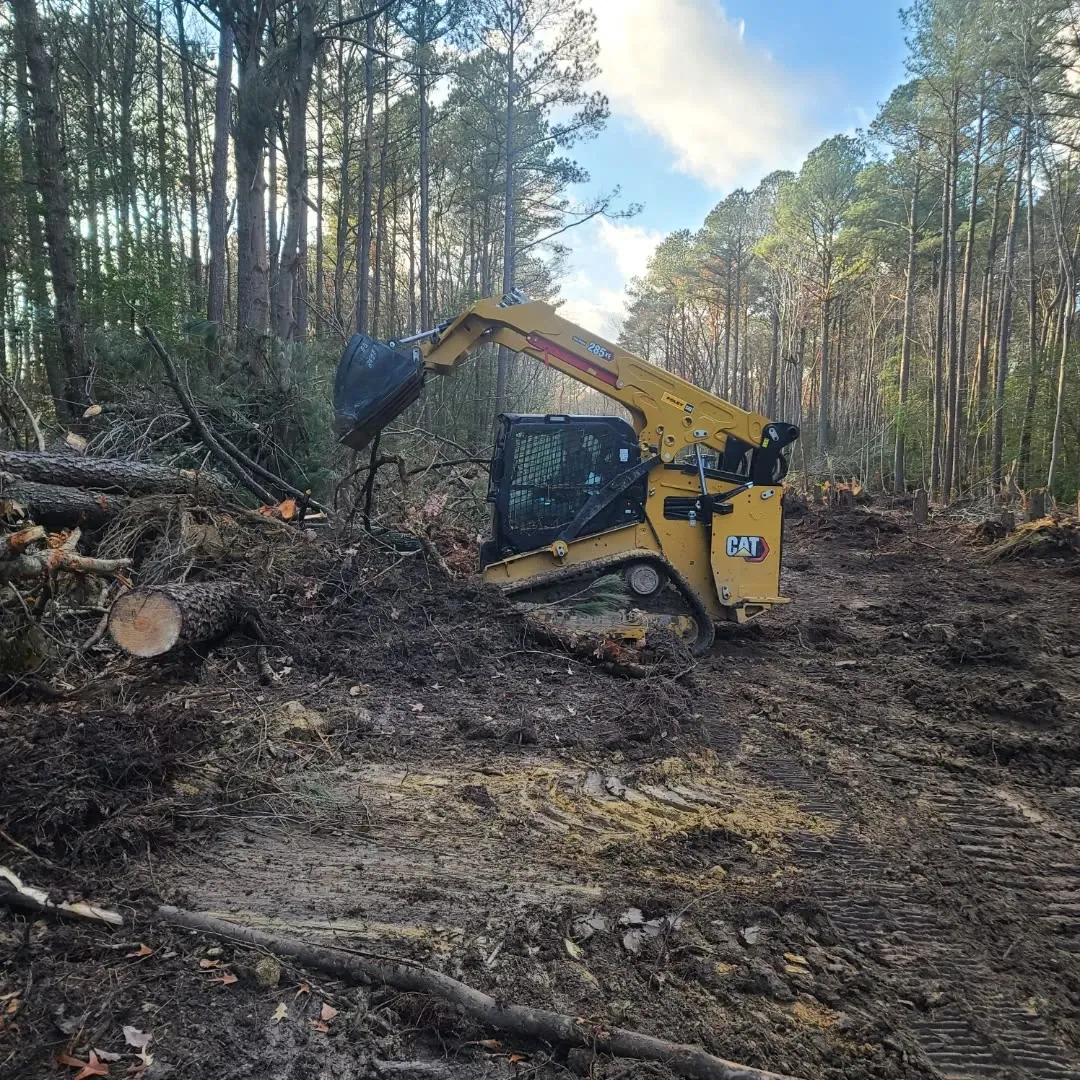
We mulch greenbrier thickets in place with a drum mulcher on our flagship Cat 285XE, and use the BRX418 brush cutter along fence lines, trail margins and edges the mulcher cannot reach. The rock grapple pulls tangled canes and debris out of the way. Nothing is burned, and the Forest Service reports that greenbrier sprouts vigorously from rhizomes after fire.
We are plain about what mulching does. It removes the top growth, the thorns and the tangle, so the ground and fence line can be seen and used again. It does not remove the rhizomes. The Forest Service says rhizomes persist for years after the plant has been top-killed by fire or other disturbance. A cleared thicket is a good start, not an end.
Chemical control is hard on this plant. The Forest Service says greenbriers are resistant to most herbicides, and cites a case where foliage looked normal and healthy two years after a late-summer application. If an owner wants chemical follow-up, it is done by a licensed applicator, and we name no products.
Timing by season
| When | Step | What happens |
|---|---|---|
| Late fall through winter | Cut and mulch | The leaves are deciduous, the ground is firm, and the thicket is easy to see and reach. The berries persist into winter as bird food, so decide with us which patches to leave. |
| Spring | Check regrowth | The Forest Service says annual growth is completed in a short time in spring. Walk the cleared area early and mark where shoots are returning. |
| Summer into fall | Regrowth pass | Cut back what returned and look for new seedlings where light reached the soil. Fruit ripens in the fall. |
This is the typical shape. Your dates, the number of passes and the finish standard are set on the site walk and written into the plan.
Regrowth and follow-up visits
Expect sprouts from the rhizome mat the first spring. The Forest Service gives one Connecticut figure of about 10 inches of radial clone expansion a year on mesic shrub sites, and notes that on dry sites the clones shrank, so results depend on the ground. It is a reminder that a thicket does not stand still.
We schedule return passes to cut young shoots before they are thorny canes again, and to catch seedlings from the new light. The count depends on how dense the rhizome mat was and on how much of the canopy was opened. It is written into the plan after the site walk.
What the owner can do
- Decide early which patches you want to keep for wildlife, and mark them before the crew arrives.
- Do not burn it. The Forest Service reports vigorous sprouting after fire.
- Photograph the cleared edge each spring so the rate of return is easy to see.
- Ask for the regrowth pass to be booked in the plan, since a single cut is rarely the end.
- Tell us which fence lines and trails must stay open, so those edges get the first return visits.
Questions about greenbrier
Sources: USDA Forest Service, Fire Effects Information System, Smilax rotundifolia (roundleaf greenbrier). Chemical-control notes are general; Huntly confirms the scope of each site on the walk.
Is greenbrier an invasive plant?
No. The USDA Forest Service lists roundleaf greenbrier as native and noninvasive. It becomes a problem when thickets block fence lines, trails and field edges, which is why the work is thicket control and not eradication.
Will mulching greenbrier kill it?
No. Mulching removes the top growth, but the Forest Service says rhizomes persist for years after the plant is top-killed. Expect sprouts the next spring and plan on return visits to cut them while they are young.
Why does greenbrier come back after clearing?
It regrows from rhizomes and from seed. The Forest Service says seeds often germinate when disturbance lets more light reach the soil, so clearing can start a new flush. A follow-up plan deals with both.
Can fire or herbicide clear greenbrier?
Neither is dependable. The Forest Service reports vigorous sprouting after fire and says greenbriers resist most herbicides. If you want chemical work, a licensed applicator advises on it, and we burn nothing.
More about Greenbrier (catbrier)
Regulatory notes are general guidance; Huntly confirms the rules that apply to each site before work.
How do I tell greenbrier from multiflora rose in Chester County, PA?
Greenbrier has glossy heart-shaped leaves, curling tendrils and a green, thorny stem that stays green year-round. Multiflora rose has compound leaves with fringed bases and arching canes. Pennsylvania lists multiflora rose as a Class B noxious weed and greenbrier isn't listed. We mark each on the site walk.
Does greenbrier change the price of clearing in Delaware?
Yes. Thorny tangles wrap equipment, slow hand work and can bring down limbs, so allow more machine time. Price follows density, how high the vines climb and access. Because greenbrier is native, we also ask whether you want it cut back or fully cleared. You get it in writing after the site walk.
What season is best for clearing greenbrier in PA and DE?
As general guidance, dormant-season mulching works well because bare ground is firmer and the thorny mats are easier to see through. Regrowth comes from the underground stems, so the cut doesn't end the plant. A follow-up visit the next growing season keeps it from rebuilding.
Is greenbrier worth keeping on my property in New Castle County, DE?
Often yes, away from the work areas. It's a native vine that gives dense cover and berries for wildlife, and it isn't on either state's invasive list. Trouble comes when it chokes a pasture edge or blocks a lane. We usually thin it where you need access and leave it elsewhere.
How long until greenbrier is back after mulching in Pennsylvania?
Expect green shoots the first season because the underground stems stay alive after the above-ground tangle is ground up. Plan on follow-up visits for several seasons if you want it held back. Penn State says mowing isn't a standalone treatment for resprouting invasive shrubs, and the same logic applies here.
Who does the chemical follow-up on greenbrier?
If you want it, a licensed applicator does it, quoted as a separate visible line. Huntly runs the mulcher and does not apply herbicide ourselves. Many horse-farm clients skip chemicals and choose repeated mulching or ground and brush clearing passes instead. We'll price either route after the free site walk. Huntly confirms the rule that applies to each site before work.
Where does greenbrier grow in the Brandywine Valley?
Woodland edges, fence lines, old field margins, stream corridors and thickets that have grown up after farming stopped. It climbs shrubs and small trees and forms thorny walls. It's usually one part of a brushy mix, so we price the whole thicket together.
Call, or send the details.
(484) 486-7272hello@huntlyland.com. Send the town, rough acreage and two or three photographs. We reply with site-walk times, and a written plan follows the walk.
Delaware & coastal line: (302) 497-5263 · Main line: (484) 486-7272
Office hours Monday to Saturday, 8 a.m. to 4 p.m. On call 24/7 for storm and emergency cleanup. If anyone is in danger, call 911 first.