Plant guide
Poison Ivy Removal and Regrowth
A native vine on trunks, fence lines and open ground, cleared from the work area with tracked equipment. The skin hazard shapes the whole plan, so we treat this as a safety job first.
Poison ivy is a hazard to clear, not a plant to pull by hand. Penn State Extension says every part carries urushiol, and dead plant material does too. We cut and mulch it out of the work area with tracked equipment, burn nothing, and return for regrowth. We make no cure claims.
How to recognize it
Poison ivy (Toxicodendron radicans) is a native woody perennial vine. Penn State Extension describes leaflets in groups of three, which can be smooth, toothed or lobed. That is the quick way to separate it from Virginia creeper, another common native vine, which has leaflets in groups of five. Penn State also notes the foliage turns red.
The plant has two forms. Where it has something to climb, it grows vertically up trees, posts and structures. Where it cannot climb, it becomes a ground cover. A fence line can hold both at once, with vine on the posts and a mat underneath. If you are unsure what you have, send photographs of the leaves and the stem and we will tell you what we see before a site walk.
Why it matters locally
Penn State is clear that poison ivy is not the usual kind of weed problem. It does not compete for water and nutrients the way most weeds do. Its significance is the effect on people. All parts of the plant contain urushiol, which causes inflammation, itching and blistering on contact or when inhaled.
That makes the location the issue. A patch beside a barn aisle, a trail head, a gate, a mailbox or a wood pile is a patch that people and animals touch. Penn State adds that the oil can ride on tools, pets and clothing, so a vine you never touched can still reach you. Birds eat the fruit and spread the seed, which is how new plants can turn up along fence lines and under trees where birds perch.
How we remove it
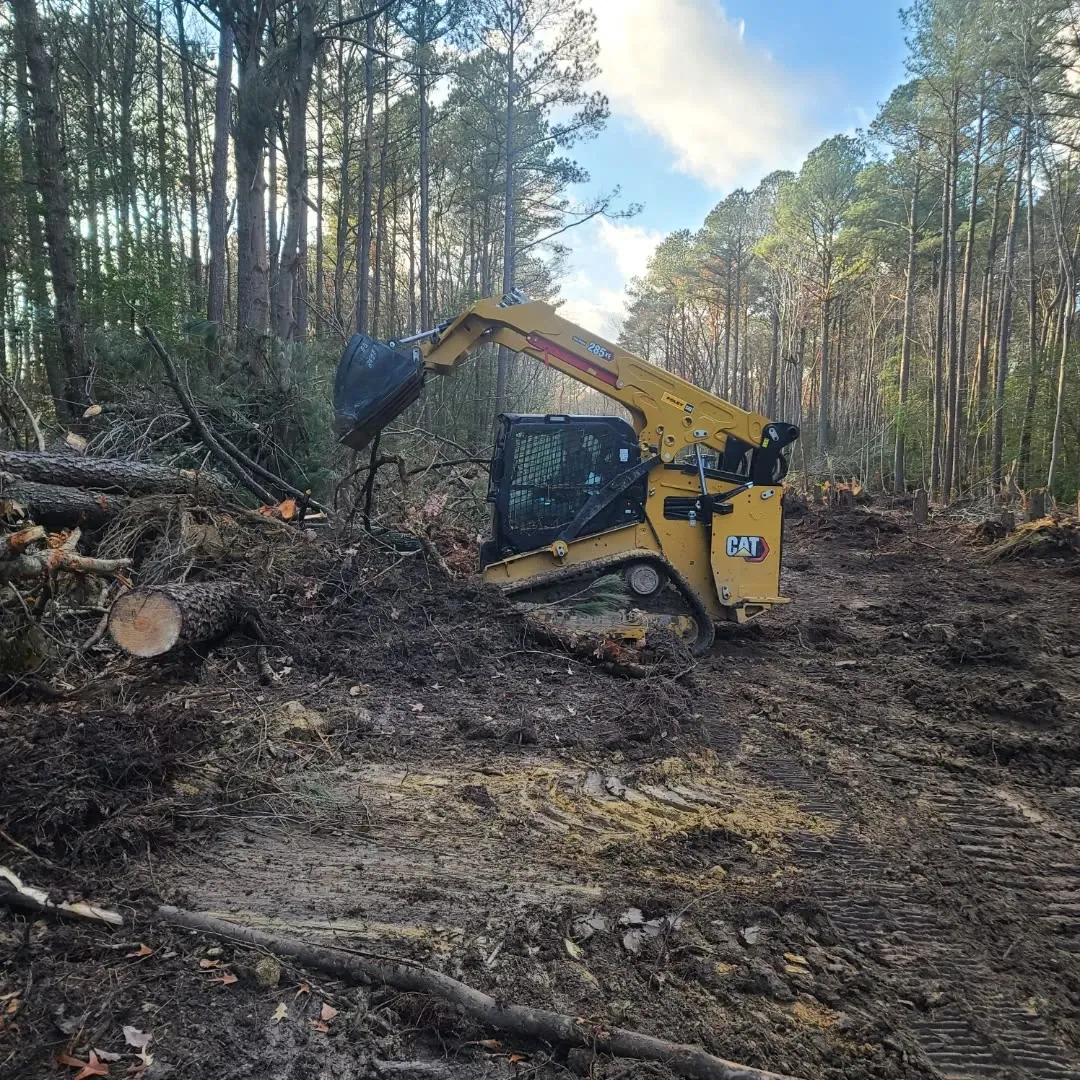
We mulch ground-level and shrub-height growth in place with a drum mulcher on our flagship Cat 285XE, and use the BRX418 brush cutter for fence lines, posts and edges the mulcher cannot reach. The rock grapple moves cut stems and debris that should not stay where they fall. Nothing is burned. Penn State warns that urushiol can be inhaled when poison ivy is burnt.
Mulching changes the plant into debris. It does not remove the hazard from the debris. Penn State says dead plant material contains urushiol too, so we treat cut vine and the mulch layer made from it as something people and pets should stay out of and not handle. Machine work keeps hands away from standing growth. It is not a promise that nothing can reach skin, and we do not describe it that way.
Limits matter here. A mulcher cannot reach vine that is attached high on a standing tree, and cutting it at the base leaves the stems on the trunk. We say so on the walk and agree on what can be done. Penn State lists goats as one option for poison ivy where the situation suits them, and herbicide options are limited. Any chemical work is done by a licensed applicator on a schedule set with you, and we name no products.
Timing by season
| When | Step | What happens |
|---|---|---|
| Late fall through winter | Cut and mulch | Dry or frozen ground is easier on equipment. Winter does not make the work safe, because Penn State says dead plant material still contains urushiol. |
| Spring | Walk and mark | Look for shoots from the old roots and new seedlings under fence lines and tree limbs where birds perch. Mark them before they spread. |
| Summer | Regrowth pass | Cut back what returned, and bring in a licensed applicator if you have chosen chemical follow-up. |
This is the typical shape. Your dates, the number of passes and the finish standard are set on the site walk and written into the plan.
Regrowth and follow-up visits
Penn State says poison ivy reproduces mainly from seed spread by birds, and that it also spreads from root stock and from stems that root against surfaces such as a tree trunk. After a cut you should expect two kinds of return: sprouts from roots left in the ground, and fresh seedlings from the next flock of birds.
For that reason the plan is a set of short return visits, not a single pass. We look at the cleared edge, mark what is coming back, and cut it while it is small. The number of visits depends on how much root was in the ground and how many perches sit nearby, and we write it into the plan after the walk.
What the owner can do
- Keep people and pets out of the cleared area and do not handle cut vine, since Penn State says the oil can be on tools, pets and clothing.
- Do not burn it. Smoke from burning poison ivy can be inhaled, and urushiol is the cause of the reaction.
- Tell us on the walk where the vine climbs trees, because that part needs a separate decision.
- Photograph patches in spring and again in summer so regrowth is easy to compare.
- For any skin reaction, ask a doctor or pharmacist. This page gives no medical advice and makes no cure claims.
Questions about poison ivy
Sources: Penn State Extension, Poison-Ivy. The hazard notes are general; this page makes no medical claims, and Huntly confirms the scope of each site on the walk.
Can poison ivy be removed without touching it?
Machine work keeps hands away from standing growth, but it is not a guarantee. Penn State says urushiol can be on tools, pets and clothing, and in dead plant material. We plan where people may stand and what gets handled, and we make no promise of zero contact.
Does mulching or cutting kill poison ivy?
No. Cutting removes the top growth. Penn State says the plant also spreads from root stock and rooting stems, so sprouts return and a follow-up plan is needed. Herbicide work, if you choose it, is done by a licensed applicator.
Is it safe to burn poison ivy?
No. Penn State notes that urushiol can be inhaled when poison ivy is burnt. We burn nothing on any job.
Is winter a safe time to clear it?
Winter is easier on the ground, but it is not safer for skin. Penn State says dead plant material contains urushiol too. Treat cut stems and mulch from the work as still carrying it.
More about Poison ivy
Regulatory notes are general guidance; Huntly confirms the rules that apply to each site before work.
How do I tell poison ivy from Virginia creeper?
Count the leaflets. Penn State Extension says poison ivy has three leaflets and Virginia creeper has five. Staghorn sumac is harmless but often blamed for rashes, and red maple seedlings can look similar in spring. If you aren't sure, treat it as poison ivy and call us before touching it.
Is poison ivy still dangerous when it's dead?
Yes. Penn State says dead plants and roots still carry active urushiol, so removing them stays hazardous for years. Clothes, tools and gloves can hold it too. Our crew washes gear and handles cut material carefully, and we don't pull vines out of trees by hand without a plan.
Why shouldn't poison ivy be cleared or string-trimmed?
Penn State says mowing and string-trimming spread urushiol-laden plant material and can create airborne particles. We mulch it with the cab closed, and the operator isn't hand-trimming it. The mulch stays on site or is hauled off, never burned. Burning is the worst thing you can do.
When is the best time to treat poison ivy so it stays gone?
Penn State says cut-stump treatment works best from late summer through autumn, when nutrients move down to the roots, and is less effective in spring. We cut or mulch first, then a licensed applicator treats regrowth, quoted as a separate visible line. Timing depends on the site.
Will poison ivy come back after forestry mulching?
Yes, usually. It regrows from small root and rhizome fragments, per Penn State. forestry mulching opens the area and clears the vines, but expect new leaves the next season. We return for a follow-up cut and your applicator can treat the regrowth. Plan on a couple of seasons.
Can you remove poison ivy from fence lines and trees?
Yes. On fences we cut the vine at the base and treat it. On trees, Penn State recommends a window cut rather than pulling the vine off, because pulling drops urushiol-laden roots and can damage the bark. We cut the vine low and leave the upper part to die back.
What does poison ivy clearing cost, and what makes it higher?
Price depends on how much vine, how high it climbs, how dense the stand is, and whether the work is hand-cleared near fences, trees or buildings. Hand work costs more than machine work. Treatment by a licensed applicator is quoted separately. You get a written price after a free site walk.
Can goats clear poison ivy instead?
Sometimes in part. Penn State notes goats aren't affected by urushiol and eat the foliage, but not the roots, and they need repeated grazing. They also don't tell poison ivy from plants you want. For heavy growth or fence lines, mechanical clearing plus follow-up is faster.
Call, or send the details.
(484) 486-7272hello@huntlyland.com. Send the town, rough acreage and two or three photographs. We reply with site-walk times, and a written plan follows the walk.
Office hours Monday to Saturday, 8 a.m. to 4 p.m. On call 24/7 for storm and emergency cleanup. If anyone is in danger, call 911 first.