Plant guide
Japanese Honeysuckle Removal and Regrowth
Twining vine matting woods edges and climbing fence rows and shrubs, cleared with tracked equipment, then watched and revisited, because cutting alone will not end it.
Japanese honeysuckle is hard to clear because ground and brush clearing and cutting alone stimulate it, according to University of Maryland Extension, and its runners can root at the nodes. We cut and mulch the mat and the brush it has climbed, then return to catch regrowth. Herbicide follow-up, where wanted, is done by a licensed applicator.
How to recognize it
Japanese honeysuckle is a twining vine. The University of Maryland notes that it climbs by wrapping around whatever it meets. The leaves are opposite, two to a node, egg-shaped, hairy, smooth-edged and about three inches long. Young stems are green and finely haired, and older stems are woody and hollow with brown bark that peels in sheds. Penn State Extension says the very fragrant white flowers appear in spring, and the University of Maryland puts bloom between April and July, with flowers tinged purple or pink that turn yellow with age. The fruit is a shiny black berry that ripens from September to November. In northern areas the vine drops its foliage, Penn State says.
It grows two ways at once. On the ground it forms dense, sprawling mats, with vines typically six to ten feet long. Vertically it climbs shrubs, fences and tree edges, occasionally to 50 feet, and the University of Maryland says it can grow more than 30 feet in a year. Bush honeysuckles such as Amur and Morrow's are separate shrubs with their own page.
Why it matters locally
The University of Maryland reports Japanese honeysuckle in all of Delaware and much of Pennsylvania. It reached Long Island in 1806 for erosion control and ornamental planting, and was also planted for deer browse and along roadsides. Delaware lists it on the Invasive Plant List in Delaware Code, Title 3, Chapter 29, and on the Delaware Invasive Species Council plant list.
It tolerates shade, which lets it work under existing woods. The University of Maryland says it often smothers and kills ground-level native plants and can kill shrubs and saplings by girdling. It also takes over fence rows, roadsides and rights-of-way. DNREC's state botanist counts 175 invasive species among Delaware's 798 non-native plants, and says invasive plants overtop, cast shade and crowd natives out over time. Fence rows, lane edges and woods borders are the places to check first.
How we remove it
Japanese honeysuckle is a hard one for a mulcher, and we say so plainly. The University of Maryland advises against mowing, because mowing stimulates growth and leads to denser mats, and Penn State notes that the climbing habit makes mowing a problem. Mulching is also a cutting method, so by itself it can leave the roots and runners alive. What it does well is open the site. It clears the vine mat, the shrubs and saplings the vines have climbed, and the thicket around them, so that regrowth is visible and reachable.
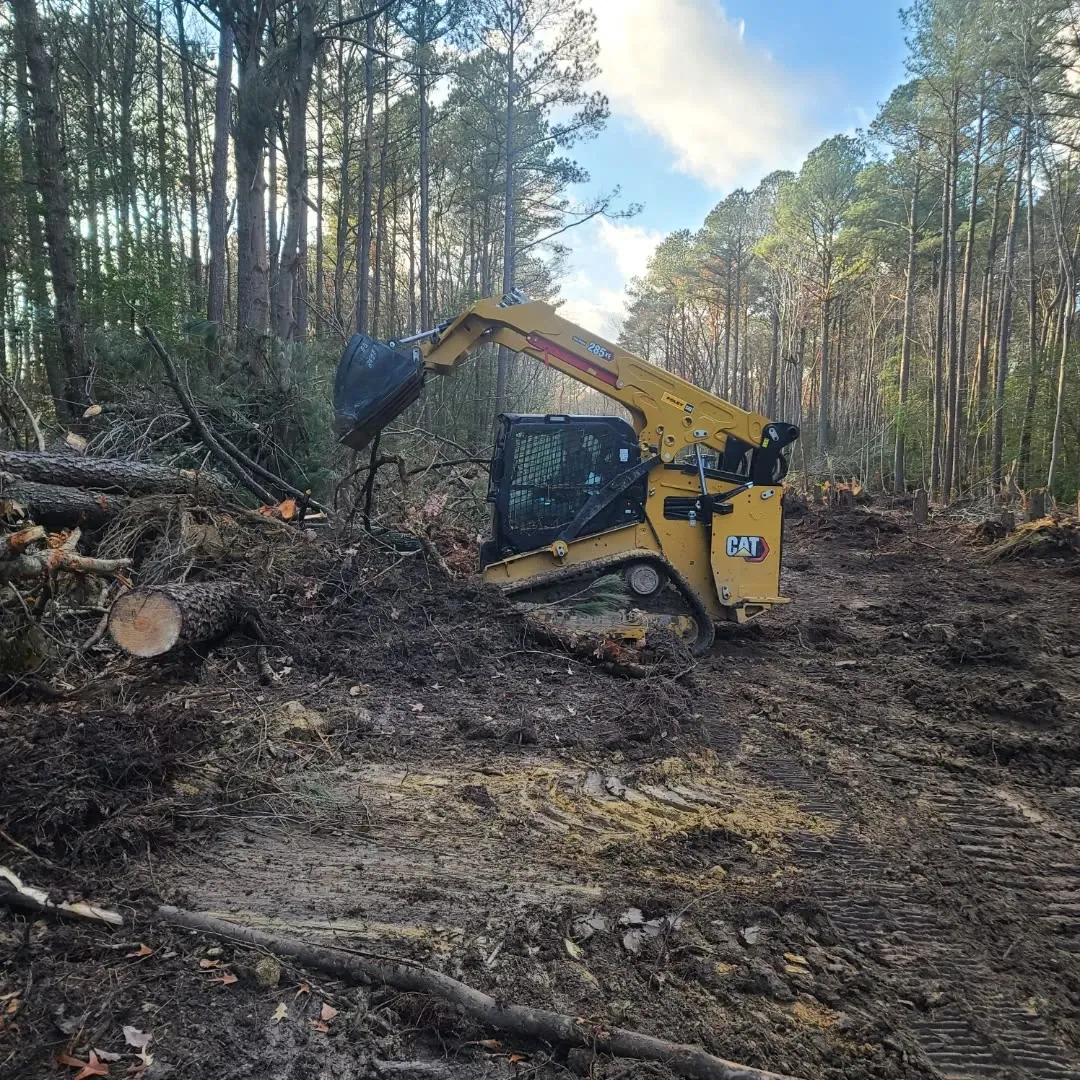
We run the drum mulcher on the Cat 285XE through mats and vine-choked brush, use the BRX418 brush cutter along fence rows and edges, and use the rock grapple to pull draped vine off the shrubs and fences that are staying.
The follow-up is what ends it. Penn State describes cutting the vines in mid to late summer, waiting for regrowth and then treating the new foliage, and also describes treating the cut wood. The University of Maryland says fall treatment is best. Those are jobs for a licensed applicator, on a schedule set with us, and a cleared site is ready for them.
Timing by season
| When | Step | What happens |
|---|---|---|
| Late fall through winter | Cut and mulch | In northern areas the vine drops its foliage, per Penn State, so fences and shrubs show what the vine is holding. Dry or frozen ground makes access easier. |
| Spring | Pull and check | Flowers open April through July. Seedlings and small plants can be pulled by hand, with any berries removed, and last year's cut areas are checked for regrowth. |
| Mid to late summer | Cut, then wait | Penn State describes cutting vines in mid to late summer and letting the plants regrow before treating the new foliage. The treatment step is for a licensed applicator. |
| Fall | Applicator window | The University of Maryland says fall treatment is best. Berries ripen September to November, so they are removed from any small plants pulled then. |
The schedule is the typical shape. Your dates, the number of passes and the finish standard are set on the site walk and written into the plan.
Regrowth and follow-up visits
Expect vines to return the first season. The University of Maryland says that whichever control method is chosen, continued monitoring is needed to find and remove re-sprouting. Seed spreads in bird and animal droppings, and Penn State says the runners can root at the nodes, so a patch can reappear from seed or from surviving runners.
We schedule return passes to catch regrowth while it is young. The number of visits depends on how thick the mat was, how much brush it had climbed and whether a licensed applicator is treating between our passes, and it is written into the plan after the site walk.
What the owner can do
- Hand-pull small patches and seedlings, and remove any berries too, as the University of Maryland advises.
- Do not rely on ground and brush clearing, and do not use goats on it. The University of Maryland says both stimulate growth and denser mats.
- Walk the fence lines and woods edges each spring and mark where the vine is climbing.
- Photograph the patch from the same spot each month so spread is easy to compare.
- Send photographs of the leaf pairs and the stem if you are not sure whether you have Japanese honeysuckle or a bush honeysuckle.
Questions about Japanese honeysuckle
Sources: Delaware Code Title 3, Chapter 29, Invasive and Potentially Invasive Plants, Delaware Invasive Species Council, Invasive Plant List, Delaware DNREC, Unseen Intruders, University of Maryland Extension, Invasives in Your Woodland: Japanese Honeysuckle, Penn State Extension, The Invasive Japanese Honeysuckle. Regulatory and chemical-control notes are general; Huntly confirms the rules that apply to each site before work.
Will forestry mulching kill Japanese honeysuckle?
Not by itself. The University of Maryland says mowing stimulates growth and denser mats, and mulching is also a cutting method, so roots and runners can survive. We clear the mat and the climbed brush, then return to cut regrowth, and any chemical follow-up is done by a licensed applicator.
Is Japanese honeysuckle the same as bush honeysuckle?
No. Japanese honeysuckle is a twining vine, while Amur, Morrow's and Tatarian honeysuckle are separate plants that Delaware also lists. The plan differs for each, so we identify which one you have first.
When should Japanese honeysuckle be cut?
We usually mulch in the dry or frozen part of the year, when fences and shrubs show what the vine is holding. Herbicide timing is separate. The University of Maryland says fall treatment is best, and a licensed applicator sets that schedule.
Is Japanese honeysuckle a problem in Chester County and Delaware?
Yes. The University of Maryland reports it throughout Delaware and much of Pennsylvania, and Delaware lists it as invasive. It shades out native ground plants and can girdle shrubs and saplings, so fence rows and woods edges are the first places to check.
More about Japanese honeysuckle
Regulatory notes are general guidance; Huntly confirms the rules that apply to each site before work.
How do I tell Japanese honeysuckle from native honeysuckle vine in Chester County, PA?
Japanese honeysuckle is a twining vine with oval leaves in pairs, white flowers fading to yellow, and black berries, and it keeps leaves into winter. Native trumpet honeysuckle has leaf pairs fused around the stem under the flowers and red tubular blooms. We mark vines on the site walk.
Does Japanese honeysuckle change the price of clearing in Delaware?
Yes. Vines wrapped around fence wire, shrubs and trunks mean hand work and cleanup before mulching, and that adds time. Price follows how much wire and structure is in the way, plus density and access. You get it in writing after the free site walk.
Does Japanese honeysuckle have look-alikes among the shrub honeysuckles?
It's easy to confuse by name. Japanese honeysuckle is a vine, while Amur and Morrow's are upright shrubs. Pennsylvania lists the shrub honeysuckles as Class B noxious weeds but not the vine; Delaware lists the vine and the shrubs. We treat them as different jobs. Huntly confirms the rule that applies to each site before work.
What season is best for clearing Japanese honeysuckle in PA and DE?
As general guidance, late fall and winter work shows the evergreen vine clearly against bare woods, and the ground is firmer. Because it holds leaves into winter, it's easy to find then. A licensed applicator may time any follow-up for the growing season, quoted separately. Huntly confirms the rule that applies to each site before work.
Will Japanese honeysuckle grow back after mulching in New Castle County, DE?
Usually, yes. The vine resprouts from cut stems and root crowns and runs along the ground. A single mulching pass reduces it but doesn't end it, so plan on follow-up visits. Chemical follow-up is done by a licensed applicator and shown as its own line.
Where does Japanese honeysuckle show up on horse farms and estates in the Brandywine Valley?
Fence lines, hedgerows, woodland edges, trails and the bases of trees, where it climbs and smothers young growth. Pasture fences with it tangled in the wire are the most common job. We often clear fence lines before new fence goes in.
Is Japanese honeysuckle covered by cost-share in Pennsylvania?
Not usually. NRCS's Pennsylvania FY26 EQIP payment is for mechanical brush management of large shrubs, and a ground vine may not qualify. Delaware is set separately. Ask NRCS before work starts. Huntly confirms the rule that applies to each site before work.
Call, or send the details.
(484) 486-7272hello@huntlyland.com. Send the town, rough acreage and two or three photographs. We reply with site-walk times, and a written plan follows the walk.
Delaware & coastal line: (302) 497-5263 · Main line: (484) 486-7272
Office hours Monday to Saturday, 8 a.m. to 4 p.m. On call 24/7 for storm and emergency cleanup. If anyone is in danger, call 911 first.