Plant guide
Canada Thistle Removal and Regrowth
A prickly, patch-forming perennial of fields, pasture edges and rough ground. Cutting helps only when it is repeated, so this page is plain about where our machines fit.
Canada thistle is a noxious weed in Pennsylvania and Delaware, and one cut will not end it. Penn State Extension says its roots reach about 6 feet deep and spread about 15 feet. Cutting must be repeated and timed before seed. In open pasture, ground and brush clearing and pasture care usually fit better than a mulcher.
How to recognize it
Penn State Extension describes Canada thistle (Cirsium arvense) as a perennial in the aster family. Young plants form rosettes of oblong to lance-shaped leaves with wavy, spiny margins. The leaf surface is smooth and not hairy, and the leaves attach directly to the stem with no leaf stalk. The stems themselves have no spines.
Flower heads are pink to lavender, about an inch or an inch and a half tall, in clusters at the stem tips. Penn State says the heads begin to form in June. Seed follows in July, each seed on a white feathery plume that the wind carries. Patches are usually dense colonies, since the plant sends up shoots from buds on the roots.
Why it matters locally
Canada thistle is a legal matter in both states. Pennsylvania's first noxious weed law, in 1862, named it, and Pennsylvania defines a noxious weed as a plant injurious to public health, crops, livestock, agricultural land or other property. Delaware designated Canada thistle a noxious weed in 1982. Delaware law makes it unlawful to knowingly allow a designated noxious weed to set seed or to reach 24 inches in height, and Delaware DNREC also lists it among its invasive non-native plants.
The Delaware rules also bar knowingly contaminating uninfested land by moving rootstocks, seed, soil, mulch or farm machinery. That matters to anyone moving equipment between fields, so tell us early where the thistle is. Penn State adds that the roots can reach 6 feet or more in depth and about 15 feet sideways, and that seeds can drift up to 0.6 mile and, in some cases, stay dormant in the soil for as long as 21 years.
How we remove it
Canada thistle is a plant where mulching is often the wrong tool. A mulcher cuts top growth the way a mower does, and Penn State says mowing one or two times a year gives the plant time to grow new foliage and keep storing food. Persistent ground and brush clearing can weaken it, especially when paired with herbicide, but Penn State also says that in many cases herbicides are needed for adequate control. In open pasture and hayfield, the work is ground and brush clearing on a schedule, pasture care and, where chosen, a licensed applicator. See the pasture reclamation page.
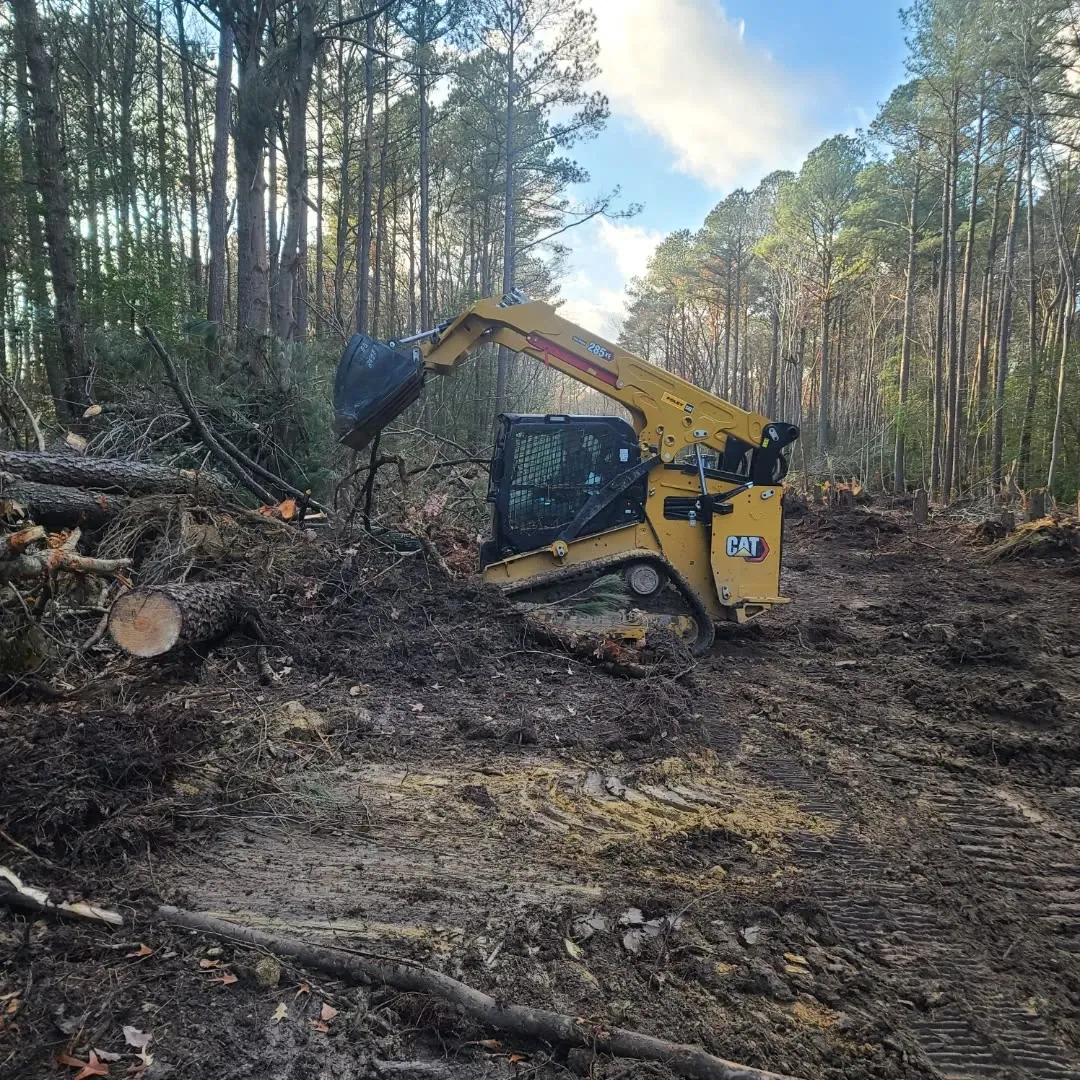
Our machines fit a narrower job. When thistle has taken over ground that has also grown up in brush, briars or rank growth too tall to clear, the Cat 285XE with the drum mulcher and the BRX418 brush cutter can bring the site down to a height where ground and brush clearing and spot work can start. The rock grapple clears cut debris. We do not claim that this removes the plant. It sets up the follow-up.
Penn State notes that dense turf or grass cover helps suppress thistle, because seedlings do poorly when shaded. A cut area that is left bare invites it back, so the plan includes what goes on the ground afterward. Chemical work is done by a licensed applicator on a schedule set with you, and we name no products.
Timing by season
| When | Step | What happens |
|---|---|---|
| Mid-April to mid-May | Walk and map | Penn State says new shoots emerge from seeds or root buds in this window in Pennsylvania. Map the rosettes so the cutting plan is tied to real patches. |
| Late spring to June | First cut | Cut before flower heads form, since Penn State says heads begin forming in June. Repeat cuts matter more than any single one. |
| July to fall | Repeat and review | Seed is usually produced in July. Keep cutting ahead of seed, and ask a licensed applicator about the late-summer or fall window Penn State describes for lawns. |
This is the typical shape. Your dates, the number of passes and the finish standard are set on the site walk and written into the plan.
Regrowth and follow-up visits
Canada thistle regrows from the root buds that Penn State describes, and from seed that has been in the soil a long time. After a cut, new rosettes appear throughout the season as long as there is moisture. That is why a single cutting day never settles the field.
We schedule return passes to keep growth down before seed, and each visit records which patches are shrinking and which are not. Delaware landowners should note the 24 inch and no-seed rule when deciding how many passes are enough. The count is written into the plan after the site walk.
What the owner can do
- Map the rosettes in spring from the same spot each year so you can see which patches are shrinking.
- Do not let it flower and set seed. In Delaware, the law bars allowing seed set or growth past 24 inches.
- Keep a dense, healthy cover of grass on cleared ground, which Penn State says helps suppress thistle seedlings.
- Do not move soil, hay or equipment out of a thistle patch into clean ground. Delaware rules address this directly.
- If you are in Delaware, ask the Department of Agriculture about compliance questions for your parcel. They set the terms.
Questions about Canada thistle
Sources: Delaware Department of Agriculture, Noxious Weeds, Delaware DNREC, Non-Native Plants of Delaware (2024), Penn State Extension, Canada Thistle, Pennsylvania Department of Agriculture, Noxious Weeds and Controlled Plants. Regulatory and chemical-control notes are general; Huntly confirms the rules that apply to each site before work.
Can Canada thistle be cleared or mulched away?
Not in one pass. Penn State Extension says mowing only once or twice a year gives the plant time to recover. Repeated, well-timed cutting can weaken it, and in many cases herbicide is also needed, which a licensed applicator handles.
Is Canada thistle regulated in Pennsylvania and Delaware?
Yes. Pennsylvania named it in its first noxious weed law in 1862. Delaware designated it a noxious weed in 1982 and bars letting it set seed or exceed 24 inches. Check with the state agriculture department for your parcel.
Is a forestry mulcher the right tool for thistle in pasture?
Usually not. A mulcher cuts top growth like a mower does. We help most where thistle sits in ground also grown up in brush or rank growth, clearing it so ground and brush clearing and follow-up can begin.
When should Canada thistle be cut?
Ahead of seed. Penn State says shoots emerge from mid-April to mid-May in Pennsylvania, flower heads begin forming in June and seed is usually produced in July. Repeated cuts before heads form matter most.
More about Canada thistle
Regulatory notes are general guidance; Huntly confirms the rules that apply to each site before work.
How do I tell Canada thistle from bull thistle in Chester County, PA?
Canada thistle spreads in patches from underground roots, has narrow, wavy, spiny leaves and clusters of small pale purple flowers. Bull thistle is a single taproot plant with big spiny leaves and larger flower heads. Pennsylvania lists both as Class B noxious weeds. We mark patches on the site walk.
Why does Canada thistle keep coming back in Delaware pastures?
It spreads by far-creeping lateral roots, so removing the top growth doesn't remove the plant. USDA Forest Service notes cutting the main shoot releases root buds, and root pieces as short as 6 millimeters can regrow. That's why the plan pairs cutting with follow-up by a licensed applicator, quoted as a separate visible line. Huntly confirms the rule that applies to each site before work.
Is Canada thistle a danger to horses or livestock?
Mostly it's a pasture-quality problem, because thistle patches spread across ground that should grow forage. We don't make toxicity claims for horses. The practical risk for a horse farm is a patchy, weedy field, which is why we map patches during the site walk and plan the clearing around grazing rotation.
What season is best to cut Canada thistle in PA and DE?
As general guidance, cut before it sets seed, which is usually summer, and repeat as regrowth appears. A licensed applicator often times treatment to follow the cutting, quoted as a separate visible line. We schedule both around your grazing calendar.
Does Canada thistle change the price of work in New Castle County, DE?
Price follows acreage, how many patches there are, ground conditions and access. Thistle in open pasture is fast machine work, so the cost driver is usually the follow-up visits rather than the cutting. You get it in writing after the free site walk, with any herbicide as a separate line.
Where does Canada thistle show up in the Brandywine Valley?
Pasture edges, hayfield corners, overgrazed or disturbed ground, roadsides, fence lines and ditch banks. USDA Forest Service lists overgrazed pastures and streambanks as typical habitat. After clearing brush from an old pasture, thistle often moves into the open ground, so we plan reseeding or ground and brush clearing and a follow-up visit right away.
Will cost-share pay for Canada thistle control in Pennsylvania?
Not usually. NRCS's Pennsylvania FY26 EQIP brush management payment is for large shrubs, not herbaceous weeds, and Delaware is set separately. Pasture plans through your conservation district may offer other help, so ask them first. Huntly confirms the rule that applies to each site before work.
Call, or send the details.
(484) 486-7272hello@huntlyland.com. Send the town, rough acreage and two or three photographs. We reply with site-walk times, and a written plan follows the walk.
Delaware & coastal line: (302) 497-5263 · Main line: (484) 486-7272
Office hours Monday to Saturday, 8 a.m. to 4 p.m. On call 24/7 for storm and emergency cleanup. If anyone is in danger, call 911 first.