Plant guide
Japanese Stiltgrass Removal and Regrowth
A shallow-rooted woodland and trail-edge grass that returns from seed every year. Cutting is timed to beat seed set, and the same ground is checked the following spring.
Japanese stiltgrass is an annual that spreads only by seed, so timing decides everything. Penn State Extension advises mechanical work from June and finishing before seed heads emerge in late August. We cut low with the brush cutter before seed set, then check the same ground every spring, because seed can stay viable for years.
How to recognize it
Penn State Extension describes Japanese stiltgrass as an annual grass that germinates in spring and dies back each fall. It forms a dense, tangled mat usually 1 to 3 feet high, sometimes up to 6 feet. The leaf blades are lance shaped, 1 to 3 inches long, with a silvery, slightly off-center stripe down the length. A three-branched flower spike, 1 to 2 inches long, appears in late summer. The thin stems are supported by small stilt-like prop roots, and the dead stems stay over winter as a tan thatch.
The closest look-alike is native whitegrass, which has a much larger flower spike, up to 10 inches, and dense white hair at the leaf bases. Stiltgrass leaves are smooth.
Why it matters locally
Penn State calls stiltgrass a widespread invader of woodlands in the eastern United States, common along trails and roads where seed arrives. It grows in most moist habitats, including woods, floodplains, abandoned fields and roadsides. Around Chester County estates, that means wooded lane edges, riding trails, stream corridors and thinned woodlots.
It spreads exclusively by seed. Penn State says one plant can produce up to 1,000 seeds a year, the seeds move on shoes, vehicles, ATVs and logging and road-maintenance equipment, and they float along ditches and streams. Seed can stay viable in the soil for up to five years. Where deer browse heavily, Penn State notes, stiltgrass infestations tend to increase, which matters on hunt-country properties with high deer numbers.
How we remove it
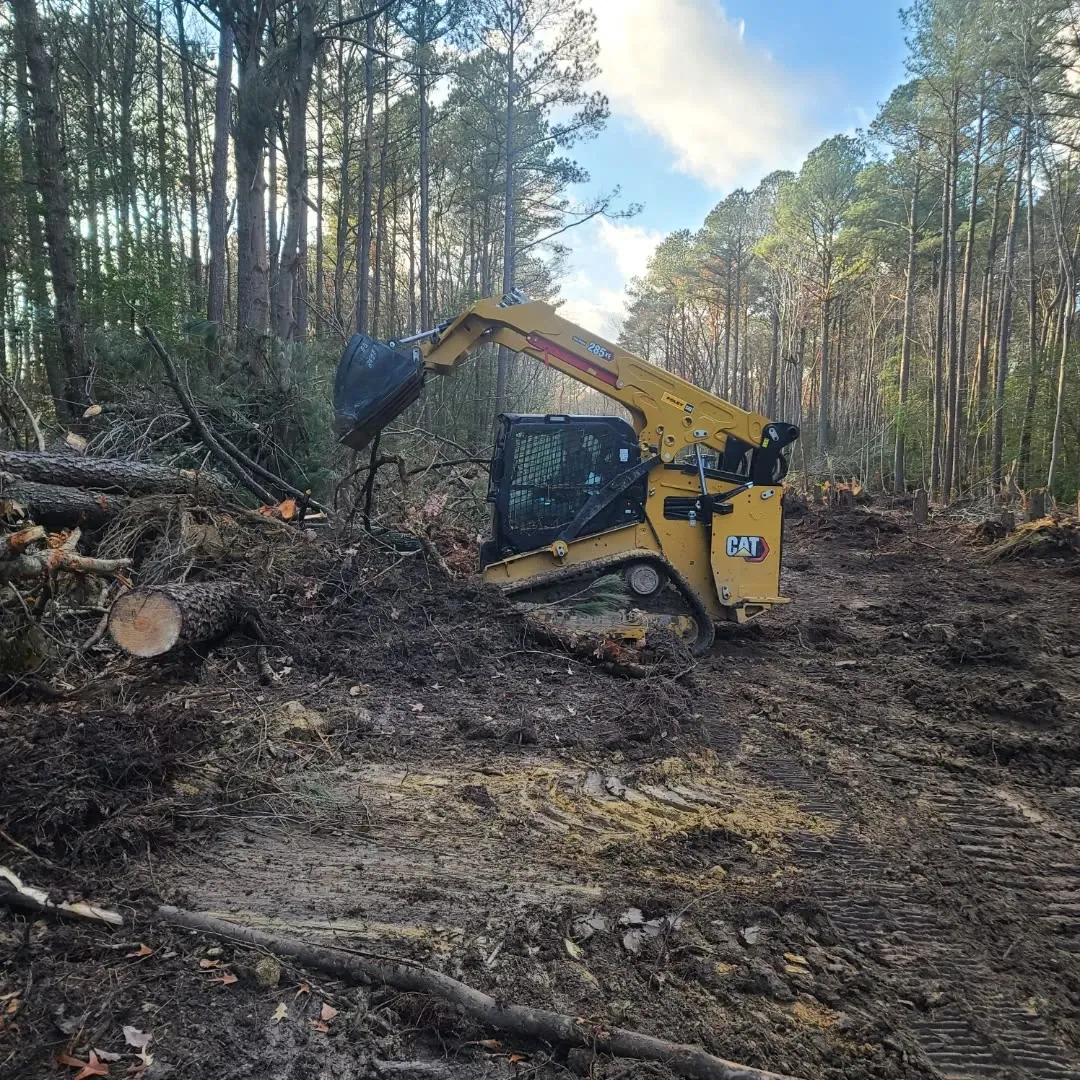
Stiltgrass has shallow roots, so the aim is not digging. It is cutting the plants before they set seed, and doing it low. Penn State says string trimming at ground level works because it removes all stem tissue, while ordinary mowing is less effective because stiltgrass regrows from the remaining stem nodes. We use the BRX418 brush cutter set low on lane edges, trail margins and open stands, and the drum mulcher where stiltgrass is mixed with brush or invasive shrubs that need clearing in the same pass.
Small pockets can be hand pulled, which is the owner-friendly option. Seed can travel on equipment, so work on infested ground is planned to avoid carrying it into clean ground. Where an owner wants herbicide, including a pre-emergent in late winter, a licensed applicator does it and the product choice is theirs.
Timing by season
| When | Step | What happens |
|---|---|---|
| Late winter through early spring | Optional applicator window | Penn State describes pre-emergent herbicides applied before germination. A licensed applicator handles this if the owner wants it. |
| June through mid-August | Cut low | Penn State advises delaying mechanical work until June to avoid a second flush of germination and finishing before seed heads emerge in late August. |
| Late August onward | Stop cutting | Once seed heads form, cutting can move seed. Mark heavy patches for next year. |
| Following spring | Walk the ground | Check where it returned and plan the next June pass. |
The schedule is the typical shape. Your dates, the number of passes and the finish standard are set on the site walk and written into the plan.
Regrowth and follow-up visits
Expect it back. Because seed can wait in the soil for several years, a good first season reduces seed production, but it does not empty the seed bank. Penn State says the cutting method may take several years to be effective in pastures because of the amount of seed already in the ground.
The follow-up is repeating the same timed cut each year, a little less each time if seed set has been stopped. Where stiltgrass is well established, Penn State recommends aiming for temporary suppression that gives native plants a window to take hold, and that works only where deer impact is low.
What the owner can do
- Hand pull small patches in summer before the seed spike forms. The roots are shallow.
- Do not clear it after seed heads appear. That spreads seed across the property.
- Wash or brush off boots, tires and equipment that have been in a stiltgrass area.
- Flag the heavy patches so we can plan the order of work and work them last.
- Think about deer. Penn State links heavy browsing to worse stiltgrass, so fencing or deer reduction may matter as much as cutting.
Questions about japanese stiltgrass
Sources: Penn State Extension, Japanese Stiltgrass, Penn State Extension, Japanese Stiltgrass in Pastures. Regulatory and chemical-control notes are general; Huntly confirms the rules that apply to each site before work.
Can stiltgrass be removed in one season?
Rarely. It is an annual that returns from seed, and Penn State Extension says seed can stay viable in the soil for up to five years. Stopping seed set each year wears the seed bank down over several seasons.
When should stiltgrass be cut?
Penn State advises delaying mechanical operations until June and completing them before seed heads emerge in late August. Cutting too early invites a second flush, and cutting too late can spread seed.
Is ground and brush clearing enough for stiltgrass?
Ground and brush clearing alone is weaker than cutting at ground level. Penn State says stiltgrass regrows from remaining stem nodes, so we cut low with the brush cutter and check the same ground the following year.
Can I do anything myself?
Yes. Small patches can be hand pulled because the roots are shallow, and cleaning boots, tires and equipment keeps seed from moving. For acreage, call us and we will plan the timing on a site walk.
More about Japanese stiltgrass
Regulatory notes are general guidance; Huntly confirms the rules that apply to each site before work.
How do I tell Japanese stiltgrass from native whitegrass in Chester County, PA?
Stiltgrass has smooth lance-shaped leaves with a silvery, slightly off-center stripe and thin stems that root at the nodes. Native whitegrass has a much larger flower spike, up to 10 inches, and dense white hairs at the leaf bases. Native grass leaves are usually rough along the blade.
How long do stiltgrass seeds last in the soil in Delaware?
Penn State Extension says seeds can stay viable up to five years, and one plant can produce up to 1,000 seeds a year. That's why one summer of control doesn't finish the job. The goal is to stop new seed every year until the soil seed supply runs down.
Why isn't a mulcher the right tool for stiltgrass in New Castle County, DE?
Stiltgrass is a low annual grass. Penn State notes mowing is less effective than string trimming because plants regrow from nodes left behind. A mulcher is for brush; we bring it where brush has to be cleared first. For the grass, the plan is cutting at ground level and repeating.
Can machines spread stiltgrass seed in Pennsylvania?
Yes. Penn State names logging and road maintenance equipment and contaminated soil on heavy equipment as ways stiltgrass spreads, and it often starts along roads and trails. We clean tracks and attachments between infested and clean sites, and we stay out of seeding patches in late summer.
Does cost-share pay for stiltgrass control in Delaware?
Not usually. NRCS's Pennsylvania FY26 EQIP brush payment is for large shrubs, not annual grasses, and Delaware is set separately. Local conservation district programs may help in some cases. Ask first. Huntly confirms the rule that applies to each site before work.
Where does stiltgrass show up in the Brandywine Valley?
Trail edges, woodland floors, floodplains, abandoned fields and roadsides. Penn State says in woodlands it is common near roads and trails. After woodlot clearing it often fills the opened, disturbed ground, so we plan seasonal follow-up.
Call, or send the details.
(484) 486-7272hello@huntlyland.com. Send the town, rough acreage and two or three photographs. We reply with site-walk times, and a written plan follows the walk.
Delaware & coastal line: (302) 497-5263 · Main line: (484) 486-7272
Office hours Monday to Saturday, 8 a.m. to 4 p.m. On call 24/7 for storm and emergency cleanup. If anyone is in danger, call 911 first.