Plant guide
Phragmites (Common Reed) Removal and Regrowth
Tall reed stands along ditches, ponds, marsh edges and wet field corners, cut and mulched with tracked equipment, then watched and revisited. Wet ground brings approvals, so those are settled first.
Phragmites cannot be removed with one cut. Delaware DNREC says mowing or burning alone fails because rhizomes reaching three feet deep and more than 30 feet out resprout. We cut and mulch the stand, then return to the thick patches on a schedule. Herbicide work is done by a licensed applicator, and wetland approvals come first.
How to recognize it
Phragmites is a tall perennial grass that grows in dense, plume-topped stands, often taller than a person, along ditches, pond edges, tidal marsh, drainage swales and wet corners of hayfields. The seed heads are large, feathery plumes in late summer and fall, and dead gray stalks stand through winter.
Delaware DNREC points out that two types exist. The non-native type is dark green with a rough, non-shiny stem, keeps its leaf sheaths, and tends to grow taller and denser. The native type is lighter green with a smooth, shiny stem and sheds its leaf sheaths. If you are unsure, send photographs of the stem and the plume and we will say what we see before a site walk.
Why it matters locally
On the Delaware coast and in tidal and freshwater marsh edges, non-native phragmites can form a complete monoculture and crowd out native marsh plants. DNREC notes that the Delaware Phragmites Control Cost-Share Program, run with USDA NRCS, exists because the problem is large enough to need public help. The Pennsylvania Natural Heritage Program, part of DCNR, also lists common reed marsh as a threat to other wetland communities through clonal growth.
For a landowner in the Brandywine Valley the picture is smaller but the same: a reed stand in a retention basin, stream corner or wet paddock edge thickens every year, hides the ground, and moves toward the next wet spot. Stands in ditches and along farm lanes also block sightlines and drainage.
How we remove it
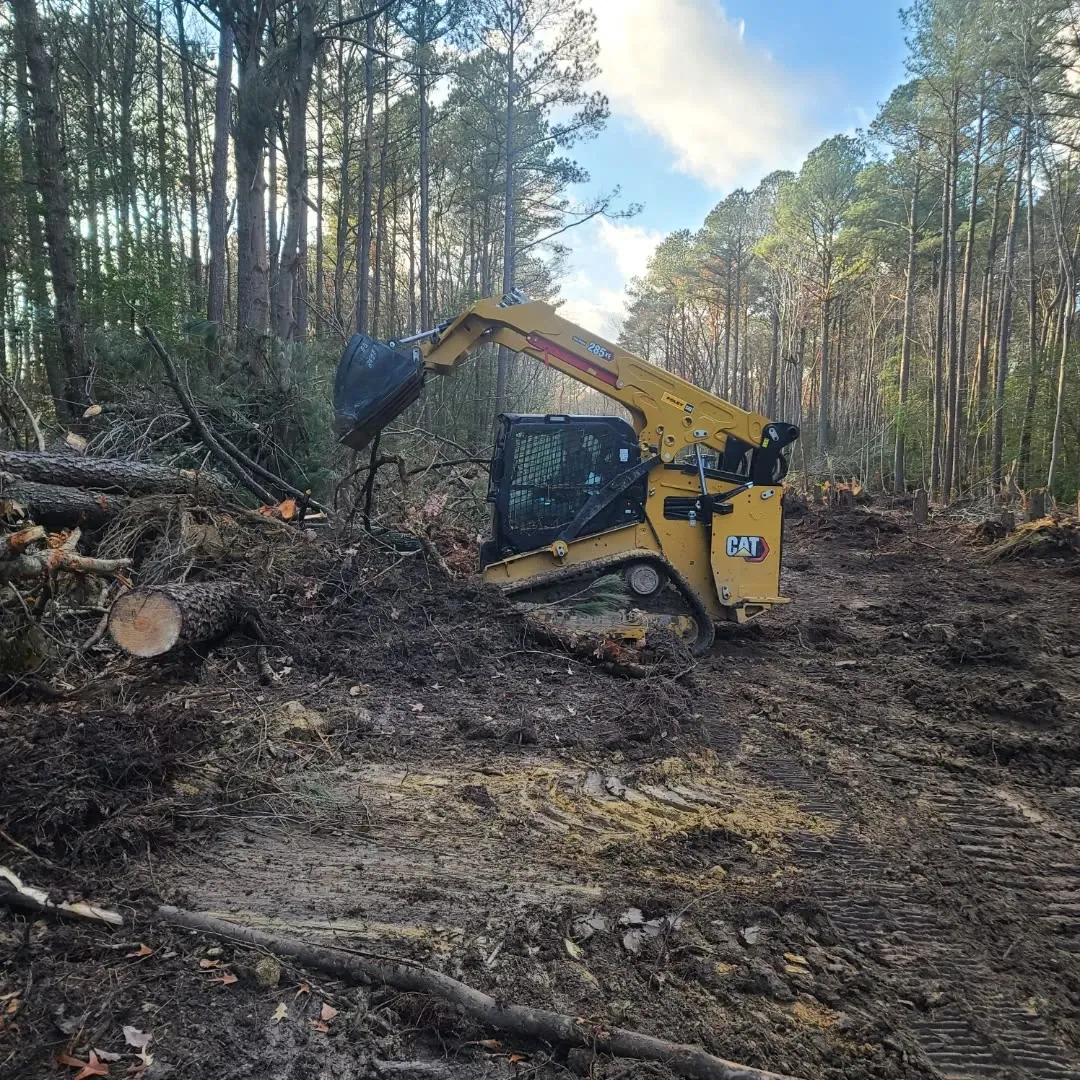
We mulch standing reed in place with a drum mulcher on our flagship Cat 285XE, and use the BRX418 brush cutter for ditch banks, fence lines and edges the mulcher cannot reach. The rock grapple moves stalks and debris that should not stay where they fall. Nothing is burned. On soft ground we pick the dry window and decide on the walk whether our tracked equipment can work the area without rutting it.
Mulching takes the stalks and the dense litter off the ground. It does not remove the rhizome network. DNREC states that rhizomes extend down as much as three feet and out more than 30 feet, which is why the first cut is the start of a plan and not the finish. Where an owner wants chemical control on the regrowth, a licensed applicator does that work on a schedule set with us, and the cut stand is ready for it.
Wet ground changes what is allowed. Before any work in or beside a wetland, stream or tidal area, the approvals that apply are confirmed with the approving body for that site, and we do not start until the owner has them.
Timing by season
| When | Step | What happens |
|---|---|---|
| Late fall through winter | Cut and mulch | Leaf-off and dry or frozen ground make the stand and its edges easy to see and easier to cross. Wet-ground approvals must be in hand first. |
| Mid to late July until first frost (Delaware) | Applicator window | DNREC says herbicide works into the rhizomes best once the plant has flowered, generally mid to late July in Delaware. A licensed applicator handles it. |
| Spring and early summer | Check regrowth | Walk the stand, mark thick patches and decide whether a regrowth pass is needed before the plants reach full height. |
The schedule is the typical shape. Your dates, the number of passes and the finish standard are set on the site walk and written into the plan.
Regrowth and follow-up visits
Expect green shoots from the rhizome mat the first spring after cutting. That is normal and it is the reason for return visits. We schedule passes to catch regrowth while it is young and to hit the thick patches that the first pass left behind. The number of visits depends on stand size, wetness and whether a licensed applicator is treating between our passes, and it is written into the plan after the site walk.
Stands rarely vanish in one season. DNREC describes the cost-share program as three consecutive years of fall treatment, which gives a sense of the multi-year scale involved.
What the owner can do
- Photograph the stand from the same spot each month so thickness and spread are easy to compare.
- Do not burn it. DNREC says burning alone does not control phragmites.
- Ask the approving body about the wet ground early. Approvals can take longer than the cutting.
- For Delaware parcels, ask DNREC about the current status of the cost-share program, since acreage limits and enrollment terms are theirs to set.
Questions about phragmites
Sources: Delaware DNREC, Facts About Phragmites, Delaware DNREC, Phragmites Control Tips, Pennsylvania Natural Heritage Program (DCNR), Common Reed Marsh. Regulatory and chemical-control notes are general; Huntly confirms the rules that apply to each site before work.
Can phragmites be cleared or mulched away in one pass?
No. Delaware DNREC states that phragmites cannot be controlled by mowing or burning alone because the rhizomes send up new shoots quickly. A mulching pass clears the stalks and litter, then regrowth is cut and watched over several seasons.
Do I need a permit to cut phragmites in a wet area?
It depends on the site. Wetland, stream and tidal ground can require approvals, and we confirm them with the approving body for that property before work starts. Send the town, rough acreage and photographs so the right agency can be identified.
When is the best time to cut phragmites?
We usually mulch in the dry or frozen part of the year when access is firm and the stand is easy to see. Any herbicide timing is separate and is set by a licensed applicator. DNREC notes that treatment works best after flowering.
Is phragmites a problem on the Delaware coast and in Chester County?
Yes in both places, though the scale differs. Delaware has large coastal marsh stands and a state cost-share program. In Chester County it more often shows up in ditches, basins and wet field corners. Both need a multi-year plan.
More about Phragmites (common reed)
Regulatory notes are general guidance; Huntly confirms the rules that apply to each site before work.
Why does Phragmites keep coming back after ground and brush clearing?
The roots do the work. Phragmites spreads from underground stems called rhizomes, so cutting the top leaves the system alive. Ground and brush clearing helps you reach the stand and removes the dead standing cane, but regrowth comes the next season. Plan on repeat passes plus a licensed applicator's treatment for a real finish.
What is the difference between Phragmites and native reed or cattail?
Phragmites stands are tall and dense with feathery seed heads. Native reeds and cattails look different up close. If you're unsure, send photos or ask at the site walk. Cutting a native stand by mistake costs a wetland its cover, so we identify first.
Who does the herbicide work on Phragmites?
A licensed applicator, not us, handles any herbicide. It's quoted as a separate visible line so you can see what the cutting costs and what the treatment costs. We cut or mulch the dead cane, and the applicator follows. We schedule both so timing works. Huntly confirms the rule that applies to each site before work.
Does the Delaware Phragmites cost-share cover mulching it?
No. The DNREC cost-share pays for helicopter spraying on properties with 5 to 200 acres of Phragmites. DNREC says it does not offer ground application or financial help for Phragmites that can't be treated by air, and tax ditches aren't eligible. Dead-cane mulching, buffers and ditch work are hired privately. Huntly confirms the rule that applies to each site before work.
What does the Phragmites follow-up visit do?
We return after regrowth shows and cut or mulch the new shoots while they're short, so the stand doesn't re-establish. If a licensed applicator has treated it, we clear the dead cane after it browns. Expect one to three seasons of follow-up on a well-rooted stand.
Does Phragmites growing in a tax ditch change who can work on it?
Yes. DNREC says Delaware has 234 tax ditch organizations and 2,000-plus miles of ditches, with a Maintenance Contractor list and form. If your ditch is a tax ditch, the organization's rules come first. Tell us at the site walk so we work with the right people. Huntly confirms the rule that applies to each site before work.
What affects the price of Phragmites clearing?
Stand density, cane height, wet or soft ground, access and whether the area is tidal or tax ditch all matter. Low-ground-pressure tracks help on soft soil but don't make it free. Treatment by a licensed applicator is a separate line. You get a written price after the free site walk.
Is it better to cut Phragmites in winter?
Often, yes. In the dormant season the ground can be frozen and drier, and the dead cane is easier to see and mulch. As general guidance, timing depends on whether treatment happens first, so we plan with the applicator. Winter cutting alone isn't a cure. Huntly confirms the rule that applies to each site before work.
Call, or send the details.
(484) 486-7272hello@huntlyland.com. Send the town, rough acreage and two or three photographs. We reply with site-walk times, and a written plan follows the walk.
Delaware & coastal line: (302) 497-5263 · Main line: (484) 486-7272
Office hours Monday to Saturday, 8 a.m. to 4 p.m. On call 24/7 for storm and emergency cleanup. If anyone is in danger, call 911 first.