Plant guide
Running Bamboo Removal and Regrowth
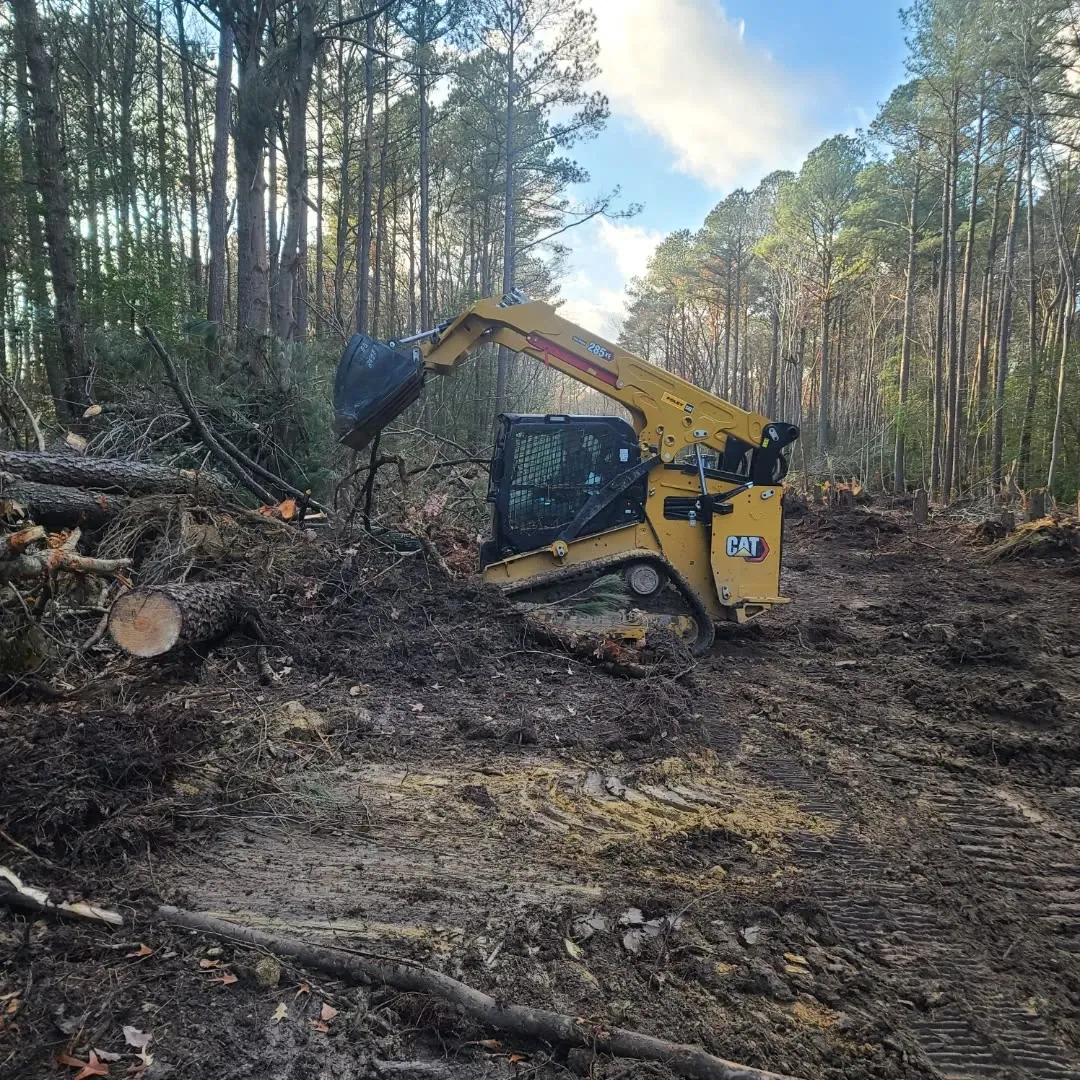
Walls of cane that started as a privacy screen and now cross property lines. Canes are cut and cleared with tracked equipment, and the rhizome edge is walked and cut back on a schedule.
Running bamboo spreads by underground rhizomes, so cutting canes does not end it. University of Maryland Extension says cut shoots must be kept off the plant for years to starve it. We cut and mulch the canes with the Cat 285XE, then walk the edge each season. Digging out rhizomes is a separate scope.
How to recognize it
Running bamboo is a large grass with woody canes, called culms, that can reach 30 feet or more. University of Maryland Extension notes the nodes are solid and the sections between them hollow, and that the leaves are slender and stay on year-round. Culms emerge from the ground at their full diameter and do not thicken later. Running types have rhizomes that spread widely and sprout canes at intervals. Clumping bamboo, in the Fargesia group, grows tightly and is considered non-invasive.
Penn State Extension points out that knotweed is often mistaken for bamboo. Knotweed dies back every winter and has broad leaves, while bamboo keeps its slender leaves and woody stems.
Why it matters locally
A typical case is bamboo planted as a screen near a lot line or garden that is now running into neighboring yards, woods and stream edges. University of Maryland Extension says several running species are invasive in the United States, that they can displace native plants in natural areas, and that rhizomes can spread a hundred or more feet in any open direction.
It is also a neighbor issue. If bamboo is coming from the next property, the same extension notes you cannot remove it completely without the adjoining owner's cooperation, so the first step may be a conversation.
How we remove it
We mulch the canes with a drum mulcher on our flagship Cat 285XE, use the BRX418 brush cutter along lot lines, fences and tight edges, and run the rock grapple to move cut canes. Cutting removes the canopy and exposes the colony edge, which is the part owners need to see.
Mulching does not remove rhizomes. University of Maryland Extension calls rhizome removal the fastest and most effective approach, but it is disruptive, usually uses excavators, leaves compacted soil and may need regrading, and any missed fragment can resprout. That is an excavation scope we write separately after the walk. For large patches the extension also advises checking with the local government about permits before digging, and using erosion control near surface water.
Where an owner wants herbicide, University of Maryland Extension treats it as a last resort, and it is applied by a licensed applicator, not by us.
Timing by season
| When | Step | What happens |
|---|---|---|
| Late fall through winter | Cut and mulch | Ground is usually firmer and there is no new flush to cut around. Mark the edge of the colony. |
| March through May | Spring flush | University of Maryland Extension says new culm growth happens in a 6 to 12 week window between March and May. New shoots are tender and easy to cut. |
| Summer | Cut hardened canes | Missed shoots harden and need cutting tools that can handle woody stems. |
| Mid-September to mid-October | Applicator window | Maryland Extension notes systemic herbicides work best then. A licensed applicator does this step, if the owner chooses it. |
The schedule is the typical shape. Your dates, the number of passes and the finish standard are set on the site walk and written into the plan.
Regrowth and follow-up visits
Expect shoots. University of Maryland Extension describes starving bamboo by repeated cutting as thorough but slow, because much of the plant's energy is stored underground. Sprouts that appear outside the cleared area, unnoticed or untreated, keep feeding the roots and undo the work.
Our follow-up passes target the spring flush and the colony edge. New culms are tender and easy to cut at first, then harden through the summer, so catching them early saves effort. The plan states how many visits we expect and where we will walk.
What the owner can do
- Check for new canes weekly during the spring flush. Maryland Extension stresses weekly checks because shoots grow fast.
- Knock tender new shoots over or cut them off before they harden.
- Keep mulch and leaf litter off the ground along the edge so emerging rhizomes stay visible.
- Talk to the neighboring owner early if the colony crosses a line.
- If you plan to keep some bamboo, ask about a deep rhizome barrier. Maryland Extension gives specifics for material and depth, and the barrier needs yearly inspection.
Questions about running bamboo
Sources: University of Maryland Extension, Containing and Removing Bamboo, Penn State Extension, Japanese Knotweed (bamboo look-alikes). Regulatory and chemical-control notes are general; Huntly confirms the rules that apply to each site before work.
Can bamboo be mulched away in one visit?
No. Mulching removes the canes, but the rhizomes stay in the ground and send up new shoots. University of Maryland Extension says starving the plant by repeated cutting takes a long time, so we plan several visits.
Do you dig out bamboo rhizomes?
Rhizome removal is a separate excavation scope that we write up after the site walk. University of Maryland Extension notes it is the fastest approach but disruptive, and missed fragments can resprout.
What if the bamboo is coming from my neighbor?
You cannot fully remove it without the adjoining owner's cooperation, according to University of Maryland Extension. We can cut your side and monitor the edge, but a barrier or a shared plan with the neighbor works better.
Is all bamboo invasive?
No. Running bamboo spreads by rhizomes and can be invasive. Clumping bamboo grows tightly and is considered non-invasive. Send photographs and we will tell you which type you have before a site walk.
More about Running bamboo
Regulatory notes are general guidance; Huntly confirms the rules that apply to each site before work.
How fast does running bamboo spread?
The Brandywine Conservancy says large running bamboos can spread about 3 to 5 feet in a year, or even 10 feet under ideal conditions. They spread by underground rhizomes, and shoots can push through cracked asphalt and foundations. Early action saves money.
How many seasons does it take to exhaust a bamboo stand?
Several. The Brandywine Conservancy says mowing must happen several times each growing season and continue for several seasons to exhaust the rhizomes. We clear the canes first, then return as shoots re-emerge. Skip the follow-ups and the stand rebuilds.
When is the best time to start clearing running bamboo?
Cut canes in fall or winter, when work is easier and the ground carries the equipment. Then plan return visits as spring shoots appear. The first spring after clearing is the most important one. A licensed applicator's treatment, if wanted, is a separate line. Huntly confirms the rule that applies to each site before work.
Can a barrier stop running bamboo?
A barrier needs proper materials, proper installation and regular maintenance, per the Brandywine Conservancy. Rhizomes that find a gap will escape. A barrier works better after the stand is cleared than as a replacement for clearing. We can clear the stand, and a landscaper can install the barrier.
Are there local rules about running bamboo in Chester County?
Some townships have them. The Brandywine Conservancy reports Chadds Ford requires running bamboo to be contained or kept at least 10 feet from property lines and rights-of-way, with fines of $100 a day. Check your township's current rules. Huntly confirms the rule that applies to each site before work.
Who handles chemical follow-up on bamboo?
A licensed applicator, quoted as a separate visible line. We cut and mulch the canes, then the applicator treats regrowth or cut stumps at the right time. We schedule the visits so the clearing and treatment line up.
Does bamboo change the price of clearing?
Yes. Thick, mature canes, large stands, rhizome mats, fences, wet ground and hauling away cane all add time. haul-off is its own line. Follow-up visits are separate lines. Every job is priced in writing after a free site walk.
Does cost-share cover running bamboo removal?
Not usually. Brush management is written around shrubs, and bamboo is a grass. Ask NRCS or your conservation district before work in case a program fits your project. Huntly quotes the clearing and follow-up either way. Huntly confirms the rule that applies to each site before work.
Call, or send the details.
(484) 486-7272hello@huntlyland.com. Send the town, rough acreage and two or three photographs. We reply with site-walk times, and a written plan follows the walk.
Delaware & coastal line: (302) 497-5263 · Main line: (484) 486-7272
Office hours Monday to Saturday, 8 a.m. to 4 p.m. On call 24/7 for storm and emergency cleanup. If anyone is in danger, call 911 first.