Plant guide
Japanese Knotweed Removal and Regrowth
Bamboo-like thickets on stream banks, road edges and old homesites, cut and mulched with the fragment risk managed, then revisited through the season and the years after.
Japanese knotweed spreads by underground rhizomes, and Penn State Extension says cutting alone does not suppress it. We cut and mulch the stand to open it up and keep stem and soil fragments from moving. Return visits catch regrowth. Herbicide work, which Penn State pairs with cutting, is done by a licensed applicator.
How to recognize it
Penn State Extension describes Japanese knotweed as an herbaceous perennial that grows up to 11 feet tall. The stems are smooth, bright green, hollow and jointed, with red or purple nodes and often darker spots, and they zigzag from node to node. Leaves are spade or heart shaped, up to 6 inches long, with a squared base. In late summer white or pale green flower clusters sprout from the nodes. New shoots in early spring are red or purple with furled, triangular leaves.
It is often confused with bamboo. Bamboo has slender, papery leaves that persist year-round and woodier stems, while living knotweed stems are herbaceous and wet when cut and the plant dies back in winter. Giant knotweed and the hybrid bohemian knotweed look similar and have larger leaves, up to a foot long.
Why it matters locally
Penn State lists Japanese knotweed as an invasive perennial and a noxious weed in Pennsylvania. It thrives on seasonally wet ground and is common on stream corridors, forest edges and drainage ditches, which describes much of the Brandywine Valley. The dense canopy excludes nearly all other vegetation, and Penn State notes it gives poor erosion control compared with native streamside plants and gradually degrades aquatic habitat and water quality.
Knotweed also damages built features. Penn State lists road and bridge foundations among the infrastructure it harms. On an estate, it tends to appear at stream crossings, old homesites and along lanes where fill or soil has been moved.
How we remove it
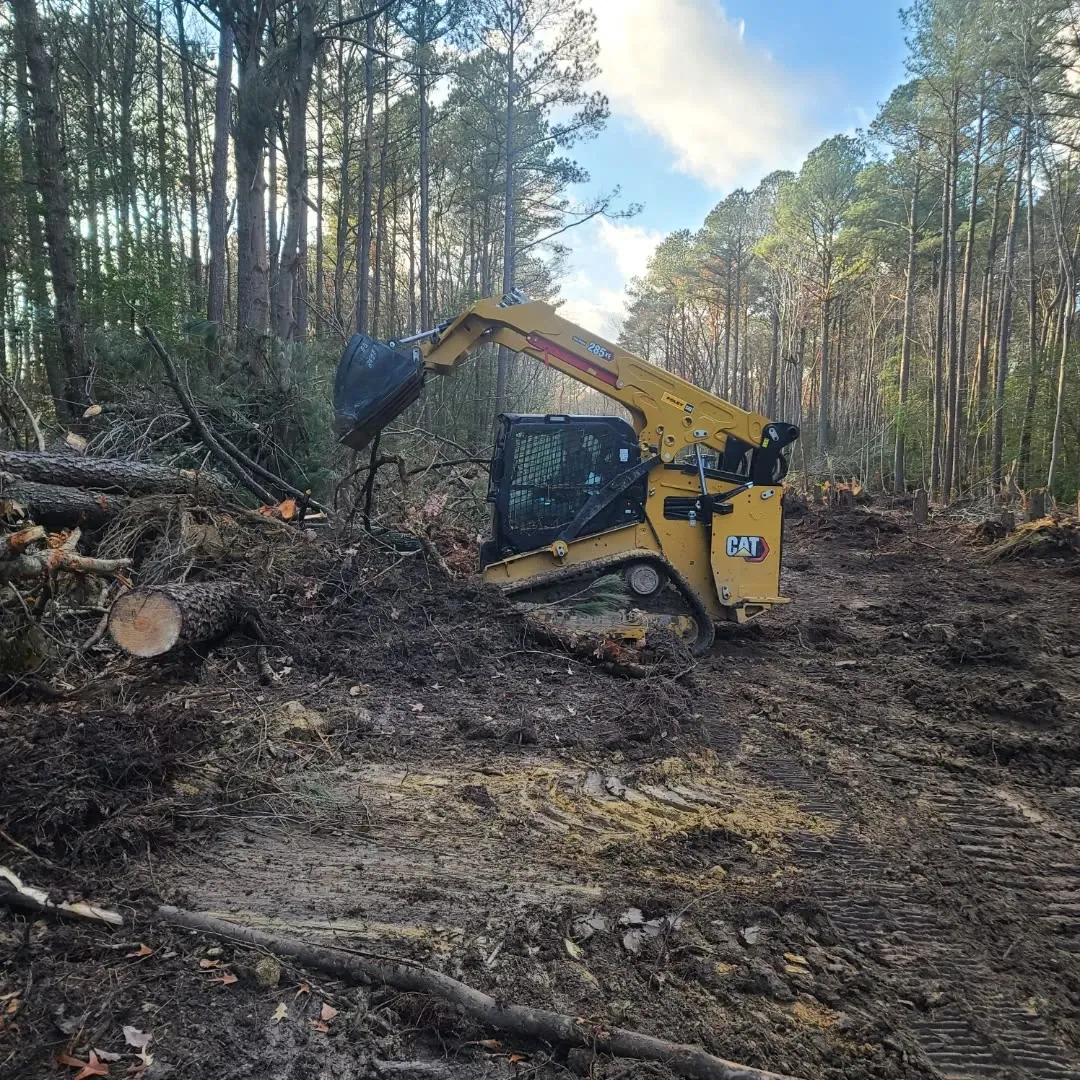
The drum mulcher on the Cat 285XE grinds the canes, and the BRX418 brush cutter handles stream banks, fence lines and tight edges. The rock grapple moves cut canes that should not stay in place. This opens the stand, removes last year's dead stems and makes the regrowth visible and short enough to treat.
Fragments are the main risk. Penn State says rhizomes split when disturbed and every fragment can form a new plant. Cut stems can also regrow if they touch moist soil, and fragments travel on floodwater or in moved soil. So digging or regrading knotweed ground is not part of a mulching scope, and the work is planned so soil and cut material are not carried out of the infested area. Excavation of rhizome soil is a separate scope, scoped on the walk.
Penn State is direct that cutting alone is not an effective suppression method. Its program pairs a June cut with a later herbicide treatment on the regrowth. We do the cutting. Any herbicide is applied by a licensed applicator.
Timing by season
| When | Step | What happens |
|---|---|---|
| Spring (shoots emerging) | Mark and map | New red shoots show exactly where the stand is. Flag the edge and any outliers. |
| June | Cut and mulch | Penn State recommends a June cut, which produces shorter regrowth, 2 to 5 feet, and removes last season's persistent stems. |
| At least eight weeks after cutting | Applicator window | Penn State says wait at least eight weeks before treating regrowth. A licensed applicator does this step. |
| Late season, before killing frost | Check and touch up | Penn State notes late-season treatment moves into the rhizomes best. We check the stand and plan next year's pass. |
The schedule is the typical shape. Your dates, the number of passes and the finish standard are set on the site walk and written into the plan.
Regrowth and follow-up visits
After the first cut, knotweed regrows. Penn State says it typically regrows 2 to 5 feet tall in the eight weeks after a June cut, and that the control phase takes at least two seasons, followed by periodic monitoring to treat new growth. We build our visits around that. A second pass catches regrowth before it shades out the edges, and later passes check the margins, where rhizomes push out new shoots.
If you see new red-tipped shoots outside the original footprint, that is the rhizome network expanding. Tell us where, because those spots shape the next visit.
What the owner can do
- Do not clear, drag or compost knotweed yourself. Cut pieces that touch moist soil can root.
- Keep soil and fill from the stand from being moved. Moved soil can carry rhizome fragments.
- Mark the stand edge with flags or stakes so every pass starts from the same line.
- Photograph new shoots outside the line each spring and send them to us.
- Near streams, ask the approving body about the rules before anything is cut. We confirm them for the site before work starts.
Questions about japanese knotweed
Sources: Penn State Extension, Japanese Knotweed. Regulatory and chemical-control notes are general; Huntly confirms the rules that apply to each site before work.
Can I mulch Japanese knotweed once and be done?
No. Penn State Extension says cutting alone is not an effective suppression approach, and the control phase takes at least two seasons. We cut and mulch the stand, then return to cut regrowth while it is young.
Does mulching spread knotweed?
It can if it is done carelessly, because rhizome and stem fragments can root in moist soil. Knotweed regrows from pieces of root and stem, so the plan avoids moving soil or cut material out of the stand, tracks and the mulcher head are cleaned on site before equipment leaves, and any digging is scoped separately.
Who applies herbicide on knotweed?
A licensed applicator. Huntly cuts and mulches, and the applicator handles any chemical control on the schedule Penn State describes, with the rules for your site confirmed first.
When is the best time to cut knotweed?
Penn State recommends cutting in June. We confirm timing on the site walk, because stream-side ground, access and any approvals can move the date.
More about Japanese knotweed
Regulatory notes are general guidance; Huntly confirms the rules that apply to each site before work.
How do I tell Japanese knotweed from native look-alikes in Chester County, PA?
Knotweed has tall, hollow, jointed stems that look like bamboo and large heart-shaped leaves on a zigzag stalk. Giant and Bohemian knotweed look similar and are also listed in Pennsylvania. Native smartweeds are smaller and softer. We confirm on the site walk before cutting anything.
When should knotweed be cut in PA and DE?
Penn State says cutting around June 1 lowers the plant's energy reserves and leaves shorter regrowth, and that mowing alone isn't effective. The licensed applicator's treatment works best later in the season, later in the season, at least eight weeks after cutting. We time the cut to that schedule.
Do I need a permit to clear knotweed on a stream bank in Pennsylvania or Delaware?
Possibly. Knotweed is common along streams, and work in or beside waterways can fall under Pennsylvania's Chapter 105 or Delaware's wetlands permit rule (7 Del. C. 6604). As general guidance, bank work needs a rule check first, and fragments floating downstream spread it. Huntly confirms the rule that applies to each site before work.
How many years does it take to clear Japanese knotweed in New Castle County, DE?
Plan on two seasons at minimum. Penn State recommends two treatments the first year and a rigorous follow-up the second, then monitoring for new growth. Mulching only opens the stand up. A licensed applicator does the chemical steps, quoted as separate visible lines. Huntly confirms the rule that applies to each site before work.
Does knotweed change the price of clearing in Pennsylvania?
Yes. Dense stands up to 10 feet tall take more machine time, stream-bank or wet ground slows access, and careful handling of cut material adds cost. Price follows stand size, ground conditions and follow-up visits. You get it in writing after the free site walk.
Where does Japanese knotweed grow in the Brandywine Valley?
Stream banks, roadside ditches, old homesites, field edges and disturbed ground, especially along creeks where floods move rhizome pieces downstream. Penn State calls it a particular problem in riparian areas. Streamside stands are the ones we handle most carefully, because moving soil or cut stems can spread it.
Call, or send the details.
(484) 486-7272hello@huntlyland.com. Send the town, rough acreage and two or three photographs. We reply with site-walk times, and a written plan follows the walk.
Delaware & coastal line: (302) 497-5263 · Main line: (484) 486-7272
Office hours Monday to Saturday, 8 a.m. to 4 p.m. On call 24/7 for storm and emergency cleanup. If anyone is in danger, call 911 first.