Plant guide
Mugwort Removal and Regrowth
A scented, spreading perennial of field edges, fence lines and disturbed ground. Mulching is the wrong tool on its own, so this page says where our machines help and where they do not.
Mulching alone will not clear mugwort. University of Maryland Extension says it tolerates mowing and spreads by extensive rhizomes, and that tilling makes it worse. We can clear the brush and rank growth around a patch, but ending mugwort takes repeated removal, smothering or applicator work over several seasons.
How to recognize it
Mugwort (Artemisia vulgaris) is an herbaceous perennial. University of Maryland Extension describes deeply dissected leaves that look like ragweed but smell strongly of chrysanthemum. Plants can reach about four feet. The flowers are small and easy to overlook, held in terminal leaf spikes from July to September.
The scent is the quickest check. Ragweed leaves can look much the same, but the chrysanthemum smell points to mugwort. If you cannot tell, send photographs of a leaf and the whole plant and we will say what we see before a site walk.
Why it matters locally
Delaware DNREC lists mugwort among the non-native plants it ranks as invasive, a species that causes environmental harm and can out-compete and displace native plants. DNREC states that its list is a reference and is not regulatory. The point for a landowner is practical. Maryland Extension calls mugwort very difficult to control, and a patch grows outward from its rhizomes.
On a Brandywine Valley property, check field edges, fence rows and any ground that was disturbed and left open.
How we remove it
Here is the honest version. Mulching and brush cutting remove top growth, and mugwort tolerates ground and brush clearing, according to Maryland Extension. In an open pasture or hayfield a ground and brush clearing or mulching pass alone will not clear it, and it is not what we would sell you as the fix. The pasture side of the problem is covered on the pasture reclamation page.
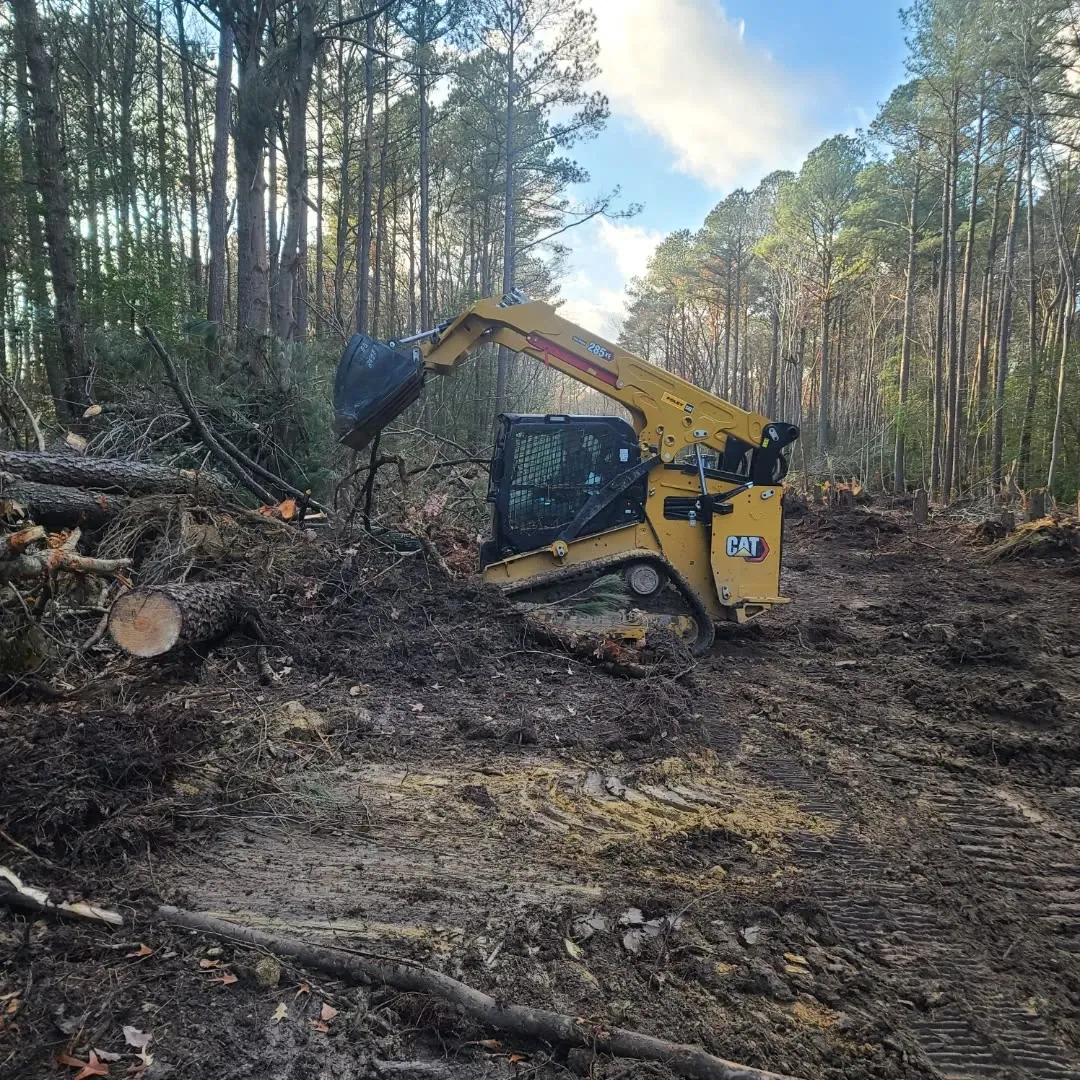
Where our equipment helps is the ground around the patch. When mugwort sits inside overgrown fence rows, brush, vines or rank growth, the Cat 285XE with the drum mulcher and the BRX418 brush cutter can open the site so the patch can be seen, mapped and worked. The rock grapple moves cut debris. We avoid any work that digs or tills the patch, because Maryland Extension warns never to till mugwort: each root piece generates a new plant.
Maryland Extension lists three ways to deal with the roots. You can smother it with black plastic or layers of newspaper covered with mulch. You can exhaust the root system by continuous pulling or removal of the leaves, which it calls difficult. Or a systemic herbicide applied with care for nearby plants, with a combination of methods called the best approach. Any herbicide work is done by a licensed applicator, and we name no products.
Timing by season
| When | Step | What happens |
|---|---|---|
| Late fall through winter | Open the site | Cut and mulch the brush and rank growth around the patch while the ground is firm, and mark the patch edge for the plan. |
| Spring and summer | Repeat removal | Maryland Extension describes exhausting the roots by continuous removal of the leaves. We set return cuts in the plan if you choose that route. |
| July to September | Watch flowering | Flower spikes appear. Photograph the patch so you can compare its size from year to year. |
This is the typical shape. Your dates, the number of passes and the finish standard are set on the site walk and written into the plan.
Regrowth and follow-up visits
Expect mugwort to come back from the rhizomes after any cut. That is the main reason to treat the first visit as the start of a plan. Maryland Extension notes that the plant spreads by extensive rhizomes and that the work is hard, so a realistic plan runs more than one season.
Each return visit is short. We look at the edge of the patch, cut what came back, and note whether it has moved outward. Whether you add smothering of small patches or applicator work between our visits is your decision, and it is written into the plan after the walk.
What the owner can do
- Do not till, disc or dig the patch. Maryland Extension says each root piece makes a new plant.
- Small patches can be smothered with black plastic, or layers of newspaper covered with mulch, as Maryland Extension describes.
- Photograph the patch from the same spot each month so the edge is easy to track.
- Do not move soil from the patch to other ground, since each root piece makes a new plant.
- Tell us on the walk whether the patch sits in pasture, since that changes what we recommend.
Questions about mugwort
Sources: University of Maryland Extension, Mugwort, Delaware DNREC, Non-Native Plants of Delaware (2024). Chemical-control notes are general; Huntly confirms the scope of each site on the walk.
Can mugwort be cleared or mulched away?
Not by itself. University of Maryland Extension says mugwort tolerates mowing and is very difficult to control. Ground and brush clearing or mulching removes top growth, so regrowth from the rhizomes is expected and the plan runs over several seasons.
Why should I not till or dig out mugwort?
Maryland Extension says never to till it, because each root piece will generate a new plant. Digging or discing can multiply the patch, so we avoid any work that turns the soil in a mugwort area.
Is mulching a good fix for mugwort in pasture?
No, not on its own. A mulching or ground and brush clearing pass in open pasture only removes top growth. We can help where mugwort sits in overgrown fence rows or brush, but the roots need repeated removal, smothering or applicator work.
How do I tell mugwort from ragweed?
Maryland Extension says the leaves are deeply dissected and similar to ragweed, but mugwort is strongly scented like chrysanthemum. Smell a leaf, and send us photographs if you are still unsure.
More about Mugwort
Regulatory notes are general guidance; Huntly confirms the rules that apply to each site before work.
Why does mugwort come back after cutting in Chester County, PA?
Mugwort spreads from underground rhizomes, so removing the top growth doesn't remove the plant. A cut patch can send up shoots again from the roots. The plan pairs cutting with follow-up by a licensed applicator, quoted as a separate visible line. Huntly confirms the rule that applies to each site before work.
What month should mugwort be cut in PA and DE?
As general guidance, cut before flowers form in late summer, then repeat as regrowth appears. Cutting is mostly to stop seed and weaken the patch. A licensed applicator times any herbicide, and we schedule our visits around your grazing and hay calendar.
Is mugwort dangerous to horses or livestock?
We don't make toxicity claims for horses or other livestock. The practical risk is a weedy, patchy pasture, since mugwort spreads in clumps and crowds out better forage. We map the patches on the site walk and plan the clearing around grazing.
Does mugwort change the price of work in New Castle County, DE?
Price follows acreage, how many patches, ground conditions and access. Mugwort in open ground is quick machine work, so the follow-up visits are the main cost. You get it in writing after the free site walk, with any herbicide shown as a separate line.
Does cost-share pay for mugwort control in Pennsylvania?
Not usually. NRCS's Pennsylvania FY26 EQIP brush payment is for large shrubs, not herbaceous weeds, and Delaware is set separately. Your conservation district may know of other help. Ask first. Huntly confirms the rule that applies to each site before work.
Where does mugwort show up in the Brandywine Valley?
Roadsides, ditch banks, old lots, field edges and disturbed ground. It is a recognized problem across the region. It often moves into ground opened by clearing, so we plan reseeding or ground and brush clearing right away.
What's the best way to clear mugwort that has spread across a pasture in Delaware?
Cut or clear at the right time, remove seed heads, and follow with treatment by a licensed applicator, repeated over seasons. Tilling or digging spreads rhizome pieces and makes it worse. Reseeding with a competitive pasture mix after clearing helps hold the ground.
Call, or send the details.
(484) 486-7272hello@huntlyland.com. Send the town, rough acreage and two or three photographs. We reply with site-walk times, and a written plan follows the walk.
Delaware & coastal line: (302) 497-5263 · Main line: (484) 486-7272
Office hours Monday to Saturday, 8 a.m. to 4 p.m. On call 24/7 for storm and emergency cleanup. If anyone is in danger, call 911 first.