Plant guide
Mile-a-Minute Vine Removal and Regrowth
Barbed annual vine smothering stream banks, road edges and fresh clearings, cut low before it seeds, then rechecked every year. Wet ground brings approvals, so those are settled first.
Mile-a-minute vine is an annual, yet it keeps returning because Penn State Extension says its seed stays viable for at least six years. The aim is to cut it low before seed ripens, ideally before July, and recheck every year. We cut with tracked equipment and plan repeat visits. Herbicide work belongs to a licensed applicator.
How to recognize it
Mile-a-minute is a trailing vine with thin, flexible stems armed with tiny hooked barbs. The leaves are bright green and shaped like triangles or arrowheads, one to three inches wide, with more barbs under the central vein and on the leaf stem. At the base of each leaf stalk, a small round, leaf-like cup called an ocrea wraps the main stem, a marker Penn State Extension points to. In late summer the vine tips carry clusters of shiny blue to purple berry-like fruit, each about a quarter inch across, with another round cup directly below the cluster.
Unlike most invasive vines, it is an annual. Penn State says it dies each fall and grows again from seed in spring. A single vine can run 20 to 30 feet, with growth of up to six inches a day at the peak of the season, and the dead barbed stems stay standing through winter as a tangled mat over whatever is underneath. Wear long sleeves and leather gloves around it.
Why it matters locally
Penn State reports that mile-a-minute was first found in Pennsylvania in York County in the 1930s, in contaminated nursery soil. It is a Class B noxious weed in the state, a designation that restricts sale and acknowledges an infestation too widespread to eradicate. Delaware also lists mile-a-minute weed on the Invasive Plant List in Delaware Code, Title 3, Chapter 29, and on the Delaware Invasive Species Council plant list.
The plant likes moist soil and full sun, which describes forest edges, roadsides, stream banks and fresh clearings. Penn State adds that forest fragmentation from development creates more of that habitat. The seed travels well. The fruit floats for up to nine days, so it can land far downstream of the parent patch. Birds and small mammals eat and move it, and Penn State notes seed also rides in contaminated soil on heavy machinery and logging equipment. Tell us where you have seen the vine before the site walk, since the order of work on a site with seed matters.
How we remove it
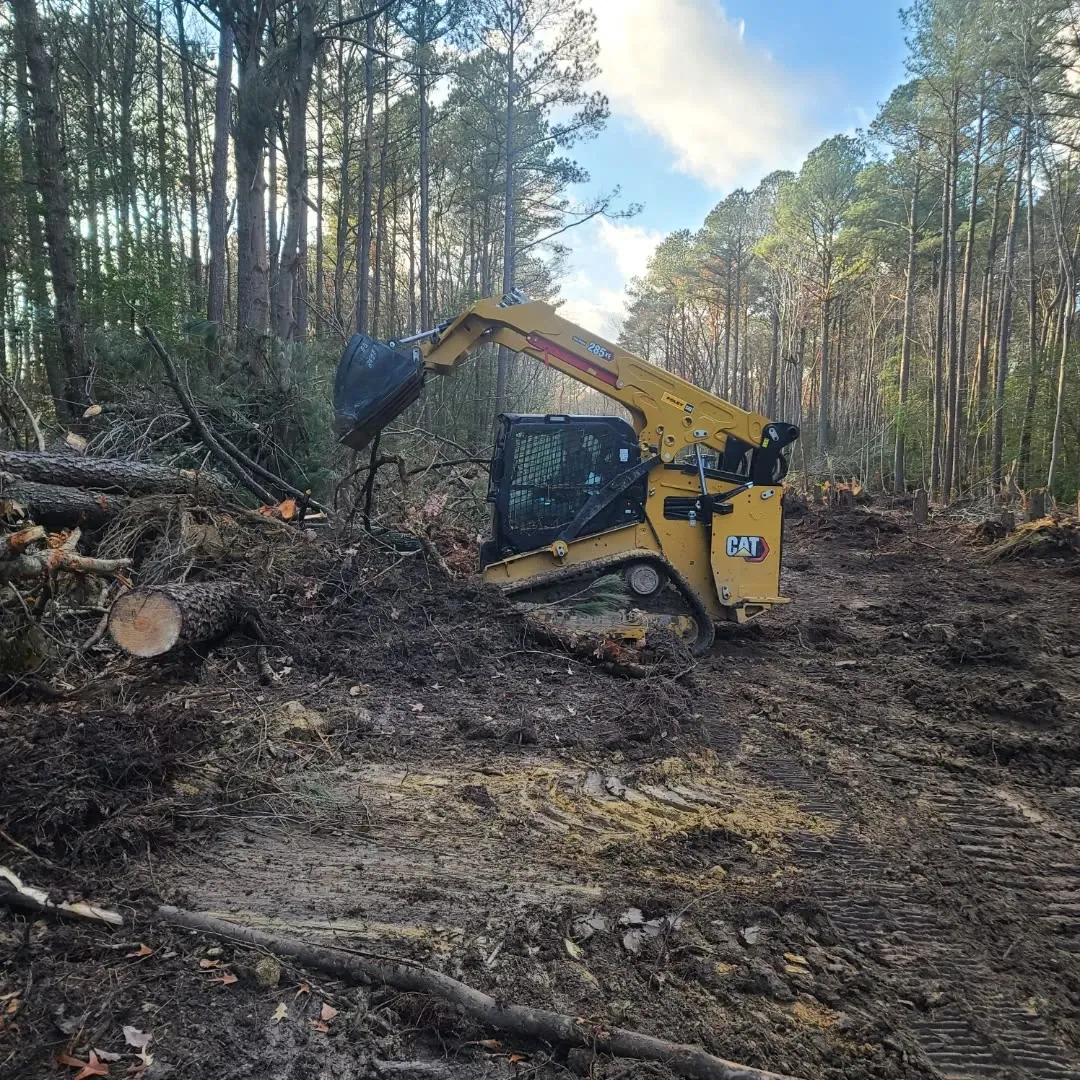
Penn State's advice for limited infestations is ground-level cutting, which it calls effective, and it warns that if some stem nodes remain after cutting the vine will likely regrow. So the job is cutting low, and cutting before seed ripens. We use the BRX418 brush cutter for the close, low cutting along stream banks, fence lines, road edges and lane shoulders, and the drum mulcher on the Cat 285XE where the vine has overtopped brush and young trees. The rock grapple lifts heavy vine mats and debris off whatever they are smothering.
Seed changes the handling. Penn State says that once fruit is on the vine, pulled plants bearing fruit should be bagged and destroyed because the fruit can keep ripening. What that means for a given patch is decided on the walk.
Penn State also describes a biological control, the mile-a-minute weevil, which feeds only on this vine. It says the weevil does not eradicate mile-a-minute but severely stunts its growth, and that sale of the weevil is regulated by USDA APHIS. It is a question for your extension office, not something we supply. Where chemical control is wanted, a licensed applicator does that work on a schedule set with us. Stream banks can fall under wetland or stream rules, so the approvals that apply are confirmed with the approving body before work starts.
Timing by season
| When | Step | What happens |
|---|---|---|
| Winter | Mark and plan | The dead barbed stems stay standing, so the outline of last year's infestation is visible. That makes it the time to map patches and plan the season. |
| Early spring to May | Seedlings emerge | Seed germinates in spring. Penn State describes preemergence work up to mid-March, which is applicator work. Small seedling patches can be pulled or cut low. |
| May to June, before July 1 | Cut low | Penn State stresses finishing control before July 1 to prevent seed production. Before June, pulled plants can be left on site to dry. This is the main window. |
| July through fall | Seed present | Penn State says that by late summer you are unlikely to affect the seed bank, and cutting mostly removes shade and releases smothered plants. Penn State says plants bearing fruit should be bagged and destroyed. |
The schedule is the typical shape. Your dates, the number of passes and the finish standard are set on the site walk and written into the plan.
Regrowth and follow-up visits
Penn State says mile-a-minute seed can stay viable for at least six years, so a site that looks clear will still produce seedlings. It also says it is unlikely you can eradicate the vine from a site even with repeated effort. Its alternative is to suppress the vine long enough for desired native plants to shade it out, with trees the best long-term option once they are tall enough that the vine cannot smother them.
That is the realistic plan: cut low before seed each year, return in spring and early summer to catch seedlings, and decide what will grow in afterward. Repeated cutting reduces or prevents seed set, Penn State notes, though it is hard work in a large infestation. The number of visits is written into the plan after the site walk.
What the owner can do
- Pull small patches before June, in long sleeves and leather gloves. Penn State says plants pulled before seed matures can be left on site to dry.
- If fruit has formed, bag and destroy the plants rather than leaving them on the ground.
- Avoid moving soil out of an infested spot. Penn State says contaminated soil is one way the seed travels.
- Check the downstream edge of a stream bank patch. Floating fruit can seed ground below it.
- Photograph the patch each spring from the same spot, and note where seedlings return.
Questions about mile-a-minute vine
Sources: Delaware Code Title 3, Chapter 29, Invasive and Potentially Invasive Plants, Delaware Invasive Species Council, Invasive Plant List, Penn State Extension, Mile-a-Minute. Regulatory and chemical-control notes are general; Huntly confirms the rules that apply to each site before work.
Mile-a-minute is an annual, so does one cut end it?
No. Penn State Extension says its seed can stay viable for at least six years, so new plants keep coming after the vines are gone. The aim is to cut low before seed forms, every year, and let shade from native trees take over in time.
When is the best time to cut mile-a-minute?
Before seed ripens. Penn State stresses finishing control before July 1. Cut low, because the vine regrows from any stem nodes left behind. Any herbicide timing is separate and is set by a licensed applicator.
Can I pull mile-a-minute by hand?
Small patches, yes. Penn State says limited infestations can be pulled easily with long sleeves and leather gloves because of the barbs. Before June, pulled vines can be left on site to dry. After fruit forms, pulled plants bearing fruit should be bagged and destroyed.
Is mile-a-minute a problem in Chester County and Delaware?
Yes. It is a Class B noxious weed in Pennsylvania and appears on Delaware's Invasive Plant List. The fruit floats for up to nine days, so a patch on one stream bank can seed ground far downstream.
More about Mile-a-minute vine
Regulatory notes are general guidance; Huntly confirms the rules that apply to each site before work.
How do I tell mile-a-minute from native vines in Chester County, PA?
Mile-a-minute has bright green triangular leaves, tiny hooked barbs on the stems and leaf stalks, round leaf-like collars at each node, and metallic blue berries in late summer. It has no true thorns. Penn State recommends long sleeves and leather gloves when pulling it.
How long do mile-a-minute seeds last in the soil in Delaware?
Penn State says seed can remain viable for at least six years, which makes eradication difficult. Because it's an annual, the target each year is to stop seed. That means cutting or pulling before seed forms, and repeating for several seasons.
What month should mile-a-minute be controlled in PA and DE?
Penn State says to finish control before July 1 to prevent seed production, with seed starting to mature around June. Pulled plants can be left to dry only before June; after that, fruiting plants should be bagged and destroyed. Late-summer cutting mainly releases the plants it smothered.
Does mile-a-minute change the price of clearing in New Castle County, DE?
Yes. Vines draped over shrubs and fences take hand work first, and wet stream-side ground slows equipment down. Price follows cover, access and how many visits the follow-up needs. You get it in writing after the free site walk.
Does the mile-a-minute weevil replace clearing in Pennsylvania?
No. The weevil feeds only on mile-a-minute and can stunt it, but Penn State says it doesn't eradicate the plant. It helps over time, and mechanical or chemical control by a licensed applicator is still needed on priority areas, quoted as a separate visible line. Huntly confirms the rule that applies to each site before work.
Where does mile-a-minute show up in the Brandywine Valley?
Forest edges, roadsides, stream banks and wet sunny openings. Penn State says it prefers moderate to high soil moisture and full sun and spreads in contaminated soil, water and machinery. We clean equipment between sites so we don't carry seed.
Can birds and water spread mile-a-minute seed in Delaware?
Yes. Penn State says fruit is eaten by birds and small mammals and floats for up to nine days. That's why infestations appear along creeks and below clearings. A yearly check of stream-side edges helps catch new patches while they are small.
Call, or send the details.
(484) 486-7272hello@huntlyland.com. Send the town, rough acreage and two or three photographs. We reply with site-walk times, and a written plan follows the walk.
Delaware & coastal line: (302) 497-5263 · Main line: (484) 486-7272
Office hours Monday to Saturday, 8 a.m. to 4 p.m. On call 24/7 for storm and emergency cleanup. If anyone is in danger, call 911 first.