Plant guide
Groundsel Tree and Marsh Elder Removal and Regrowth
Native shrubs of the salt and brackish marsh edge, thinned where they crowd lanes, ditches and sightlines and left where they protect the shore. Wet ground brings approvals, so those are settled first.
Groundsel tree and marsh elder are native shrubs of the coastal marsh edge, so the goal is management, not wiping them out. We thin or cut back stands that crowd lanes, ditches and sightlines, and leave the edge that protects the shoreline. Wet ground approvals are confirmed with the approving body first.
How to recognize it
Groundsel tree is a sturdy shrub, not a true tree. The Virginia Institute of Marine Science describes it as reaching about 15 feet, though 6 to 10 feet is typical. Its lower leaves are wedge-shaped, roughly 1.5 to 2.5 inches long, with a few irregular teeth, while the upper leaves are small and nearly smooth. The twigs are greenish and faintly ridged. It is a member of the aster family, which has few woody members in cool climates.
The easiest time to spot it is fall. Beige-yellow flower heads open in early to mid September. From late September into early winter, female shrubs turn silver-white with seed bristles, which is where the name silvering comes from. Each shrub is either male or female. Marsh elder is the lower, wetter partner in the same plant community. We sort the two from photographs and by where they stand on the slope.
Why it matters locally
These shrubs belong to the edge. VIMS places groundsel tree in the higher parts of salt and brackish marshes, right at the line where marsh meets upland, often growing with marsh elder in what it calls the saltbush community. The zones run from marsh elder at the lowest elevation, to groundsel tree, to wax myrtle at the highest. Unlike marsh elder, groundsel tree also grows in open, nontidal coastal wetlands.
That is why this page is about management and not removal. VIMS notes the shrubs give nesting cover for birds, trap flotsam and help shield nearby uplands from storm surge. The trouble for an owner starts when the same shrubs close over a farm lane, a ditch, a fence line, a boat path or the view across the water. In those spots the job is to thin or cut back, keep the shrubs that are doing the protective work, and keep the edge from marching inland and across the whole property.
How we remove it
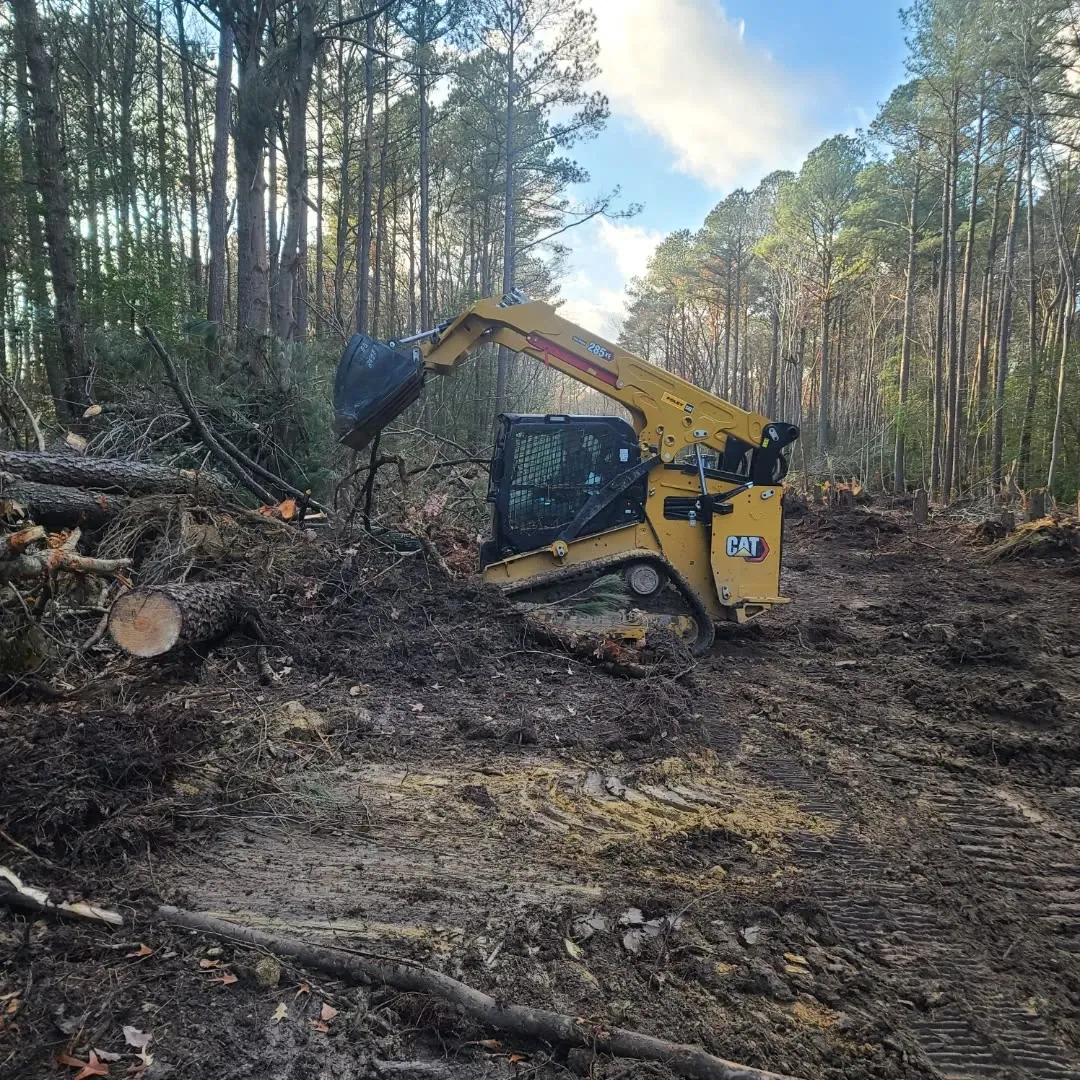
We mulch standing growth in place with a drum mulcher on our flagship Cat 285XE, and use the BRX418 brush cutter for ditch banks, fence lines and edges the mulcher cannot reach. The rock grapple moves stems and debris that should not stay where they fall. Nothing is burned. Because the stands sit on soft, salty ground, we pick the dry window and decide on the walk how close our tracked equipment can work to the marsh line.
Most of these jobs are selective. We mark what stays, which is usually the marsh-side band of shrubs, then clear a lane, widen a ditch bank or cut back a sightline. We have not found a solid published source on how hard each of these shrubs resprouts after cutting, so we do not promise a one-time result. We plan on regrowth, watch the first spring and adjust.
Wet ground changes what is allowed. Before any work in or beside a wetland, stream or tidal area, the approvals that apply are confirmed with the approving body for that site, and we do not start until the owner has them.
Timing by season
| When | Step | What happens |
|---|---|---|
| Late fall through winter | Cut and mulch | Dry or frozen ground gives the best footing near the marsh line. The shrubs are leafless or nearly so, which makes the edge easy to read. Wet-ground approvals must be in hand first. |
| Before the fall seed set | Preferred cutting limit | Female groundsel tree sheds silvery seed from late September into early winter. Where an owner wants to limit new seedlings, we aim to cut ahead of that window. |
| Spring and early summer | Check regrowth | Walk the cut line, see what came back and decide whether a trim pass is needed. |
The schedule is the typical shape. Your dates, the number of passes and the finish standard are set on the site walk and written into the plan.
Regrowth and follow-up visits
Expect new growth along cut lanes and ditch banks. These shrubs thrive at the edge, and a cleared strip is open ground for seedlings, especially under female shrubs that dropped seed. We schedule a light follow-up pass to hold the line at the width the owner chose.
The number of visits depends on how wet the site is, how wide the cleared strip is and how much seed source stands next to it. It is written into the plan after the site walk. A well-held edge usually asks for trimming, not for starting over.
What the owner can do
- Decide with us which stretch of edge stays. The marsh-side band is the part that traps debris and softens storm surge.
- Photograph the edge each fall when the female shrubs turn silver, since that shows where the seed source is.
- Do not push cut stems into the marsh or the ditch.
- Ask the approving body about work near tidal or nontidal wetland early. Approvals can take longer than the cutting.
- Mark the lane, ditch or sightline you want open with flagging tape before the site walk.
Questions about groundsel tree and marsh elder
Sources: Virginia Institute of Marine Science, Groundsel Tree wetland technical report. Delaware agency profiles for these two species were not found, so ask DNREC how it treats shrubs at the marsh edge on your parcel. Regulatory notes are general; Huntly confirms the rules that apply to each site before work.
Are groundsel tree and marsh elder invasive?
They are native to the Mid-Atlantic coast. The Virginia Institute of Marine Science treats them as part of the natural saltbush community at the marsh edge. They become a problem for owners when they crowd lanes, ditches, fence lines and views, so we manage them instead of clearing them out.
Should I remove all of it?
Usually not. VIMS notes the shrubs provide bird nesting cover, trap flotsam and help protect nearby uplands from storm surge. We thin or cut back where the stand is in the way and leave the marsh-side band that does the protective work.
When is the best time to cut them?
We usually work in the dry or frozen part of the year, when footing near the marsh is firm. Where an owner wants to limit seedlings, we aim to cut before female groundsel tree sheds seed in the fall.
Do I need approval to cut shrubs at the marsh edge?
It depends on the site. Wetland, stream and tidal ground can require approvals, and we confirm them with the approving body for that property before work starts. Send the town, rough acreage and photographs so the right agency can be identified.
More about Groundsel tree and marsh elder
Regulatory notes are general guidance; Huntly confirms the rules that apply to each site before work.
How do I tell groundsel tree from marsh elder at a Delaware marsh edge?
Groundsel tree (Baccharis) has toothed oval leaves above and turns white with fluffy seed in fall. Marsh elder (Iva) has thick, fleshy leaves with toothed edges, usually opposite each other on the stem. Both grow where upland meets the high marsh. We identify them on the site walk before any cutting.
Does cutting groundsel tree or marsh elder at a marsh edge need a wetland permit?
It may. As general guidance, work in Delaware wetlands needs a DNREC permit under 7 Del. C. 6604 unless exempt, and waterways in Pennsylvania fall under Chapter 105, so work at the marsh edge needs a rule check first. Huntly confirms the rule that applies to each site before work.
Will groundsel tree and marsh elder come back after mulching in Delaware?
Often yes. USDA Forest Service reports groundsel tree resprouts if clipped above ground, and disturbed ground lets seedlings in. Plan on a follow-up visit rather than a one-time clear. A licensed applicator handles any chemical step, quoted separately, and wet marsh edges may restrict what can be used. Huntly confirms the rule that applies to each site before work.
Is it worth keeping groundsel tree and marsh elder at the shoreline?
Often, yes. Both are native shrubs and a ragged edge of them helps hold the shoreline against waves and erosion. If the problem is a view or an access path, we cut a corridor and leave the rest. If Phragmites is the concern, we treat that separately.
Does soft wet ground change the price of marsh-edge clearing?
Yes. Soft, saturated ground needs low-ground-pressure tracks, extra time, and sometimes mats, and the work may be limited to frozen or dry periods. Price follows access, density and haul-off, and it is written down for you after the free site walk. You get it in writing after the free site walk.
Can groundsel tree clearing be combined with Phragmites control in Delaware?
Often yes, since they share the same marsh edge. DNREC's Phragmites cost-share is built around state-coordinated aerial spraying of 5 to 200 acres, and it covers Phragmites only, not shrubs. Huntly can clear shrubs and cut marsh edge, with spraying done by a licensed applicator. Huntly confirms the rule that applies to each site before work.
Where do groundsel tree and marsh elder show up in the service area?
Mostly along Delaware's tidal edges, high marsh borders, spoil banks and ditch margins in northern New Castle County. They are far less common in Chester County, PA, where inland shrub problems are usually multiflora rose, honeysuckle and autumn olive. Forest Service notes groundsel tree also colonizes fencerows and abandoned fields.
Related pages
Call, or send the details.
(484) 486-7272hello@huntlyland.com. Send the town, rough acreage and two or three photographs. We reply with site-walk times, and a written plan follows the walk.
Delaware & coastal line: (302) 497-5263 · Main line: (484) 486-7272
Office hours Monday to Saturday, 8 a.m. to 4 p.m. On call 24/7 for storm and emergency cleanup. If anyone is in danger, call 911 first.