Plant guide
Loblolly Pine and Sweetgum Thickets Removal and Regrowth
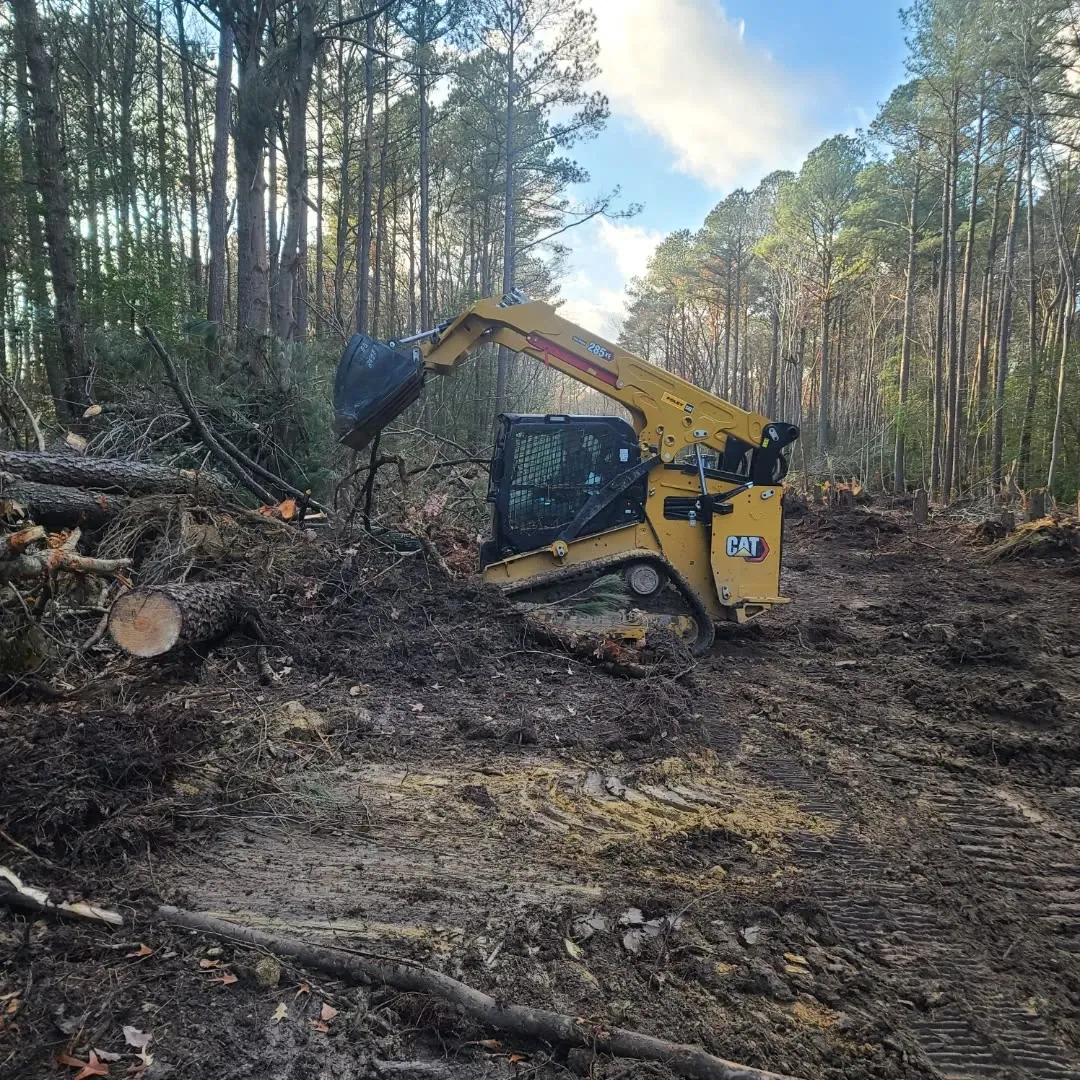
Dense young stands of pine and sweetgum that have closed over old fields, lanes and field edges, mulched in place with tracked equipment and followed up where they sprout back.
Loblolly pine and sweetgum fill idle ground quickly, and the two behave differently after cutting. Pine does not sprout back from older stumps, while sweetgum sends up sprouts from its roots. We mulch the thicket in place, then return to deal with sweetgum sprouts and new seedlings.
How to recognize it
Sweetgum is easy to know by its green, five-lobed star-shaped leaves and its spiky seed balls, which hang in clusters about 1 to 1.5 inches across. Loblolly pine is a native southern pine with long needles in bundles, and young stands grow fast. When an old field or a cleared lane is left alone, these two are often the first trees to come in, forming a thick young thicket where you could once drive a tractor.
Thickets are usually mixed. Pines stand tallest, sweetgum fills the gaps, and other hardwoods creep in underneath. A stand may look like a woodland from the road and still be only a few years old. If you are unsure what is on the ground, send photographs of the leaves, bark and seed balls and we will say what we see before a site walk.
Why it matters locally
On the coastal plain of Delaware and the Delmarva region, idle farmland and cut-over ground do not stay open. The USDA Forest Service notes that loblolly pine native range runs from southern New Jersey south to central Florida, and that stands following old-field abandonment pass through a predictable succession as hardwoods move in under the pines. Sweetgum, per the Forest Service, often pioneers old fields and logged areas in the Coastal Plain and can form nearly pure stands.
For an owner, that means a hayfield corner or a farm lane that was clear five years ago can now be a wall of young trees. These stands block access, shade out the grass, crowd fence lines and hide the property lines. They are not exotic invaders, and that matters: this is overgrown regrowth clearing, not a native plant removal fight, and the decision is about land use.
How we remove it
We mulch standing growth in place with a drum mulcher on our flagship Cat 285XE, and use the BRX418 brush cutter for ditch banks, fence lines and edges the mulcher cannot reach. The rock grapple moves stems and debris that should not stay where they fall. Nothing is burned. Young pine and sweetgum stems are well suited to a drum mulcher, and the grapple pulls out larger stems and brush piles that should not be ground in place.
The two species ask for different follow-up. The Forest Service reports that older loblolly pines do not sprout from the stump or the root collar and do not produce root sprouts, so a cut pine stays cut. Sweetgum is the opposite. It regenerates heavily from root sprouts, and one parent tree can have 40 or more stems on its root system. A mulched sweetgum stand can fill back in from the roots, which is the main reason this page has a regrowth section.
Wet ground changes what is allowed. Before any work in or beside a wetland, stream or tidal area, the approvals that apply are confirmed with the approving body for that site, and we do not start until the owner has them.
Timing by season
| When | Step | What happens |
|---|---|---|
| Late fall through winter | Cut and mulch | Dry or frozen ground gives firm footing and a clear view of the stand. Mulch ahead of seed release when possible. |
| September through early December | Seed release | The Forest Service reports sweetgum seed matures September to November and loblolly seedfall begins in October, with most seed released in November and early December. Clearing before this limits the new seed crop on the property. |
| Spring and early summer | Check sprouts | Walk the cleared ground, mark sweetgum root sprouts and new pine seedlings, and decide on a follow-up pass. |
The schedule is the typical shape. Your dates, the number of passes and the finish standard are set on the site walk and written into the plan.
Regrowth and follow-up visits
Expect two kinds of regrowth. Sweetgum sprouts will rise from the roots, sometimes all over the former stand. Pine seedlings will come in from seed. The Forest Service reports that about 96 percent of sweetgum seed lands within 200 feet of the parent, and that effective loblolly seeding reaches 200 to 300 feet downwind, so trees standing next to a cleared area keep sending seed in.
Young pine seedlings up to about 3 years old can sprout from needle buds if clipped, so very young ones should be cut low and checked again. A timely regrowth pass, while sprouts are still small, keeps them from re-forming a thicket. The number of visits is written into the plan after the site walk.
What the owner can do
- Walk the line of the cleared area and note which trees next to it are seed sources.
- Decide what you want the ground to be afterward: pasture, lane, meadow or managed woodland. That sets the follow-up schedule.
- Keep the cleared strip cleared or cut once sprouts appear, so they do not form a new thicket.
- Photograph the ground each spring so sweetgum sprout density is easy to compare.
- Tell us about wet spots, old drainage and buried fence wire before work starts.
Questions about loblolly pine and sweetgum thickets
Sources: USDA Forest Service, Silvics of North America, Sweetgum, USDA Forest Service, Silvics of North America, Loblolly Pine. Regulatory notes are general; Huntly confirms the rules that apply to each site before work.
Will loblolly pine and sweetgum grow back after mulching?
Sweetgum will. The USDA Forest Service reports heavy root sprouting, with one parent tree sometimes having 40 or more stems on its roots. Older loblolly pine does not sprout from the stump or roots, but new pine seedlings can arrive from nearby trees. We plan follow-up passes.
Are these trees invasive?
No, they are native to the region. They become a problem when they fill old fields, lanes and fence lines faster than the owner can keep up. The USDA Forest Service describes sweetgum as an old-field pioneer, and loblolly pine as a fast-growing species. This is overgrown regrowth clearing.
When is the best time to clear a pine and sweetgum thicket?
We usually mulch in the dry or frozen part of the year. The Forest Service reports that sweetgum seed matures September to November and most loblolly seed is released in November and early December, so clearing before the seed drop can limit new seedlings.
Do I need approval to clear regrowth on wet ground?
It depends on the site. Wetland, stream and tidal ground can require approvals, and we confirm them with the approving body for that property before work starts. Send the town, rough acreage and photographs so the right agency can be identified.
More about Loblolly pine and sweetgum thickets
Regulatory notes are general guidance; Huntly confirms the rules that apply to each site before work.
How do I tell loblolly pine from other pines in Delaware?
Loblolly pine carries needles in bundles of three, about 6 to 9 inches long, with spiny cones. Eastern white pine has five soft needles per bundle, and pitch pine has three shorter, stiff ones. Sweetgum has star-shaped leaves and spiky round fruit. We identify the stand on the site walk.
Will sweetgum resprout after mulching in Pennsylvania?
Sweetgum commonly sprouts from the stump and roots after cutting, so expect regrowth. Pine is different, since most pines don't resprout from stumps. A thicket of both may need a follow-up visit for the sweetgum. A licensed applicator does any chemical step, quoted as a separate visible line. Huntly confirms the rule that applies to each site before work.
Is a pine and sweetgum thicket worth keeping in New Castle County, DE?
Sometimes. Mature loblolly is a source of sawtimber, and stands give wildlife cover. A dense sapling thicket that is shading out a pasture or blocking a lane isn't worth much. We'll mark good timber to keep and thin the rest, and refer you to a forester when sawlog value matters.
Does thick sapling regrowth change the price of clearing in Delaware?
Yes. Price follows stem diameter, how dense the stand is, and whether the ground is wet. Small saplings mulch fast, while larger trunks take longer or are decked for sale or haul-off. You get it in writing after the free site walk.
Will cost-share cover pine and sweetgum thicket clearing in Pennsylvania?
Possibly for shrub-sized material. NRCS Pennsylvania EQIP cost-shares mechanical brush management of large shrubs (practice 314) at a per-acre rate set each year, but larger trees and stands may not fit. Delaware is set separately. Ask NRCS before work starts. Huntly confirms the rule that applies to each site before work.
Where do loblolly pine and sweetgum thickets show up in the service area?
Mostly old fields and pasture edges that stopped being cleared, and cleared utility corridors. Sweetgum is widespread in Delaware and the Mid-Atlantic, while loblolly is more of a southern Delaware tree. In Chester County, similar thickets are usually mixed with red cedar, red maple and other young volunteers.
Call, or send the details.
(484) 486-7272hello@huntlyland.com. Send the town, rough acreage and two or three photographs. We reply with site-walk times, and a written plan follows the walk.
Delaware & coastal line: (302) 497-5263 · Main line: (484) 486-7272
Office hours Monday to Saturday, 8 a.m. to 4 p.m. On call 24/7 for storm and emergency cleanup. If anyone is in danger, call 911 first.