Plant guide
Reed Canary Grass Removal and Regrowth
A dense, sod-forming grass of ditch banks, wet meadows and pond edges, cut and mulched with tracked equipment, then watched and revisited. Wet ground brings approvals, so those are settled first.
Reed canary grass is a tall wet-ground grass that spreads by creeping rhizomes and by seed, so one ground and brush clearing or mulching pass does not end it. We cut and mulch the stand with tracked equipment, then return to catch regrowth. Wet ground approvals are confirmed with the approving body first.
How to recognize it
Reed canary grass is a perennial grass with a hollow stem and broad, flat leaves, usually 5 to 25 millimeters wide, or up to about an inch. Mature stands stand roughly 2 to 7 feet tall and carry a narrow seed head 2 to 12 inches long. It grows in wet meadows, marshes, riparian strips and ditch banks, and in the right spot it can make up half or more of the plant cover.
The USDA Forest Service fire effects database notes that no single physical trait cleanly separates native plants from introduced ones, so a photograph does not settle the question. It is also easy to confuse with other tall wet-ground grasses. If you are unsure, send photographs of the leaf, the stem base and the seed head and we will say what we see before a site walk.
Why it matters locally
On the Sussex County side of the shore, the places this grass shows up are the ones that stay wet: drainage ditches, the edge of a farm pond, a low field corner, a swale along a lane. Once it takes hold it thickens each year, hides the ground, and moves along the wet line to the next patch.
Its status is genuinely mixed. The Forest Service reports that most North American floras list reed canary grass as native, that Pennsylvania sources consider it native, and that the aggressive populations are generally thought to be introduced European strains or hybrids. Its advice is that control decisions can rest on a stand's impact, not on its uncertain origin. We follow that: if a stand is taking over a ditch, a pasture edge or a view, it gets managed. This page leans on federal research because we did not find a Delaware agency profile for the species, so ask DNREC how it treats the plant on your parcel.
How we remove it
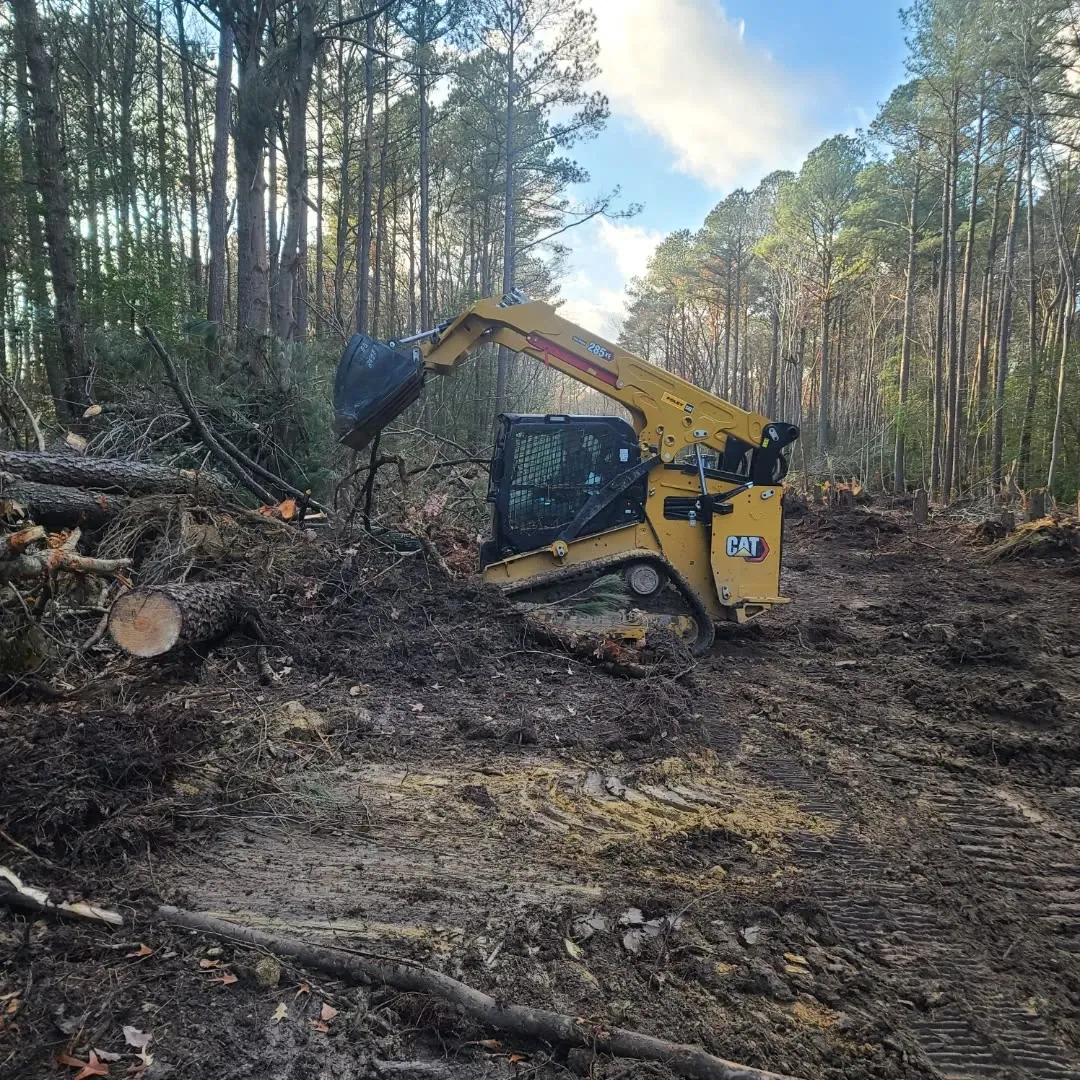
We mulch standing growth in place with a drum mulcher on our flagship Cat 285XE, and use the BRX418 brush cutter for ditch banks, fence lines and edges the mulcher cannot reach. The rock grapple moves stems and debris that should not stay where they fall. Nothing is burned. On soft ground we pick the dry window and decide on the walk whether our tracked equipment can work the area without rutting it.
Mulching removes the leaf and stem growth. It does not remove the root system. The Forest Service describes creeping, scaly rhizomes that mostly lie in the top 1 to 5 inches of soil and can knit into an almost impenetrable sod. That shallow sod is why a cut stand looks clean for a few weeks and then greens up again. The first pass is the start of a plan, not the finish.
Wet ground changes what is allowed. Before any work in or beside a wetland, stream or tidal area, the approvals that apply are confirmed with the approving body for that site, and we do not start until the owner has them.
Timing by season
| When | Step | What happens |
|---|---|---|
| Late fall through winter | Cut and mulch | Ground is dry or frozen, the stand has gone over, and ditch banks are easy to see and cross. Wet-ground approvals must be in hand first. |
| Spring | Check regrowth | The Forest Service notes new shoots develop mainly in fall and again the following spring. Walk the stand, mark the patches that greened up and decide on a follow-up cut. |
| Mid to late summer | Second look | Shoots collapse in mid to late summer and the rhizomes store energy from late summer into fall. We use that window to see how the stand is behaving before the next season. |
The schedule is the typical shape. Your dates, the number of passes and the finish standard are set on the site walk and written into the plan.
Regrowth and follow-up visits
Expect green shoots from the sod the first spring after cutting. That is normal, and it is the reason for return visits. Reed canary grass also builds a seed bank. The Forest Service reports that seed usually stays viable for more than a year, and a small share survives 20 or more years in the ground, so bare mud left by the mulcher can sprout seedlings in light and saturated soil.
The number of visits depends on stand size, wetness and how much open ground the first pass exposed. It is written into the plan after the site walk. Seed also moves on water, animals and machinery, so we walk the equipment over before it leaves a seeded patch.
What the owner can do
- Photograph the stand from the same spot each month so thickness and spread are easy to compare.
- Do not push cut material into a ditch or pond. Seed can float for a few days after it falls and will settle downstream.
- Keep boots, tires and tools clean when leaving a seeded patch, since seed travels on machinery.
- Ask the approving body about the wet ground early. Approvals can take longer than the cutting.
- Leave the cut stand alone through the first spring, then call us when the regrowth is a few inches tall.
Questions about reed canary grass
Sources: USDA Forest Service, Fire Effects Information System, Phalaris arundinacea, Delaware DNREC, Facts About Phragmites. Regulatory notes are general; Huntly confirms the rules that apply to each site before work.
Is reed canary grass the same as phragmites?
No. They are different grasses. Delaware DNREC describes phragmites rhizomes reaching three feet deep, while the Forest Service puts reed canary grass rhizomes mostly in the top few inches of soil. Reed canary grass is usually 2 to 7 feet tall. Both regrow after cutting and both need a multi-year plan.
Is reed canary grass native or invasive?
Both statements appear in the research. The USDA Forest Service says most North American floras list it as native, while the aggressive populations are generally thought to be introduced European strains or hybrids. Control decisions can rest on a stand's impact. We manage stands that take over ditches, edges and views.
Will one mulching pass be enough?
No. Creeping rhizomes form a dense sod and the plant leaves a seed bank, so green growth returns after cutting. A mulching pass clears the stems and litter, then regrowth is cut and watched over several seasons.
Do I need approval to work on a wet ditch or pond edge?
It depends on the site. Wetland, stream and tidal ground can require approvals, and we confirm them with the approving body for that property before work starts. Send the town, rough acreage and photographs so the right agency can be identified.
More about Reed canary grass
Regulatory notes are general guidance; Huntly confirms the rules that apply to each site before work.
What does reed canary grass look like?
The National Park Service describes it as a cool-season perennial grass, 2 to 9 feet tall, that sprouts early in spring. Leaves are flat, rough and tapered, the stem is hairless and upright, and seed heads start purplish and turn yellow in June and July.
How does reed canary grass spread?
By creeping rhizomes that form dense, single-species mats, and by seed, per the National Park Service. It grows in wet meadows, swamps and along streams and can dominate wetlands for decades. That's why ground and brush clearing only slows it down.
When is the best time to cut reed canary grass?
Spring green-up is the key moment, because the National Park Service says it's one of the first grasses to sprout. For small patches the NPS suggests repeat work in June and October, and any herbicide timing belongs to a licensed applicator. Frozen or dry ground keeps ruts down on wet sites. Huntly confirms the rule that applies to each site before work.
Does mulching reed canary grass kill it?
No. It cuts the top growth, but rhizomes survive and resprout. One pass won't be enough. Expect repeat cuts across seasons, and a licensed applicator's treatment, quoted as a separate visible line, is how dense mats are usually finished. We schedule both together.
Who handles herbicide on reed canary grass?
A licensed applicator, quoted as a separate visible line. We cut or mulch the stand first so the applicator can reach regrowth, and we schedule the visits around spring green-up. Near streams and ditches, the applicator confirms what's allowed. Huntly confirms the rule that applies to each site before work.
Does reed canary grass change the price of clearing?
Yes. Soft, wet ground, dense mats, ditch access and larger acreage all change the price. Low-ground-pressure tracks help on soft soil. Follow-up visits and licensed treatment are separate lines. Written price after a free site walk.
Is reed canary grass good or bad for horse pasture?
It's a tall, tough grass that forms thick mats, and in a wet pasture it can crowd out better forage. We can clear it and reseed. Ask your vet or extension office about feeding and grazing; we're not giving feed advice. We handle the clearing and footing.
Can I get cost-share to clear reed canary grass?
Not usually. DNREC's Phragmites cost-share is for Phragmites only, and brush management is written for shrubs. Ask NRCS or your conservation district before work in case a program fits your project. Huntly quotes either way. Huntly confirms the rule that applies to each site before work.
Related pages
Call, or send the details.
(484) 486-7272hello@huntlyland.com. Send the town, rough acreage and two or three photographs. We reply with site-walk times, and a written plan follows the walk.
Delaware & coastal line: (302) 497-5263 · Main line: (484) 486-7272
Office hours Monday to Saturday, 8 a.m. to 4 p.m. On call 24/7 for storm and emergency cleanup. If anyone is in danger, call 911 first.