Plant guide
Oak Saplings and Brush Clearing and Regrowth
Oak saplings, stump sprouts and brushy regrowth along fence lines, field edges and old clearings, cut and mulched, with sound oaks marked to stay. Native trees, so this is clearing, not eradication.
Oak is a native tree, so this is clearing and selection, not eradication. We mulch oak saplings and brush out of fields, fence lines and trail edges and leave the oaks you mark. Plan on sprouts: the USDA Forest Service says northern red oak commonly sprouts vigorously after cutting or other injury. Big trunks are assessed on a site walk.
How to recognize it
Oak regrowth rarely looks like a tidy young tree. After cutting, ground and brush clearing or fire, an oak often comes back as a clump of several stems from one stump or root collar, or as a patch of knee-high seedlings that die back and resprout. The USDA Forest Service notes that cycles of dying back and sprouting can leave crooked, flat-topped or forked stems.
This page uses the Forest Service review of northern red oak as its working example, since oaks of the red group are common in the region and the sprouting habit is well documented. Other oaks behave in a similar way but not identically, so photographs of the leaves and acorns help us name what you have before a site walk.
Why it matters locally
Oaks are native trees and often the trees an owner most wants to keep. The problem is where they land. The Forest Service says northern red oak seeds are mainly spread by birds and mammals. Gray squirrels bury a large share of the acorn crop and miss many of them, and blue jays can carry acorns from several hundred yards to two or three miles and prefer to cache them on open sites or at forest margins.
That describes a fence line, a field corner or the edge of a pasture next to woods almost exactly. Acorns arrive in the open ground you keep cleared, seedlings come up in the grass, and a few years later you have a band of oak brush that blocks a trail, shades out the sod, or closes a view.
How we clear it
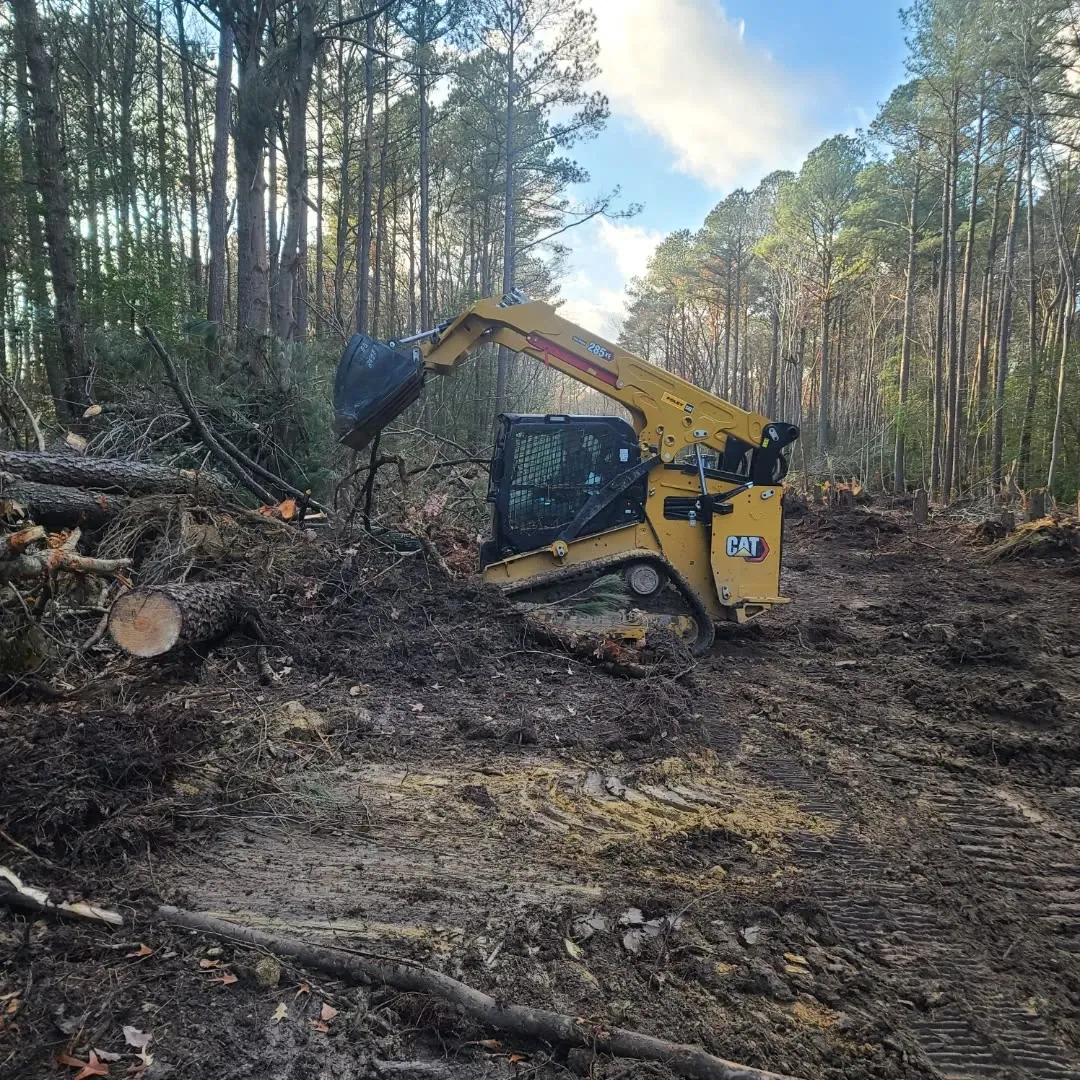
We mulch oak saplings and brush in place with a drum mulcher on our flagship Cat 285XE with its full forestry package. The BRX418 brush cutter handles fence lines, trail edges and the smaller stems close to trees you want to keep. The rock grapple pulls larger stems and debris out of the work area. Nothing is burned.
Selection matters more with oak than with most species. Before work starts we walk the property with you and mark the sound oaks that stay, so the clearing works around them and not through them. We regularly take trees of 100 feet and more, up to 130 feet, and each one is assessed on a site walk. Mature oaks are part of the work: we regularly take trees of 100 feet and more, up to 130 feet, and each trunk is assessed on a site walk.
Timing by season
| When | Step | What happens |
|---|---|---|
| Late fall through winter | Mark and clear | Leaf-off oaks are easier to judge. Tag the trees that stay, then clear the brush and saplings around them on firm or frozen ground. |
| Growing season after the pass | Cut the sprouts | Stump and root-collar sprouts grow fast. A brush-cutter pass while they are young keeps them from forming a second thicket. |
| Autumn acorn drop | Expect seedlings | Squirrels and jays move acorns into open ground and field margins. Plan a spring check along fence lines and trail edges. |
The schedule is the typical shape. Your dates, the number of passes and the finish standard are set on the site walk and written into the plan.
Regrowth and follow-up visits
Oak sprouting is strong and the Forest Service data is specific. Small poles, saplings and even seedlings can sprout if cut. Young oaks usually stump sprout more readily than older ones, but northern red oaks up to 22 inches in diameter have produced sprouts, and trees 20 to 25 years old average four or five sprouts each. Repeated sprouting is common, and initial sprout growth is typically rapid.
So the first cut is the start. We plan a follow-up pass in the growing season to take the young shoots with the brush cutter, and we look again the next year. The same source says sprouting is reduced by low light, which is one reason an open, grassed strip stays cleaner than a cleared patch left to shrub up.
What the owner can do
- Decide which oaks stay before the site walk, and tie ribbon on them if you can.
- Send photographs of leaves and acorns along with the town and rough acreage.
- Keep a cleared or grazed strip along the cleared edge so new oak seedlings are cut as they appear.
- Tell us about trail, drive and fence locations so the pass is shaped around how you use the land.
- For wooded acreage in Delaware, ask the Delaware Forest Service about a stewardship plan and timber stand improvement help.
Questions about oak saplings and brush
Sources: USDA Forest Service FEIS, Northern Red Oak (Quercus rubra), Delaware Department of Agriculture, Delaware Forest Service, Conservation Programs. Notes on permits and approvals are general; Huntly confirms the rules that apply to each site before work.
Will oak grow back after I clear the saplings?
Yes, expect sprouting. The USDA Forest Service says northern red oak commonly sprouts vigorously after cutting or other injury, and that repeated sprouting is common. We plan a follow-up cut in the growing season and a second look the next year.
Can you clear oak brush and leave the good oaks?
Yes. We walk the property with you, mark the sound oaks that stay, and clear the saplings and brush around them. We regularly take trees of 100 feet and more, up to 130 feet, and each one is assessed on a site walk.
Why do oaks keep coming up along my fence line?
Birds and mammals spread acorns. The USDA Forest Service reports that blue jays prefer to cache acorns on open sites and forest margins, and squirrels bury many that they never recover. Fence lines and field edges next to woods are where they land.
Is oak removal an eradication job?
No. Oaks are native trees and often worth keeping. This is selective clearing of saplings, stump sprouts and brush that block fields, trails or views, with a follow-up schedule written into the plan.
More about Oak saplings and brush
Regulatory notes are general guidance; Huntly confirms the rules that apply to each site before work.
Is oak brush the same as an invasive thicket?
No. Oak is native. Oak saplings and brush are usually a clearing choice, not a legal one. Fields turning to woods, fence lines gone to scrub and view corridors closing in are the common reasons. That's why we mark which oaks stay before work starts.
When is the best time of year to clear oak saplings in PA and DE?
Fall through winter works well. Leaves are down so we can see what we're keeping, and ground is firmer. As general guidance, tree cutting is commonly timed Oct 1 to Mar 31 for bat roosting season. Summer clearing is possible for brush, but regrowth is quicker. Huntly confirms the rule that applies to each site before work.
Does forestry mulching kill oak saplings or only cut them back?
Mostly it cuts them back. Young oaks have strong roots and often resprout from the stump base. forestry mulching gives you a clean field now. Expect sprouts the next season, and plan a follow-up mulch pass or a licensed applicator's treatment, quoted as a separate visible line.
How long until oak sprouts return after clearing?
Usually the next growing season, starting in spring. Sprouts are small at first and easy to mulch again. One follow-up pass in year one and a check in year two keeps a pasture or lane open. Skip the follow-up and you're back to brush in a few seasons.
Which oaks should I keep when we clear?
Keep straight, healthy trees with good crowns, especially along edges and for shade or habitat. Oaks are worth keeping for timber and wildlife. We flag them with ribbon at the site walk, work around them, and protect their roots from machine traffic.
Does stem size and density change the price of oak brush clearing?
Yes. Saplings under a few inches mulch fast. Dense stands, larger stems, rocks, wet soil and wire in the brush all add time. Hourly machine time drives the job, so a tight stand costs more than the same acreage thinly scattered. You get a written price after the free site walk.
Is there cost-share money to clear oak brush?
Not usually, and never promised. EQIP brush management (practice 314) is a listed practice, and Pennsylvania's schedule sets the mechanical large-shrub rate each year. Whether oak brush on your land qualifies is NRCS's call. Ask your local NRCS office before work starts, and we'll quote either way. Huntly confirms the rule that applies to each site before work.
Can you clear oak brush from a horse pasture and leave the fence line trees?
Yes. We mulch the pasture brush and leave shade trees, fence-line oaks you flag, and a buffer where needed. Trunks near fences get hand-cleared where equipment could damage wire. Horses go back on after the footing is checked and loose wood is raked or hauled off.
Call, or send the details.
(484) 486-7272hello@huntlyland.com. Send the town, rough acreage and two or three photographs. We reply with site-walk times, and a written plan follows the walk.
Delaware & coastal line: (302) 497-5263 · Main line: (484) 486-7272
Office hours Monday to Saturday, 8 a.m. to 4 p.m. On call 24/7 for storm and emergency cleanup. If anyone is in danger, call 911 first.