Plant guide
Red Maple Clearing and Regrowth
Red maple saplings and thickets crowding fields, fence lines and pasture edges, cleared with tracked equipment and planned around stump sprouting. Native trees, so this is clearing, not eradication.
Red maple is a native tree, so this is clearing, not eradication. We mulch thickets and saplings out of fields and fence lines, then plan on sprouts, because the USDA Forest Service says red maple sprouts vigorously from the stump, root crown or root suckers after mechanical damage. Large trees are assessed on a site walk.
How to recognize it
Red maple is a deciduous tree that the USDA Forest Service describes as growing 30 to 90 feet tall. Bark on younger stems is smooth and gray, then darkens and furrows into narrow ridges with age. Twigs are stout and shiny red to grayish brown.
In a field edge or fence line the usual sign is a dense band of slim, smooth-barked saplings of similar height, often with reddish twigs. It is one of the first trees to flower in early spring, and the flowers open several weeks before the leaf buds. Send a photograph of a twig and a branch tip if you are unsure what is coming up, and we will say what we see before a site walk.
Why it matters locally
The Forest Service lists red maple as native across Pennsylvania and Delaware, so it is not a newcomer that needs to be removed. It becomes a job when it fills ground you want open. The same source says a bank of persistent seedlings often builds up beneath a forest canopy, with more than 11,000 per acre recorded in one study, and that seedlings can survive three to five years under moderate shade. Open the light along a woodland edge and those waiting seedlings move.
On horse properties there is a second reason. Penn State Extension lists red maple as extremely toxic to horses and ponies: the wilted or dried leaves are the poisonous part, and as little as 1.5 to 3 pounds can cause toxicity. Leaves are most dangerous when wilting, for example after a branch comes down in a storm, and fallen autumn leaves stay toxic for about 30 days and should be removed from pastures. Maples along a paddock fence are worth a hard look.
How we clear it
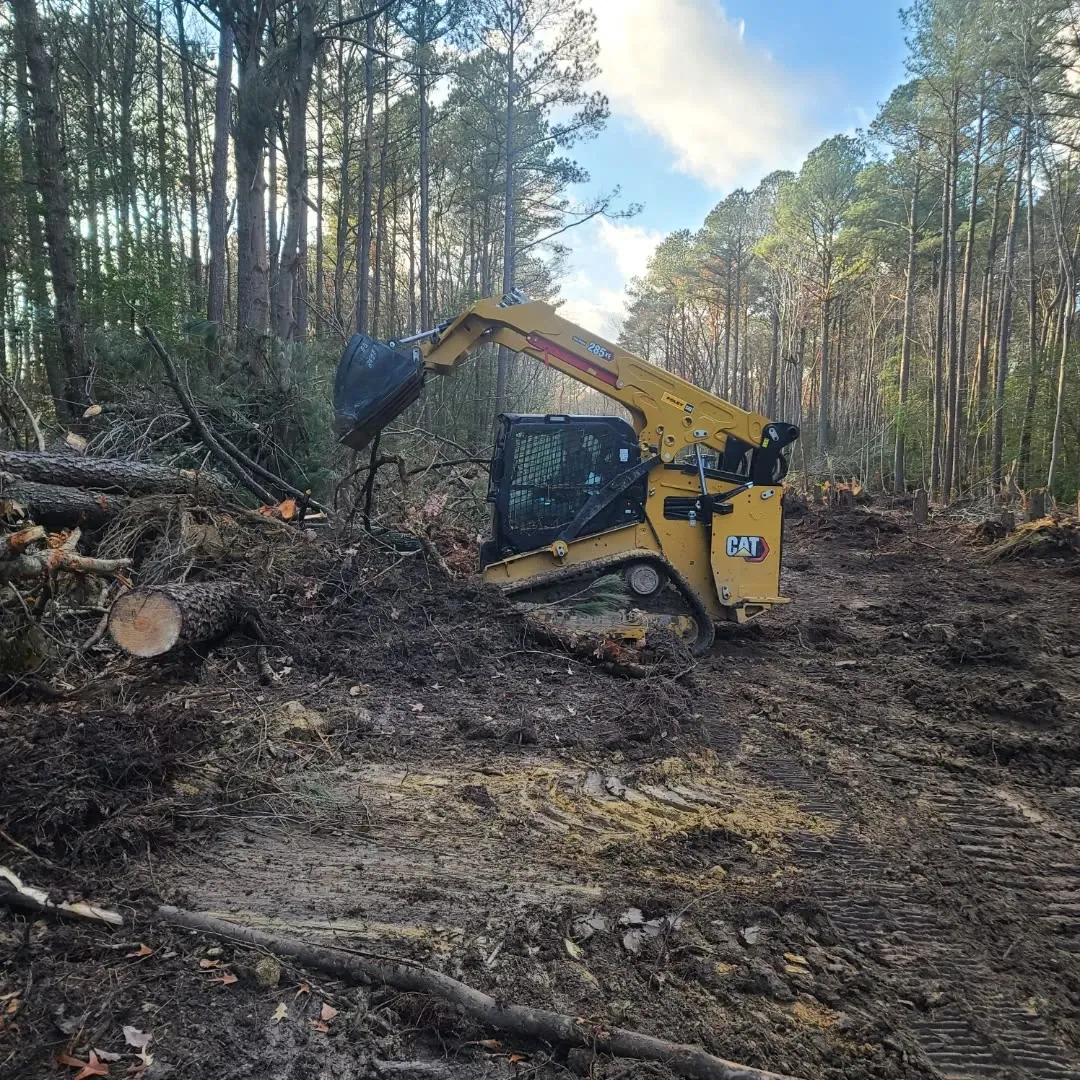
We mulch red maple thickets and saplings in place with a drum mulcher on our flagship Cat 285XE with its full forestry package. The BRX418 brush cutter works fence lines, ditch banks and tight edges the larger machine should not enter, and the rock grapple pulls limbs and stems that should leave the field. Nothing is burned.
We regularly take trees of 100 feet and more, up to 130 feet, and each one is assessed on a site walk. A mature red maple is a big tree. We regularly take trees of 100 feet and more, up to 130 feet, then clear the brush and edge and mulch what is left. We say which on the walk and write it into the plan.
Where horses graze, we plan the pass and the cleanup so cut leafy material is not left where animals can reach it, and we tell you how long to keep animals off the cleared ground.
Timing by season
| When | Step | What happens |
|---|---|---|
| Late fall through winter | Main clearing pass | Leaf-off stems are easy to see and dormant ground is firmer or frozen. Fallen autumn leaves are cleaned out of pasture areas, since Penn State says they stay toxic to horses for about 30 days. |
| Spring | Seedling check | Red maple flowers early and its fruit matures in spring. Expect seedlings to appear in the newly opened light; walk the edge and mark where they are thick. |
| Growing season after the pass | Follow-up cutting | Cut stump and root-crown sprouts while they are young. Keep horses off any freshly cut or storm-downed maple material. |
The schedule is the typical shape. Your dates, the number of passes and the finish standard are set on the site walk and written into the plan.
Regrowth and follow-up visits
Expect sprouts. The USDA Forest Service says red maple sprouts vigorously from the stump, root crown or root suckers after fire or mechanical damage, and that at least three generations of stump sprouts have been seen thriving on the same root system. A mulching pass takes the stems down; it does not end the root system.
We schedule a follow-up cut in the growing season after the main pass while sprouts are young and easy to take with the brush cutter, and a second look the following year. Seedlings that were waiting under the old canopy will also come up in the new light, and they are cheapest to deal with small. Chemical treatment of stumps is a separate decision with a qualified applicator, and we do not specify products on this page.
What the owner can do
- Keep horses away from any red maple limb or cut material that is wilting, and clear fallen autumn leaves out of paddocks.
- Walk the fence line and mark the maples you want to keep for shade, so the plan leaves them standing.
- Photograph the thicket and a twig up close, and send the town and rough acreage.
- Have the grass or cover plan ready for the cleared strip, since open ground fills with seedlings quickly.
- For wooded acreage in Delaware, ask the Delaware Forest Service about stewardship planning and timber stand improvement help.
Questions about red maple
Sources: USDA Forest Service FEIS, Red Maple (Acer rubrum), Penn State Extension, Plants Toxic to Horses, Delaware Department of Agriculture, Delaware Forest Service, Conservation Programs. Notes on permits and approvals are general; Huntly confirms the rules that apply to each site before work.
Will red maple grow back after clearing?
Plan on it. The USDA Forest Service reports that red maple sprouts vigorously from the stump, root crown or root suckers after mechanical damage. We cut the first pass, then return in the growing season to take the young sprouts and any new seedlings.
Is red maple dangerous to my horses?
It can be. Penn State Extension lists red maple as extremely toxic to horses and ponies, mainly through wilted or dried leaves. Storm-downed limbs and fallen autumn leaves are the usual risk. Keep animals off cut or fallen maple material until it is cleaned up.
Can you clear large red maples, or only saplings and thickets?
Mulching equipment is best suited to saplings, thickets and brush. We regularly take trees of 100 feet and more, up to 130 feet, and each one is assessed on a site walk. We clear the brush, edges and regrowth around them.
When is the best time to clear red maple?
Most often late fall through winter, when stems are leafless and the ground is firm or frozen. Follow-up cutting happens in the growing season after the main pass, while sprouts are young. Your dates are set on the site walk.
More about Red maple
Regulatory notes are general guidance; Huntly confirms the rules that apply to each site before work.
Is red maple a weed or a tree worth keeping?
It's a native tree, so not a weed in the legal sense. It earns its keep as shade, fall color and wildlife cover. In a pasture, fence line or view corridor it's often a clearing target. We help you decide at the site walk, tree by tree.
Why does red maple fill in my old field so fast?
It seeds heavily and sprouts readily from stumps, so fields left unmown turn to maple thickets within a few years. As general guidance, old fields and wet woodland edges in Chester County and Delaware grow it quickly. Regular ground and brush clearing or a yearly mulch pass keeps it back.
How many passes does red maple need to stay cleared?
One main clearing, then a follow-up pass about a year later and another after that if it keeps sprouting. Stumps resprout, but the sprouts are small and easy to mulch. After two or three seasons of that, most sites stay open with regular ground and brush clearing. forestry mulching does the heavy work.
Does a licensed applicator treat red maple stumps?
If you want the stumps finished, yes. A licensed applicator handles any herbicide work, quoted as a separate visible line. We cut or mulch first, then the applicator treats regrowth or stumps at the right time. Many owners skip it and mulch the sprouts instead.
Does red maple clearing price change with tree size?
Yes. Saplings and thickets mulch fast. Larger trunks need felling, cut-up or haul-off, and those are separate lines. Wet ground, rocks, wire and tight spacing add time. Every job is priced in writing after a free site walk.
Does red maple have timber or habitat value?
Some. It's a native hardwood that gives shade, seed and nesting cover, and larger trees can have firewood or low-grade lumber value. We don't promise timber sales, but we can help you decide what's worth keeping before you clear. Mark keepers at the walk.
Can cost-share pay to clear red maple brush?
Not usually, and never promised. EQIP brush management (practice 314) is a listed practice, and Pennsylvania's schedule sets the mechanical large-shrub rate each year. Whether red maple brush on your land qualifies is NRCS's call. Ask your local NRCS office before work starts, and we'll quote either way. Huntly confirms the rule that applies to each site before work.
Call, or send the details.
(484) 486-7272hello@huntlyland.com. Send the town, rough acreage and two or three photographs. We reply with site-walk times, and a written plan follows the walk.
Delaware & coastal line: (302) 497-5263 · Main line: (484) 486-7272
Office hours Monday to Saturday, 8 a.m. to 4 p.m. On call 24/7 for storm and emergency cleanup. If anyone is in danger, call 911 first.