Plant guide
White Pine and Virginia Pine Clearing and Regrowth
Pine saplings and young stands that have moved into pasture, lanes and view corridors, cleared for access, grazing and sightlines. Native trees, so this is clearing, not eradication.
White pine and Virginia pine are native trees, so this is clearing, not eradication. We mulch young pine out of pastures, lanes and views. Pines clear differently from hardwoods: the USDA Forest Service says eastern white pine does not reproduce vegetatively, while Virginia pine stump sprouts are usually short lived. We regularly take trees of 100 feet and more, up to 130 feet, and each one is assessed on a site walk.
How to recognize it
Eastern white pine needles are 2.5 to 5 inches long, according to the USDA Forest Service, and the tree grows quickly: about 60 feet tall in 40 years on a good site. Roots are widespreading and moderately deep. Virginia pine is a two-needle pine that reaches 50 to 75 feet by age 50 on better sites, with long horizontal branches and a relatively shallow root system.
The practical difference in a field is that white pine is the softer, longer-needled pine and Virginia pine is the scrubbier two-needle one that likes poor, open ground. If you cannot tell which you have, send a photograph of a branch with the needles in focus. The answer changes the plan only a little, because both are cleared the same way.
Why it matters locally
Both pines are pioneers on open ground. The Forest Service says eastern white pine temporarily increased in the northeastern United States by colonizing abandoned fields and pastures, and that Virginia pine is usually well represented in the early stages of old-field succession. A pasture, hayfield or lane that stops being cleared is exactly that kind of ground.
Seed travels. White pine seed moves about 200 feet within a stand and more than 700 feet in the open, mostly by wind. Most Virginia pine seed lands within 100 feet of the parent, and the tree is a prolific seed producer. A few pines along a boundary can seed the open acre next to them. Left alone, the young stand shades out grass, crowds a lane and closes a view.
How we clear it
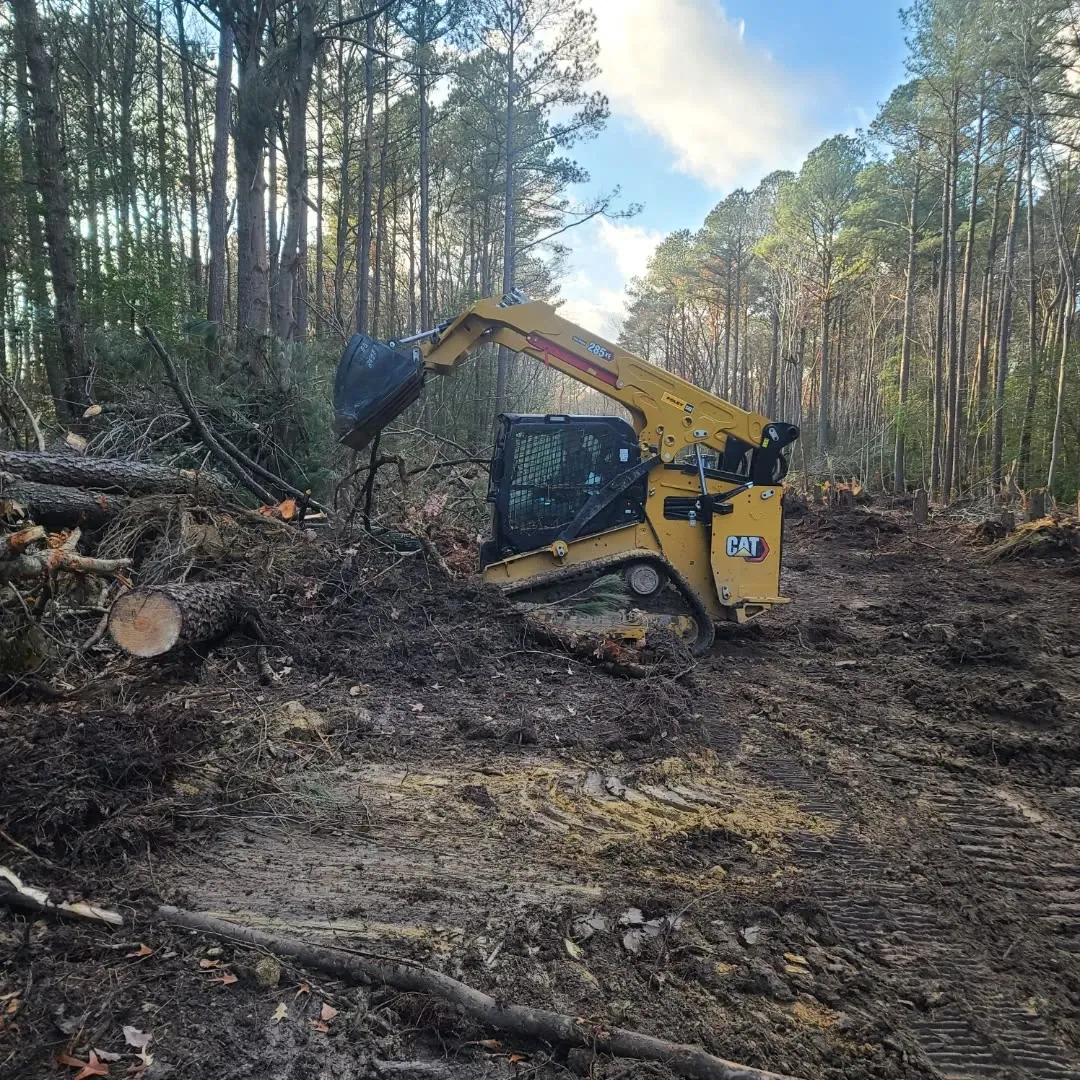
We mulch young pine in place with a drum mulcher on our flagship Cat 285XE with its full forestry package. The BRX418 brush cutter works the edges, lane shoulders and the smaller stems between trees. The rock grapple moves larger stems and debris out of the area. Nothing is burned. We can clear a whole encroached field or take only what blocks the lane, the gate or the view.
We regularly take trees of 100 feet and more, up to 130 feet, and each one is assessed on a site walk. A stand of pine that has grown to sawlog size is a different job. We regularly take trees of 100 feet and more, up to 130 feet, and timber with sale value can be sold as timber. The Delaware Forest Service offers help with forest inventories, timber stand improvement projects and timber sale help for Delaware owners, which is worth a call before you decide.
Timing by season
| When | Step | What happens |
|---|---|---|
| Late fall through winter | Main clearing pass | Firm or frozen ground and good visibility through the stand. The pass can be timed after seed fall. |
| October through January | Seed fall | The USDA Forest Service reports Virginia pine seed dispersal begins in October and is usually complete by January. Boundary pines keep reseeding open ground. |
| Growing season after the pass | Seedling check | Walk the cleared ground and cut new pine seedlings while they are small, then re-seed or graze the strip so grass holds it. |
The schedule is the typical shape. Your dates, the number of passes and the finish standard are set on the site walk and written into the plan.
Regrowth and follow-up visits
Pines regrow differently from maples and oaks. The Forest Service says eastern white pine does not reproduce vegetatively, so a cleared white pine does not send up sprouts from the stump. Virginia pine stump sprouts have been reported but are usually short lived. Most of the coming-back is from seed that was already on the ground or arrives later.
Virginia pine seedlings need exposed mineral soil and almost no shade to establish, according to the same source, so how the ground is left after a pass matters. We talk through the ground finish on the walk. We plan a check in the growing season after the pass to catch seedlings small, and another the following year if the boundary pines keep seeding in.
What the owner can do
- Decide whether any pines stay as a windbreak, screen or specimen, and mark them.
- Get the ground back into grass or grazing soon after the pass, since Virginia pine needs open, bare soil to start.
- Check the boundary for seed-source pines that will keep reseeding the cleared strip.
- Send photographs of the needles, the stand and any large trunks, plus the town and rough acreage.
- For Delaware parcels with a pine stand worth selling, ask the Delaware Forest Service about timber stand improvement and timber sale help before clearing.
Questions about white pine and virginia pine
Sources: USDA Forest Service FEIS, Eastern White Pine (Pinus strobus), USDA Forest Service FEIS, Virginia Pine (Pinus virginiana), Delaware Department of Agriculture, Delaware Forest Service, Conservation Programs. Notes on permits and approvals are general; Huntly confirms the rules that apply to each site before work.
Will pines grow back after you clear them?
Not from the stump in the case of white pine. The USDA Forest Service says eastern white pine does not reproduce vegetatively. Virginia pine stump sprouts are usually short lived. New pines come mainly from seed, so we plan a seedling check after the pass.
Can you clear a pine stand for pasture, access or a view?
Yes for young stands and encroaching pine. We mulch pine out of pasture edges, lanes and view corridors. We regularly take trees of 100 feet and more, up to 130 feet, and each one is assessed on a site walk. Timber with sale value can be sold as timber.
How do I tell white pine from Virginia pine?
White pine has needles 2.5 to 5 inches long and grows quickly; Virginia pine is a two-needle pine with a shallower root system that favors poor, open ground. Photographs of the needles help us confirm which you have.
Why are pines moving into my old field?
Pines are early arrivals on abandoned fields and pastures. The USDA Forest Service says white pine colonized abandoned northeastern fields and pastures, and Virginia pine is common in early old-field succession. Seed from a few nearby trees is enough to start a stand.
More about Eastern white pine and Virginia pine
Regulatory notes are general guidance; Huntly confirms the rules that apply to each site before work.
Are white pine and Virginia pine invasive?
No. Both are native to the region. Pines get cleared because they take over old fields, crowd pasture edges and block views. They also have value as screens and wildlife cover. We help you decide which to keep before work starts.
Do pines resprout after forestry mulching?
Mostly not. Unlike hardwoods, pines usually don't resprout from a cut stump. forestry mulching removes seedlings and small trees, and what you get back comes from seed. A light follow-up pass the next year catches new seedlings.
When is the best time to clear pine stands in PA and DE?
As general guidance, tree cutting is commonly timed Oct 1 to Mar 31 to stay outside bat roosting season. Winter also means firmer ground. Resin and chips from mulching are easier to deal with in cooler months. Huntly confirms the rule that applies to each site before work.
Can pines be sold as timber?
Sometimes. Larger straight white pines can have sawlog value, but a small stand may not be worth a logger's trip. We don't broker timber. If you think the trees have value, talk to a forester before clearing. We can wait.
Does pine clearing change the price?
Yes. Tree diameter, stand density, access and slope matter. Seedlings and small trees mulch fast. Larger trunks need felling, cut-up and haul-off, priced as separate lines. Resinous trees can slow tooling. Written price after a free site walk.
Can you clear a pine row but leave a screen?
Yes. Tell us what to leave. We flag keeper trees at the site walk, mulch around them, and protect roots from machine traffic. A thinned pine screen can still block a road or neighbor and let in light for pasture grass.
Can I get cost-share to clear pines?
Not usually, and never promised. EQIP brush management (practice 314) is a listed practice, and Pennsylvania's schedule sets the mechanical large-shrub rate each year. Whether pine saplings and brush on your land qualifies is NRCS's call. Ask your local NRCS office before work starts, and we'll quote either way. Huntly confirms the rule that applies to each site before work.
What grows back after pines are cleared?
Grasses and weeds first if the ground is bare, then new pine seedlings from seed on the ground. Seed or plant promptly if you want pasture. A follow-up mulch pass in year one keeps seedlings from re-establishing. We plan that at the site walk.
Call, or send the details.
(484) 486-7272hello@huntlyland.com. Send the town, rough acreage and two or three photographs. We reply with site-walk times, and a written plan follows the walk.
Delaware & coastal line: (302) 497-5263 · Main line: (484) 486-7272
Office hours Monday to Saturday, 8 a.m. to 4 p.m. On call 24/7 for storm and emergency cleanup. If anyone is in danger, call 911 first.