Plant guide
Weeping Willow Clearing and Regrowth
Large willow trees and their sprouts along ponds and streams, with brittle limbs and water-seeking roots. Cleared on a site walk plan, with wet-ground approvals confirmed first.
A large weeping willow by a pond or stream is cleared or cut back, not eradicated. Michigan State University MISIN warns that stumps and roots resprout vigorously and that cut branches root on wet ground. We handle brush, limbs and sprouts. We regularly take trees of 100 feet and more, up to 130 feet, and each one is assessed on a site walk. Wet ground needs approvals first.
How to recognize it
Weeping willow is unmistakable in outline. Michigan State University MISIN describes a broad, rounded tree 30 to 40 feet tall with long, slender, drooping branches that hang in curtains, often nearly to the ground. The twigs are very slender and smooth, olive-green to yellow-brown, and hang almost like ropes.
It is often a planted ornamental by a pond, a lawn edge or a creek. Because it hybridizes with native willows and its branches root so readily, trees along waterways are sometimes a mix of the original planting and its offspring. Send a photograph of the whole tree and a close view of a branch tip and we will tell you what we think before the site walk.
Why it matters locally
MISIN describes weeping willow as a non-native tree that can naturalize along streams, ponds and wet ground. For a landowner the first problems are physical. It has aggressive, water-seeking roots that can invade and damage drains, sewer lines and septic systems, and its brittle branches break and litter, so it is generally not recommended for home landscapes.
Along a waterway the effects reach further. MISIN notes that a branch that snaps off and falls into a stream can float downstream, lodge on a bank and take root, which is how willow moves along water. Documented effects of invasive willows include changed water flow and shaded-out understory plants. On a pond bank, that means limb drop over the water and sprouts crowding the shoreline.
This is not the same page as our willow thickets page. That one covers overgrown native black willow in thickets along ditches and wet field edges. This page is about the large, weeping ornamental tree and its limbs, roots and sprouts. See Willow Thickets: removal and regrowth for the native-willow thicket case.
How we clear it
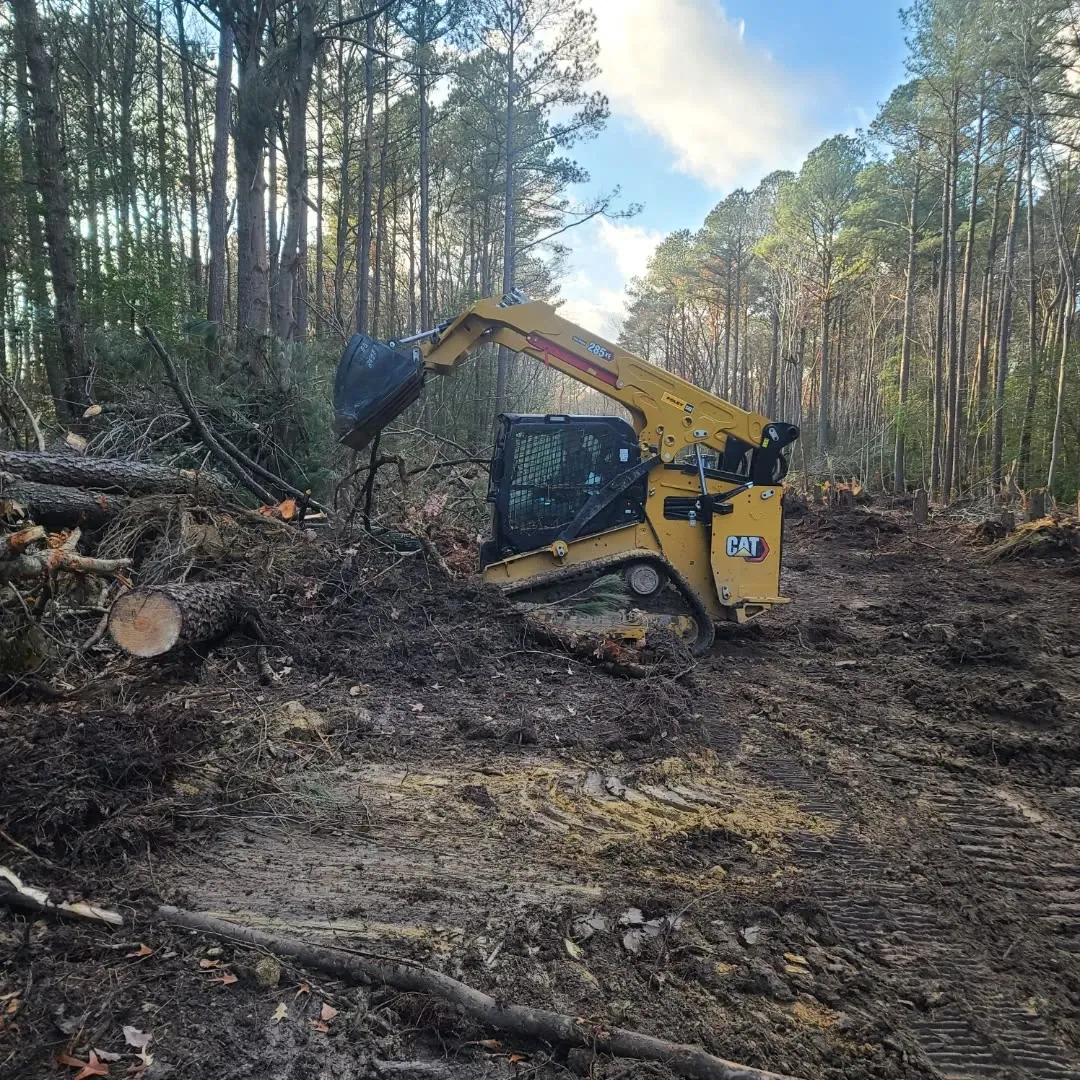
We mulch willow brush and sprouts in place with a drum mulcher on our flagship Cat 285XE with its full forestry package, and use the BRX418 brush cutter along banks and tight edges. The rock grapple lifts limbs and debris out of the water edge and away from where they could root. Nothing is burned.
We regularly take trees of 100 feet and more, up to 130 feet, and each one is assessed on a site walk. A full-size weeping willow is a big job, and we regularly take trees of 100 feet and more, up to 130 feet. We clear the limbs and brush, mulch sprouts and tidy the bank. MISIN notes that for larger trees the stump may need to be ground or excavated, or the resprouts cut repeatedly. We say on the walk which of those fits your site.
Wet ground changes what is allowed. Before work in or beside a pond, stream or wetland, the approvals that apply are confirmed with the approving body for that site, and we do not start until the owner has them. Soft ground may also limit equipment, and in very soft soil the right answer may be to wait.
Timing by season
| When | Step | What happens |
|---|---|---|
| Late fall through winter | Cut back and clear | Leaf-off limbs are easier to read and frozen or firm ground carries equipment. Approvals for wet ground must be in hand first. |
| Growing season after the pass | Cut the sprouts | Willow resprouts from stump and roots. Cut sprouts young and move all cut branches off wet ground. |
| After storms | Limb check | Brittle branches break and litter. A storm-damaged tree over a lane or pond edge is a call-us-first situation. If anyone is in danger, call 911. |
The schedule is the typical shape. Your dates, the number of passes and the finish standard are set on the site walk and written into the plan.
Regrowth and follow-up visits
Plan on resprouting. MISIN says willow stumps and roots resprout vigorously, so the stump may need to be ground or excavated, or the resprouts cut repeatedly. After the main pass we return in the growing season to cut sprouts while they are small, and we check again the next year along the bank.
The loose-branch rule matters too. MISIN warns that cut willow branches left on wet ground or in water will root and grow into new trees. Brush from this work is moved out of the wet edge and not left lying on the bank.
What the owner can do
- Do not leave cut willow branches on wet ground or in the water. Pull them to dry ground.
- Mark the septic system, drain lines and well on a sketch, since willow roots seek water and can invade drains and septic lines.
- Keep people and animals out from under large limbs hanging over paths, docks or pond edges.
- Photograph the whole tree and a close view of a branch tip, and send the town and rough acreage.
- Ask your township what approvals apply before any work at a pond or stream edge.
Questions about weeping willow
Sources: Michigan State University MISIN, Weeping Willow. Notes on permits and approvals are general; Huntly confirms the rules that apply to each site before work.
Will a weeping willow grow back after it is cut down?
Plan on it. Michigan State University MISIN says willow stumps and roots resprout vigorously, so the stump may need to be ground or excavated, or the resprouts cut repeatedly. We schedule follow-up cutting of young sprouts after the main pass.
Can a broken willow branch start a new tree?
Yes. MISIN reports that willow twigs and branches root extremely easily, and a branch that falls into a stream can lodge on a bank and take root. We move cut branches off wet ground and out of the water.
Can willow roots damage pipes and septic systems?
MISIN says weeping willow has aggressive, water-seeking roots that can invade and damage drains, sewer lines and septic systems. If a willow stands near a drain field or line, tell us where it is so the plan accounts for it.
Is this the same as your willow thickets page?
No. The willow thickets page covers overgrown native black willow in thickets along ditches and wet field edges. This page covers the large weeping willow, a planted ornamental tree, and its limbs, roots and sprouts near water.
More about Weeping willow
Regulatory notes are general guidance; Huntly confirms the rules that apply to each site before work.
Is weeping willow an invasive plant?
Not on the Pennsylvania noxious weed list or Delaware's Invasive Plant List as checked. It's a planted ornamental that can seed and sprout in wet ground. Whether you keep it comes down to space, roots near pipes, and branch drop over lawns, lanes and ponds.
What is the best time to take down a weeping willow?
As general guidance, tree cutting is commonly timed Oct 1 to Mar 31 to stay outside bat roosting season. Dormant-season cuts also let you see the branch structure. Ground is firmer in winter, and heavy limbs are easier to handle. Huntly confirms the rule that applies to each site before work.
Does mulching a weeping willow stop it from sprouting?
No. Willow stumps sprout readily. forestry mulching clears saplings and thickets, but expect sprouts the next season. A follow-up pass the next year catches them while they're small, and a licensed applicator can treat stumps if you want them finished, quoted as a separate visible line.
Can you grind a weeping willow stump?
Yes, stump grinding is quoted as its own line after the site walk. Grinding removes the stump but roots can still sprout nearby. Where roots are close to pipes, septic or lines, we'll tell you what we can and can't do near them.
Can you remove a large weeping willow near my pond or house?
Large trees near water, buildings or lines are felled in sections and the wood is cut up or hauled off. We tell you at the site walk what's workable and what needs a specialist. Wet ground and tight access change the price. Written quote first.
Does a weeping willow change the price of clearing?
Yes. Tree size, ground wetness, access, nearby structures and haul-off of large wood all add up. Stump grinding and licensed-applicator work are separate lines. Every job is priced in writing after a free site walk.
Is weeping willow wood worth keeping?
Rarely for lumber. It's soft, and large branches can split and drop. Firewood value is modest. We can cut it up and leave it, stack it, or haul it off, whichever you prefer, priced as its own line.
Can cost-share pay to remove a weeping willow?
Not usually. A single ornamental tree isn't a typical cost-share project. Brush management is written around shrubs and brush. Ask NRCS or your conservation district if a bigger project might fit. Huntly quotes the work either way. Huntly confirms the rule that applies to each site before work.
Related pages
- Forestry mulching
- Land clearing
- Invasive regrowth plan
- Chester County and southeastern Pennsylvania
- All plant guides
- Willow Thickets: removal and regrowth (a different page: native black willow)
- Red Maple: clearing and regrowth
- Oak Saplings and Brush: clearing and regrowth
- White Pine and Virginia Pine: clearing and regrowth
Call, or send the details.
(484) 486-7272hello@huntlyland.com. Send the town, rough acreage and two or three photographs. We reply with site-walk times, and a written plan follows the walk.
Office hours Monday to Saturday, 8 a.m. to 4 p.m. On call 24/7 for storm and emergency cleanup. If anyone is in danger, call 911 first.